The best Bluetooth adapters for older cars
If your car has an aux socket, twenty dollars turns it into a Bluetooth car. If it does not, everything on this page is the wrong answer.
By Sawyer V. · Published · How we research
We have not tested any of this. Everything below is compiled from published manufacturer specifications, and the arithmetic is printed so you can check it. This page carries affiliate links: if you buy through one we earn a commission at no extra cost to you, and it does not change the order of the picks. Full disclosure.
The short answer
Check for a 3.5 mm aux socket first. If you have one, buy the Anker Soundsync A3352 — it publishes an operating temperature range of -10 C to 55 C, which almost nothing in this category does, and it runs 12 hours on its own battery. If your car has an alternator whine through the aux input, buy the Besign BK01 instead: it ships with a ground loop noise isolator, which is the actual fix. No aux socket at all means an FM transmitter instead.
| # | Pick | Install | Score | Price |
|---|---|---|---|---|
| 1 | Nulaxy KM18 Bluetooth FM Transmitter A car with a radio and nothing else | Plugs in | 9.2/10 | $21.99 - view on Amazon |
| 2 | Besign BK01 Bluetooth Car Kit An aux socket plus an alternator whine | Plugs in | 9.0/10 | $19.99 - view on Amazon |
| 3 | Anker Soundsync A3352 Bluetooth Receiver An older car with a working aux socket | Plugs in | 8.1/10 | Check price on Amazon |
Prices last verified October 20, 2026. They move constantly; the figure on Amazon when you click is the real one.
The check that decides everything
Look for a 3.5 mm headphone-style socket. It is usually on the head unit face, in the center console, or inside the armrest cubby, and it is often labeled AUX or has a headphone icon.
If it is there, an aux Bluetooth receiver is by a wide margin the best value upgrade available to an older car. It feeds a line-level signal straight into the amplifier, which means the sound quality is limited by your speakers rather than by the adapter.
If there is no socket, nothing on this page will work and you need an FM transmitter, which broadcasts on an empty radio frequency. That is a genuinely worse-sounding path and it is the only one available without one.
The specification almost nobody publishes
This is the reason the Anker wins. It publishes an operating temperature range of -10 C to 55 C — and virtually nothing in this category publishes any thermal figure at all.
That figure also carries a warning. A parked car in summer reaches roughly 60-70 C inside, which is above the Anker's published ceiling. It is the lowest ceiling of any device on this site, and it means the Soundsync is a device to take indoors in hot weather rather than leave clipped to the dash.
We would rather have a published number that tells us something inconvenient than no number at all. The Besign publishes nothing, so its behavior in a hot car is simply unknown.
| Anker Soundsync A3352 | Besign BK01 | |
|---|---|---|
| Operating temperature | -10 C to 55 C | Not published |
| Power | 180 mAh battery, 12 h playback | 12V socket, always on |
| Bluetooth | 5.x class | 4.1 + EDR |
| Multipoint | Two devices | Two devices |
| Ground loop isolator | Not included | Included |
| Extra USB ports | None | Dual-port 2.1 A |
| Size | 50 x 29 x 10 mm, 12.2 g | Not published |
Battery or socket, which is a real choice
These two products solve the same problem with opposite power strategies, and neither is simply better.
- The Anker runs on its own battery. 12 hours of playback, 2 hours to charge. Nothing occupies a socket, and it can go in a bag or another car. The cost is that it is one more thing to remember to charge, and a flat adapter is a silent car
- The Besign runs off the 12V socket. It powers on with the ignition, auto-reconnects to the last phone, and never needs charging. The cost is that it occupies the socket permanently — though it gives you two USB ports back in exchange
For most people the socket-powered version wins on the thing that actually matters day to day: it always works, with no ritual. The battery version wins if your 12V socket is already spoken for by a charger or a dash cam.
The whine, and why the isolator matters
If you have ever plugged a phone into a car's aux socket and heard a whine that rises and falls with engine speed, you have met a ground loop.
It happens when the audio source and the car stereo are grounded at two different points with a small voltage difference between them. Current flows through the audio cable's shield to equalize, and that current is audible — and because it comes from the alternator, its pitch tracks engine RPM exactly.
A ground loop isolator breaks the electrical path with small transformers, passing the audio while blocking the loop current. It is a real fix rather than a filter, and the Besign including one in the box is the strongest argument for buying it: an adapter that whines is an adapter you stop using.
Note that the problem is much more likely on the socket-powered unit, since it is connected to the car's electrical system at both ends. The battery-powered Anker is electrically isolated by design and is far less prone to it — which is a genuine advantage that offsets the charging inconvenience.
Calls, and what these do badly
Both units include a microphone for hands-free calling, and this is the weakest part of both products. The microphone is on the adapter, which is somewhere near the head unit — a long way from your mouth, with road noise, blowers and the stereo between you.
People on the other end will notice. If calls are your main reason for buying, a dedicated visor speakerphone with a microphone positioned near your head is a considerably better tool than an aux adapter with a microphone in the console.
When to skip all of this and change the head unit
An aux adapter gets you audio and basic call handling. What it cannot give you is navigation on the car's screen, steering wheel control integration, or messaging read aloud.
If you want those, the answer is a replacement head unit with wired CarPlay or Android Auto, which is a bigger job and a bigger budget. Note that a wireless adapter cannot help here — those convert existing wired CarPlay to wireless and cannot add CarPlay to a car that never had it. We spell that out in how to add CarPlay to an older car and in wireless CarPlay adapters explained.
Every pick, with the working
Each entry lists the specifications the maker publishes, the axis scores those specifications produce, and what you give up. Rows that read “Not published” are not omissions on our side: they are things the maker will not commit to in writing, and they cost the product points on the transparency axis. Specifications compiled September 4, 2026.
Our pickA car with a radio and nothing else
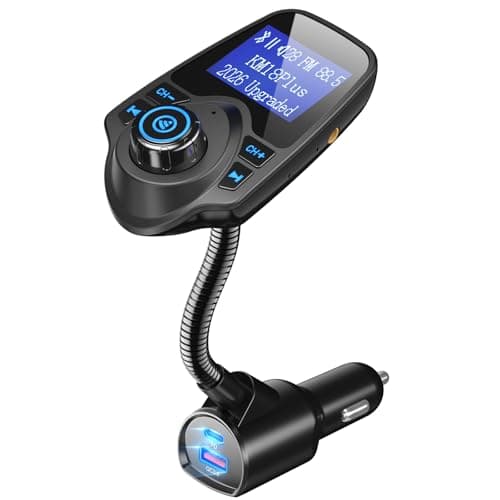
Nulaxy KM18 Bluetooth FM Transmitter
Skip this one. An FM transmitter is a worse-sounding solution than an aux adapter in every case where an aux socket exists, because it broadcasts to your radio rather than feeding the amplifier directly. It is here because it is the right answer for cars with no aux socket at all — which is a real and common situation, just not this page's.
Bluetooth 5.0 into the 87.5 to 108.0 MHz FM band, on a gooseneck with a 1.44-inch screen, running from 12 V or 24 V. It is the answer for a car too old for CarPlay, Android Auto or even an aux socket — and it is a genuinely different product from the CarPlay adapters, which need a car that already has CarPlay.
- Frequency range
- 87.5 - 108.0 MHz
- Bluetooth
- 5.0
- Display
- 1.44 in LCD
- Input voltage
- 12 V - 24 V
- Extra inputs
- TF card, aux
- Calls
- Hands-free supported
- Mounting
- Rotatable gooseneck in the 12V socket
- List price
- Not published
- Warranty
- Not published
What it gets right
- Works in literally any car with an FM radio, which no other connectivity product on this site can claim
- Published frequency range and Bluetooth version, and 12-24 V input so it works in a truck
- Screen shows battery voltage as well as the station, which is a genuinely useful extra on an old car
- Handles calls, plus TF card and aux input for when Bluetooth is not the answer
Flaws
- FM transmission is a lossy analog hop. It will never sound as good as a cable or a proper head unit
- You have to find a genuinely empty frequency, and in a city there may not be one
- Gooseneck mounted in the 12V socket means it occupies the socket and sticks out into the console
The working behind the 9.2
- Heat headroom: not scored (weight 22%)
- The maker publishes no operating-temperature ceiling, so this axis is dropped and the other weights are re-normalized.
- Install effort: 10.0 (weight 24%)
- Plugs into a 12V socket or a USB port. Nothing to mount, nothing to route, reversible in a second.
- Price against the ceiling: not scored (weight 24%)
- No published list price we could cite on the compile date, so this axis is dropped and the other weights are re-normalized.
- Written commitment: not scored (weight 15%)
- No warranty term published, so this axis is dropped and the other weights are re-normalized.
- Spec transparency: 7.8 (weight 15%)
- 7 of the 9 specifications we went looking for are published by the maker (78%). A blank row is never a guess here: it prints “Not published” and it costs the product points, because a figure nobody will commit to in writing is a figure you cannot check.
Axes with no published input are dropped and the remaining weights re-normalized, so a product is not punished for a category where an axis does not apply. Specifications compiled September 4, 2026 from Nulaxy's KM18 product page.
2An aux socket plus an alternator whine
Besign BK01 Bluetooth Car Kit
Socket-powered rather than battery-powered, so it wakes with the ignition and there is nothing to charge. The reason to pick it over the Anker is the included ground loop noise isolator, which is the fix for the whine that ruins aux audio in older cars.
- Bluetooth version
- 4.1 + EDR
- Power
- 12V socket, dual-port 2.1 A / 10 W charger included
- Multipoint
- Two devices simultaneously
- Noise handling
- Ground loop noise isolator included
- Behavior on start
- Auto power-on and auto reconnect to last device
- Included
- Kit, magnetic mounting plate, ground loop isolator, guide
- Operating temperature
- Not published
- Warranty
- Not published
What it gets right
- Ships with a ground loop noise isolator — the actual cure for engine-speed whine through an aux input
- Powers on with the car and auto-reconnects to the last phone, so there is no ritual
- Dual-port 2.1 A charger built into the 12V plug, so it does not cost you the socket
- Multipoint pairing to two devices
Flaws
- Bluetooth 4.1 + EDR, an older radio than the Anker's
- No published operating temperature range, which the Anker does publish
- Occupies the 12V socket permanently — you get two USB ports back, but the socket itself is gone
- No published warranty term
The working behind the 9.0
- Heat headroom: not scored (weight 22%)
- The maker publishes no operating-temperature ceiling, so this axis is dropped and the other weights are re-normalized.
- Install effort: 10.0 (weight 24%)
- Plugs into a 12V socket or a USB port. Nothing to mount, nothing to route, reversible in a second.
- Price against the ceiling: not scored (weight 24%)
- No published list price we could cite on the compile date, so this axis is dropped and the other weights are re-normalized.
- Written commitment: not scored (weight 15%)
- No warranty term published, so this axis is dropped and the other weights are re-normalized.
- Spec transparency: 7.5 (weight 15%)
- 6 of the 8 specifications we went looking for are published by the maker (75%). A blank row is never a guess here: it prints “Not published” and it costs the product points, because a figure nobody will commit to in writing is a figure you cannot check.
Axes with no published input are dropped and the remaining weights re-normalized, so a product is not punished for a category where an axis does not apply. Specifications compiled September 4, 2026 from Besign BK01 published specifications.
3An older car with a working aux socket
Anker Soundsync A3352 Bluetooth Receiver
Skip this one. If your car has no aux socket this does nothing at all — check for the 3.5 mm jack before you buy, not after. An FM transmitter is the fallback for a car without one.
The cheapest real upgrade available to a car with an aux socket and no Bluetooth. It publishes an operating temperature range, which is genuinely rare, and it runs on its own battery so nothing has to be plugged in.
- Operating temperature
- -10 C to 55 C (14 F to 131 F)
- Battery
- 180 mAh
- Playback time
- Up to 12 hours
- Charge time
- About 2 hours
- Multipoint
- Two devices simultaneously
- Range
- 10 m / 33 ft
- Profiles
- HFP, A2DP, AVRCP
- Dimensions
- 50 x 29 x 10 mm
- Weight
- 12.2 g
- Direction
- Receiver only — cannot transmit
- Warranty
- Not published
- List price
- Not published
What it gets right
- Publishes an operating temperature range of -10 C to 55 C — almost nothing in this category publishes one at all
- 12 hours of playback on a 180 mAh battery, charging in about 2 hours
- Connects to two devices at once, so a second phone can take a call without unpairing the first
- 50 x 29 x 10 mm and 12.2 g — small enough to stick anywhere
Flaws
- 55 C ceiling is the lowest of any device on this site, and a parked car in summer runs 60-70 C. Take it inside
- Receiver only. It cannot send audio out of the car to headphones
- A battery device means one more thing to charge, unlike a socket-powered kit
- No published warranty term
The working behind the 8.1
- Heat headroom: 6.0 (weight 22%)
- Published operating ceiling 55 C (131 F). A car parked in summer sun runs roughly 60-70 C inside, so 65 C and up is real headroom, 60 C is living at the limit, and anything under 55 C is a summer problem waiting to happen.
- Install effort: 10.0 (weight 24%)
- Plugs into a 12V socket or a USB port. Nothing to mount, nothing to route, reversible in a second.
- Price against the ceiling: not scored (weight 24%)
- No published list price we could cite on the compile date, so this axis is dropped and the other weights are re-normalized.
- Written commitment: not scored (weight 15%)
- No warranty term published, so this axis is dropped and the other weights are re-normalized.
- Spec transparency: 8.3 (weight 15%)
- 10 of the 12 specifications we went looking for are published by the maker (83%). A blank row is never a guess here: it prints “Not published” and it costs the product points, because a figure nobody will commit to in writing is a figure you cannot check.
Axes with no published input are dropped and the remaining weights re-normalized, so a product is not punished for a category where an axis does not apply. Specifications compiled September 4, 2026 from Anker Soundsync A3352 manual specification table.
Prices last verified October 20, 2026. They move constantly; the figure on Amazon when you click is the real one.
Questions people actually ask
How do I know if my car has an aux input?
Look for a 3.5 mm socket on the head unit, in the console, or inside the armrest, often labeled AUX. Plug any headphone cable in and cycle the head unit's source button — on some cars the aux source only appears when something is connected.
Will an aux Bluetooth adapter sound better than an FM transmitter?
Considerably, yes. An aux adapter feeds a line-level signal directly to the amplifier. An FM transmitter broadcasts a low-power radio signal that your receiver then demodulates, with all the noise and interference that implies.
Why does my aux adapter whine?
It is a ground loop — a voltage difference between two grounding points putting current through the audio shield. A ground loop noise isolator fixes it properly, and the Besign BK01 includes one.
Can I leave the adapter in the car in summer?
Anker publishes a 55 C ceiling for the Soundsync, and a parked car in summer exceeds that. Take it inside on hot days. The Besign publishes no temperature figure at all, so its behavior is simply unknown.