The best car speakers for an easy upgrade
The number printed largest on the box is the one that matters least. On a factory head unit, a speaker's sensitivity does more than its power rating ever will.
By Sawyer V. · Published · How we research
We have not tested any of this. Everything below is compiled from published manufacturer specifications, and the arithmetic is printed so you can check it. This page carries affiliate links: if you buy through one we earn a commission at no extra cost to you, and it does not change the order of the picks. Full disclosure.
The short answer
Read sensitivity in dB, not peak watts. A factory head unit delivers roughly 20W per channel continuous, and sensitivity is how efficiently a speaker turns that into sound. Pioneer publishes 91 dB at 1 W / 1 m for the TS-A1671F along with 70W RMS and a 37 Hz to 31 kHz response. KICKER publishes a recommended power figure and no sensitivity, which makes it impossible to compare on the axis that matters.
| # | Pick | Install | Score | Price |
|---|---|---|---|---|
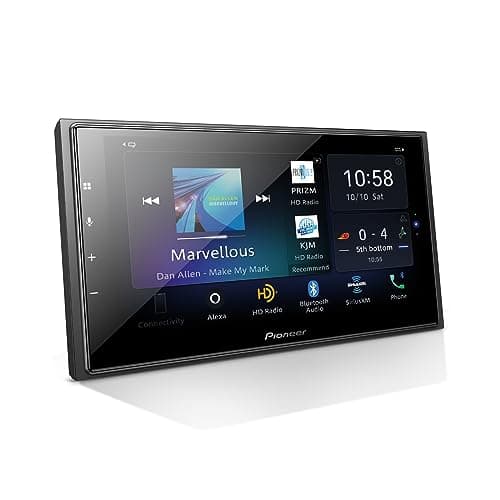
| 1 | Pioneer DMH-W4660NEX Publishing the power figure that actually matters | Hardwire | 5.3/10 | $599.99 - view on Amazon |
| 2 | Pioneer TS-A1671F 6.5 in. Coaxial Speakers The only speaker here publishing sensitivity | Hardwire | 5.2/10 | $62.18 - view on Amazon |
| 3 | KICKER CS Series 6.5 in. Coaxial Speakers Zero-protrusion tweeters that clear a factory grille | Hardwire | 3.6/10 | $73.95 - view on Amazon |
Prices last verified October 26, 2026. They move constantly; the figure on Amazon when you click is the real one.
Sensitivity is the specification
Sensitivity is measured in decibels at one watt from one meter. It describes how much sound a speaker produces from a given amount of power.
A few decibels sounds trivial and is not. Sensitivity is logarithmic: a difference of 3 dB is equivalent to doubling the power going in. A 91 dB speaker on a factory head unit is meaningfully louder than an 88 dB speaker fed the same signal, without anything else changing.
This matters because the amplifier in a head unit is small. Pioneer publishes 22W x 4 channels continuous on one of its better aftermarket units, and a factory deck is generally in the same territory or below. You are not choosing between speakers that will be driven hard; you are choosing which one does more with very little.
What each publishes
| Pioneer TS-A1671F | KICKER CS 6.5 | |
|---|---|---|
| Sensitivity | 91 dB (1 W / 1 m) | Not published |
| Continuous power (RMS) | 70 W | Not published |
| Recommended power | Not published | 100 W |
| Peak power | 320 W per pair | Not published |
| Frequency response | 37 Hz to 31 kHz | Not published |
| Impedance | 4 ohm nominal | Not published |
| Tweeter | Three-way coaxial | Zero-protrusion PEI, neodymium |
That is an unusually lopsided table, and it should not be read as KICKER making a worse speaker — the CS Series is well regarded, and its zero-protrusion tweeter solves a real fitment problem that domed tweeters cause behind factory grilles.
It should be read as KICKER giving you nothing to compare. "Recommended power: 100 W" is not the same kind of claim as a measured sensitivity, and on a page that ranks by published specification, the maker that publishes wins.
The fitment number that is not the size
A 6.5 inch speaker is a nominal description, and two 6.5 inch speakers can be physically incompatible with the same door.
- Mounting depth is the figure that decides it. A deeper magnet fouls the window glass inside the door, or the window regulator mechanism. Measure the depth available before buying, not after
- Tweeter protrusion decides whether the factory grille goes back on. A domed tweeter standing proud of the cone fouls the grille — which is exactly what KICKER's zero-protrusion design addresses
- Screw pattern and frame diameter vary. Adapter brackets exist for most cars and are cheap; not having one stops the job dead
- Speaker wire connectors are rarely a match. A vehicle-specific harness adapter avoids cutting factory wiring, which matters if you ever sell the car
Look up your vehicle in a fitment guide before ordering. Every retailer has one and it is the five minutes that prevents a return.
The part that is actually the work
Speakers are not the difficult bit. Door cards are.
- Remove the door card — usually a mix of visible screws, hidden screws behind trim caps, and clips that need a plastic trim tool rather than a screwdriver
- Disconnect the window switch and any wiring before lifting the card away, rather than discovering the connectors under tension
- Peel back the vapor barrier carefully. That plastic sheet keeps water out of the cabin, and it needs to go back sealed
- Unbolt the speaker, fit the adapter bracket, fit the new speaker, connect via the harness adapter
- Test before reassembling. Turn the ignition on and check the speaker works while the card is still off
Broken clips are the usual casualty. Order a few spares for your car before starting; they cost almost nothing and a door card that rattles afterwards is the alternative.
Whether this is a job you should take on is the same question as everything else here — what car accessories can you install yourself.
Order of operations
If you are planning to upgrade several things, the sequence changes how much you enjoy each step.
Front speakers first. They are where almost all the sound you hear comes from, and replacing just the front pair is the highest-value single change in car audio.
Source second. A head unit with a cleaner output and real preamp outputs gives you somewhere to go next — best car stereos and head units. Doing this first, on factory speakers, usually disappoints.
Amplifier last, if at all. This is where the job stops being an accessory purchase and becomes a wiring project, and it is outside what this site covers.
And before any of it: if your complaint is that phone audio sounds bad rather than that the speakers sound bad, the problem may be the connection rather than the hardware — Bluetooth vs aux vs FM transmitter covers what each link does to the signal.
Every pick, with the working
Each entry lists the specifications the maker publishes, the axis scores those specifications produce, and what you give up. Rows that read “Not published” are not omissions on our side: they are things the maker will not commit to in writing, and they cost the product points on the transparency axis. Specifications compiled September 4, 2026.
Our pickPublishing the power figure that actually matters
Pioneer DMH-W4660NEX
Skip this one. Not a speaker, and on this page because of the order people do this in. Replacing speakers while keeping a factory head unit works and is the cheaper first step. Replacing the head unit while keeping factory speakers usually sounds worse than expected, because the speakers were the limit. If you are doing both, do the speakers first and hear what you actually gained.
Wireless CarPlay and wireless Android Auto on a 6.8 inch capacitive screen, and — unusually for this category — Pioneer publishes continuous power output as well as the maximum. 22W per channel continuous is the number that describes what your speakers actually get; the 50W on the box does not.
- Screen
- 6.8 in WVGA capacitive
- Continuous power
- 22 W x 4 channels
- Maximum power
- 50 W x 4 channels at 4 ohm
- Preamp outputs
- 6-channel RCA, 4 V RMS
- Wireless CarPlay
- Yes
- Wireless Android Auto
- Yes
- Operating temperature
- Not published
- List price
- Not published
What it gets right
- Publishes continuous power output: 22 W x 4 channels, alongside the 50 W x 4 maximum
- Wireless Apple CarPlay and wireless Android Auto, so nothing needs plugging in
- Six-channel RCA preamp outputs at 4 V RMS, which is what you need if an amplifier ever follows
- 6.8 in WVGA capacitive touchscreen rather than the resistive panels at the cheap end
- Plays up to 192 kHz/24-bit WAV and FLAC, and DSD up to 5.6 MHz, from USB
Flaws
- Fitting it means a dash kit, a wiring harness and often an antenna adapter, none of which are included
- Steering wheel controls need a separate interface module on most cars
- A double-DIN unit does not fit a single-DIN opening without modifying the dash
- No published operating temperature range, on a device permanently in a dashboard
The working behind the 5.3
- Heat headroom: not scored (weight 22%)
- The maker publishes no operating-temperature ceiling, so this axis is dropped and the other weights are re-normalized.
- Install effort: 4.0 (weight 24%)
- Wires into the fuse box. Half an hour, a fuse tap, a trim tool and a willingness to be upside down under the dash. This is the real cost of parking mode.
- Price against the ceiling: not scored (weight 24%)
- No published list price we could cite on the compile date, so this axis is dropped and the other weights are re-normalized.
- Written commitment: not scored (weight 15%)
- No warranty term published, so this axis is dropped and the other weights are re-normalized.
- Spec transparency: 7.5 (weight 15%)
- 6 of the 8 specifications we went looking for are published by the maker (75%). A blank row is never a guess here: it prints “Not published” and it costs the product points, because a figure nobody will commit to in writing is a figure you cannot check.
Axes with no published input are dropped and the remaining weights re-normalized, so a product is not punished for a category where an axis does not apply. Specifications compiled September 4, 2026 from Pioneer DMH-W4660NEX published power, preouts and display.
2The only speaker here publishing sensitivity
Pioneer TS-A1671F 6.5 in. Coaxial Speakers
Publishes the three numbers that let you predict how a speaker will behave: continuous power, sensitivity in dB, and frequency response. Sensitivity is the one that matters on a factory head unit, because a factory deck has very little power to give and a more sensitive speaker turns what it does have into more sound.
- Continuous power (RMS)
- 70 W
- Peak power
- 320 W per pair
- Sensitivity
- 91 dB (1 W / 1 m)
- Frequency response
- 37 Hz to 31 kHz
- Impedance
- 4 ohm nominal
- Warranty
- Not published
- List price
- Not published
What it gets right
- Publishes sensitivity: 91 dB at 1 W / 1 m — the figure that decides loudness on low factory power
- Publishes continuous (RMS) power handling of 70 W, not just the 320 W peak on the box
- Published frequency response of 37 Hz to 31 kHz
- 4 ohm nominal impedance, which is what a factory head unit expects
- Three-way coaxial, so it drops into a factory location without a crossover to mount
Flaws
- The 320 W peak figure is the one printed largest and it describes nothing you will ever use
- Fitment is vehicle-specific — 6.5 in is a nominal size and mounting depth and screw pattern vary
- Replacing speakers means removing door cards, which is where most of the effort is
- No warranty figure published alongside the specifications
The working behind the 5.2
- Heat headroom: not scored (weight 22%)
- The maker publishes no operating-temperature ceiling, so this axis is dropped and the other weights are re-normalized.
- Install effort: 4.0 (weight 24%)
- Wires into the fuse box. Half an hour, a fuse tap, a trim tool and a willingness to be upside down under the dash. This is the real cost of parking mode.
- Price against the ceiling: not scored (weight 24%)
- No published list price we could cite on the compile date, so this axis is dropped and the other weights are re-normalized.
- Written commitment: not scored (weight 15%)
- No warranty term published, so this axis is dropped and the other weights are re-normalized.
- Spec transparency: 7.1 (weight 15%)
- 5 of the 7 specifications we went looking for are published by the maker (71%). A blank row is never a guess here: it prints “Not published” and it costs the product points, because a figure nobody will commit to in writing is a figure you cannot check.
Axes with no published input are dropped and the remaining weights re-normalized, so a product is not punished for a category where an axis does not apply. Specifications compiled September 4, 2026 from Pioneer TS-A1671F published RMS, sensitivity and frequency response.
3Zero-protrusion tweeters that clear a factory grille
KICKER CS Series 6.5 in. Coaxial Speakers
A well-regarded coaxial with a genuinely useful design detail: the PEI tweeter sits flush rather than protruding, so it fits behind factory grilles that a domed tweeter fouls. KICKER publishes a recommended power figure but not the sensitivity that would let you compare it against anything.
- Continuous power (RMS)
- Not published
- Recommended power
- 100 W
- Sensitivity
- Not published
- Frequency response
- Not published
- Tweeter
- Zero-protrusion PEI, neodymium
- Warranty
- Not published
- List price
- Not published
What it gets right
- Zero-protrusion PEI tweeter with a neodymium magnet — fits behind factory grilles that block protruding tweeters
- Published recommended power of 100 W
- Polypropylene cone with a UV-treated ribbed surround, which is the right material for a door that gets wet
- Extended Voice Coil motor structure for more excursion from a shallow frame
Flaws
- No published sensitivity figure, which is the specification that predicts loudness on factory power
- No published frequency response
- No published continuous (RMS) rating — 'recommended power' is a different thing
- Same fitment caveats as any speaker: nominal size, real mounting depth
The working behind the 3.6
- Heat headroom: not scored (weight 22%)
- The maker publishes no operating-temperature ceiling, so this axis is dropped and the other weights are re-normalized.
- Install effort: 4.0 (weight 24%)
- Wires into the fuse box. Half an hour, a fuse tap, a trim tool and a willingness to be upside down under the dash. This is the real cost of parking mode.
- Price against the ceiling: not scored (weight 24%)
- No published list price we could cite on the compile date, so this axis is dropped and the other weights are re-normalized.
- Written commitment: not scored (weight 15%)
- No warranty term published, so this axis is dropped and the other weights are re-normalized.
- Spec transparency: 2.9 (weight 15%)
- 2 of the 7 specifications we went looking for are published by the maker (29%). A blank row is never a guess here: it prints “Not published” and it costs the product points, because a figure nobody will commit to in writing is a figure you cannot check.
Axes with no published input are dropped and the remaining weights re-normalized, so a product is not punished for a category where an axis does not apply. Specifications compiled September 4, 2026 from KICKER CS Series published construction and recommended power.
Prices last verified October 26, 2026. They move constantly; the figure on Amazon when you click is the real one.
Questions people actually ask
What speaker specification actually matters?
Sensitivity, in dB at 1 W / 1 m. A factory head unit delivers roughly 20W per channel, and sensitivity describes how much sound a speaker makes from it. A 3 dB difference is equivalent to doubling the power.
Do I need an amplifier for new car speakers?
No. Coaxial speakers with a sensible sensitivity work fine on head unit power, and replacing the front pair is the highest-value single change in car audio. An amplifier is a wiring project rather than an accessory purchase.
Will 6.5 inch speakers fit my car?
Not automatically. The size is nominal — mounting depth, tweeter protrusion and screw pattern all vary, and a deep magnet can foul the window glass inside the door. Check a fitment guide for your vehicle before ordering.
Should I replace speakers or the head unit first?
Speakers, and specifically the front pair. A new head unit driving factory speakers usually disappoints, because the speakers were the limit. Do the speakers, listen, then decide whether the source needs changing.