The best car stereos and head units
This site keeps telling you a replacement head unit is the proper fix for an older car. This is the page that says what that actually costs and involves.
By Sawyer V. · Published · How we research
We have not tested any of this. Everything below is compiled from published manufacturer specifications, and the arithmetic is printed so you can check it. This page carries affiliate links: if you buy through one we earn a commission at no extra cost to you, and it does not change the order of the picks. Full disclosure.
The short answer
Read the continuous power figure, not the maximum. Pioneer publishes 22W x 4 channels continuous on the DMH-W4660NEX alongside a 50W x 4 maximum — the first number describes what your speakers actually receive, the second is a peak nobody sustains. And check the model has CarPlay: plenty of double-DIN screens are Bluetooth media receivers, not CarPlay units. Budget for a dash kit, a wiring harness and often an antenna adapter on top of the unit.
| # | Pick | Install | Score | Price |
|---|---|---|---|---|
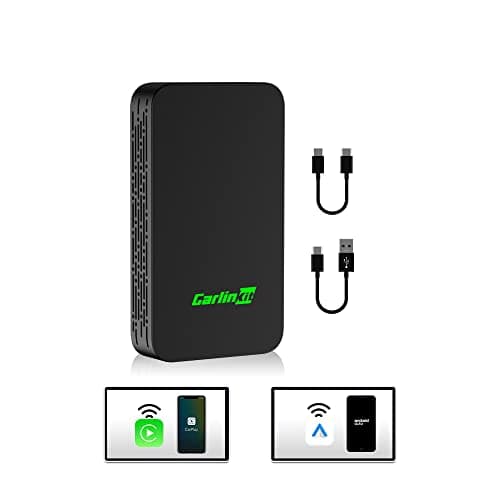
| 1 | CarlinKit 5.0 (CPC200-2air) Making factory wired CarPlay wireless | Plugs in | 8.2/10 | $54.99 - view on Amazon |
| 2 | Pioneer DMH-W4660NEX Publishing the power figure that actually matters | Hardwire | 5.3/10 | $599.99 - view on Amazon |
| 3 | Pioneer DMH-241EX A cheap screen that is not a CarPlay unit | Hardwire | 3.9/10 | $149.98 - view on Amazon |
Prices last verified October 26, 2026. They move constantly; the figure on Amazon when you click is the real one.
Continuous power against maximum power
Head units are sold on a wattage figure that is almost always the peak, and the peak is not a number that describes anything you experience.
Continuous — sometimes called RMS — is what the amplifier can deliver sustained. Maximum is an instantaneous figure measured under conditions that do not occur while playing music.
Pioneer publishes both for the DMH-W4660NEX: 22W x 4 channels continuous, and 50W x 4 maximum at 4 ohm. Two and a bit times the difference, and it is the smaller number that determines how loud the car actually gets.
A screen is not a CarPlay unit
This is the most expensive mistake in the category and it is entirely avoidable.
The DMH-241EX and the DMH-W4660NEX look like the same class of product: double-DIN, big touchscreen, Bluetooth. One has wireless CarPlay and wireless Android Auto. The other has neither — it is a digital media receiver with Bluetooth calling and audio streaming and a backup camera input.
Both are legitimate products. Only one of them does the thing most people are shopping for.
- Check for "Apple CarPlay" explicitly in the feature list, not "smartphone connectivity" or "Bluetooth"
- Check whether it is wireless or wired CarPlay. Wired means a cable every trip, which is fine, but it is a different daily experience
- Resistive versus capacitive touchscreen is a decent proxy for tier. The cheaper DMH-241EX is resistive, which wants a firm press; the W4660NEX is capacitive, like a phone
What the two units publish
| DMH-W4660NEX | DMH-241EX | |
|---|---|---|
| Screen | 6.8 in WVGA capacitive | 6.2 in resistive |
| Wireless CarPlay | Yes | No — none at all |
| Wireless Android Auto | Yes | No |
| Continuous power | 22 W x 4 | Not published |
| Maximum power | 50 W x 4 at 4 ohm | Not published |
| Preamp outputs | 6-channel RCA, 4 V RMS | Not published |
| Hi-res audio | 192 kHz/24-bit WAV and FLAC, DSD 5.6 MHz | Not published |
The preout row matters more than it looks. Six channels of RCA output at 4V RMS is what lets you add an amplifier later without replacing the head unit again — front, rear and subwoofer, at a voltage high enough that the amplifier's gain does not have to work hard and amplify noise along with signal.
The three parts nobody puts in the price
The unit is not the cost. This is the part that surprises people, and it is why a "$200 stereo" is a $300 job.
- A dash kit. A plastic fascia specific to your car that makes an aftermarket unit fit an opening designed for the factory one. Vehicle-specific, and required
- A wiring harness adapter. Plugs into your car's factory connector at one end and the head unit's standard connector at the other, so nothing gets cut. Also vehicle-specific
- An antenna adapter, on many cars, because the factory antenna plug is not the standard one head units use
Two further items are common rather than universal: a steering wheel control interface, if you want the buttons on the wheel to keep working, and a data interface on cars where the factory radio is tied into vehicle systems like climate display or chimes.
When not to replace the head unit at all
This site has said repeatedly that a head unit swap is the proper fix for an older car. It is also frequently the wrong purchase, and the honest version of this page has to say when.
- Your car already has wired CarPlay. An adapter converts it to wireless for a fraction of the cost and touches nothing — best wireless CarPlay adapters
- You only want music and hands-free calls. A Bluetooth receiver into an aux socket does that for a fraction of the price — best Bluetooth adapters for older cars
- The factory unit runs other vehicle functions. The interface modules can cost more than the stereo
- You are selling the car soon. A portable screen leaves with you — best portable CarPlay screens
The full decision tree for a car with no CarPlay is in how to add CarPlay to an older car.
Which to buy
- You want CarPlay and Android Auto without a cable: the DMH-W4660NEX, which publishes continuous power and preouts as well
- You want Bluetooth and a backup camera on a budget: the DMH-241EX, understanding clearly that it has no CarPlay
- Your car already has wired CarPlay: neither. Buy the adapter
Whichever you choose, the platform requirements are worth knowing first — CarPlay vs Android Auto.
Every pick, with the working
Each entry lists the specifications the maker publishes, the axis scores those specifications produce, and what you give up. Rows that read “Not published” are not omissions on our side: they are things the maker will not commit to in writing, and they cost the product points on the transparency axis. Specifications compiled September 4, 2026.
Our pickMaking factory wired CarPlay wireless
CarlinKit 5.0 (CPC200-2air)
A dongle that plugs into the USB port your wired CarPlay already uses and turns it wireless, on 2.4 and 5 GHz, drawing 0.75 watts. CarlinKit states compatibility with more than 800 car models from 2016 onwards. The prerequisite is absolute: your car must already have wired CarPlay or Android Auto. This adds no CarPlay to a car that has none.
- Wi-Fi
- 2.4 GHz and 5.0 GHz
- Power consumption
- 0.75 W
- Power input
- 5 V +/- 0.2 V, 1.0 A
- Vehicle compatibility
- Stated 800+ models from 2016 with factory wired CarPlay or Android Auto
- Requirement
- Factory wired CarPlay or Android Auto must already be present
- Dimensions
- 76 x 43 x 12.3 mm
- Brand exclusion
- Stated not compatible with BMW vehicles
- List price
- Not published
- Operating range
- Not published
- Warranty
- 1 year
What it gets right
- Removes the single most annoying thirty seconds of every commute
- Dual band 2.4 and 5 GHz, published, which is what keeps the link stable
- 0.75 W draw, published, so it is not a parasitic load worth worrying about
- Nothing to install: it plugs into the existing USB port
Flaws
- Requires factory wired CarPlay or Android Auto already present. This is not optional
- Adds a handshake delay at startup, which is shorter than plugging a cable in but not zero
- Firmware updates are a manual job through a web interface, and they are occasionally necessary
The working behind the 8.2
- Heat headroom: not scored (weight 22%)
- The maker publishes no operating-temperature ceiling, so this axis is dropped and the other weights are re-normalized.
- Install effort: 10.0 (weight 24%)
- Plugs into a 12V socket or a USB port. Nothing to mount, nothing to route, reversible in a second.
- Price against the ceiling: not scored (weight 24%)
- No published list price we could cite on the compile date, so this axis is dropped and the other weights are re-normalized.
- Written commitment: 5.5 (weight 15%)
- 12-month warranty. This is the only promise in the entire listing that a court would read, which is why it is scored and the marketing copy is not.
- Spec transparency: 8.0 (weight 15%)
- 8 of the 10 specifications we went looking for are published by the maker (80%). A blank row is never a guess here: it prints “Not published” and it costs the product points, because a figure nobody will commit to in writing is a figure you cannot check.
Axes with no published input are dropped and the remaining weights re-normalized, so a product is not punished for a category where an axis does not apply. Specifications compiled September 4, 2026 from CarlinKit's 2air product page.
2Publishing the power figure that actually matters
Pioneer DMH-W4660NEX
Wireless CarPlay and wireless Android Auto on a 6.8 inch capacitive screen, and — unusually for this category — Pioneer publishes continuous power output as well as the maximum. 22W per channel continuous is the number that describes what your speakers actually get; the 50W on the box does not.
- Screen
- 6.8 in WVGA capacitive
- Continuous power
- 22 W x 4 channels
- Maximum power
- 50 W x 4 channels at 4 ohm
- Preamp outputs
- 6-channel RCA, 4 V RMS
- Wireless CarPlay
- Yes
- Wireless Android Auto
- Yes
- Operating temperature
- Not published
- List price
- Not published
What it gets right
- Publishes continuous power output: 22 W x 4 channels, alongside the 50 W x 4 maximum
- Wireless Apple CarPlay and wireless Android Auto, so nothing needs plugging in
- Six-channel RCA preamp outputs at 4 V RMS, which is what you need if an amplifier ever follows
- 6.8 in WVGA capacitive touchscreen rather than the resistive panels at the cheap end
- Plays up to 192 kHz/24-bit WAV and FLAC, and DSD up to 5.6 MHz, from USB
Flaws
- Fitting it means a dash kit, a wiring harness and often an antenna adapter, none of which are included
- Steering wheel controls need a separate interface module on most cars
- A double-DIN unit does not fit a single-DIN opening without modifying the dash
- No published operating temperature range, on a device permanently in a dashboard
The working behind the 5.3
- Heat headroom: not scored (weight 22%)
- The maker publishes no operating-temperature ceiling, so this axis is dropped and the other weights are re-normalized.
- Install effort: 4.0 (weight 24%)
- Wires into the fuse box. Half an hour, a fuse tap, a trim tool and a willingness to be upside down under the dash. This is the real cost of parking mode.
- Price against the ceiling: not scored (weight 24%)
- No published list price we could cite on the compile date, so this axis is dropped and the other weights are re-normalized.
- Written commitment: not scored (weight 15%)
- No warranty term published, so this axis is dropped and the other weights are re-normalized.
- Spec transparency: 7.5 (weight 15%)
- 6 of the 8 specifications we went looking for are published by the maker (75%). A blank row is never a guess here: it prints “Not published” and it costs the product points, because a figure nobody will commit to in writing is a figure you cannot check.
Axes with no published input are dropped and the remaining weights re-normalized, so a product is not punished for a category where an axis does not apply. Specifications compiled September 4, 2026 from Pioneer DMH-W4660NEX published power, preouts and display.
3A cheap screen that is not a CarPlay unit
Pioneer DMH-241EX
Skip this one. Skip it if you are buying a screen to get CarPlay, because it does not have CarPlay or Android Auto. It is a Bluetooth digital media receiver with a 6.2 inch resistive touchscreen and a backup camera input — a real upgrade on a car with none of those, and not the thing most buyers of a double-DIN screen think they are purchasing. Read the feature list, not the shape of the unit.
On this page as the one to check yourself on. It is a 6.2 inch digital media receiver with Bluetooth and a backup camera input, and it does not have CarPlay or Android Auto — which is exactly what a lot of buyers assume any double-DIN screen means. A resistive touchscreen is the other tell.
- Screen
- 6.2 in resistive
- Continuous power
- Not published
- Maximum power
- Not published
- Preamp outputs
- Not published
- Wireless CarPlay
- No — no CarPlay at all
- Wireless Android Auto
- No
- Operating temperature
- Not published
- List price
- Not published
What it gets right
- Genuinely cheap route to Bluetooth calling and audio in an older car
- Backup camera ready, which is a real upgrade on a car with none
- Double-DIN screen unit at close to single-DIN money
- Amazon Alexa built in when paired with Pioneer's app
Flaws
- No Apple CarPlay and no Android Auto — the feature most buyers of a screen unit assume is present
- Resistive touchscreen rather than capacitive, so it wants a firm press rather than a light one
- 6.2 in rather than the 6.8 in that is now standard a tier up
- Same installation requirements as any head unit: dash kit, harness, often an antenna adapter
The working behind the 3.9
- Heat headroom: not scored (weight 22%)
- The maker publishes no operating-temperature ceiling, so this axis is dropped and the other weights are re-normalized.
- Install effort: 4.0 (weight 24%)
- Wires into the fuse box. Half an hour, a fuse tap, a trim tool and a willingness to be upside down under the dash. This is the real cost of parking mode.
- Price against the ceiling: not scored (weight 24%)
- No published list price we could cite on the compile date, so this axis is dropped and the other weights are re-normalized.
- Written commitment: not scored (weight 15%)
- No warranty term published, so this axis is dropped and the other weights are re-normalized.
- Spec transparency: 3.8 (weight 15%)
- 3 of the 8 specifications we went looking for are published by the maker (38%). A blank row is never a guess here: it prints “Not published” and it costs the product points, because a figure nobody will commit to in writing is a figure you cannot check.
Axes with no published input are dropped and the remaining weights re-normalized, so a product is not punished for a category where an axis does not apply. Specifications compiled September 4, 2026 from Pioneer DMH-241EX published display and feature list.
Prices last verified October 26, 2026. They move constantly; the figure on Amazon when you click is the real one.
Questions people actually ask
What does continuous power mean on a car stereo?
It is what the amplifier delivers sustained, as opposed to the maximum which is an instantaneous peak. Pioneer publishes 22W x 4 continuous against 50W x 4 maximum on the DMH-W4660NEX. The smaller number is the one that describes real listening.
Does every double-DIN touchscreen have CarPlay?
No. The Pioneer DMH-241EX is a 6.2 inch touchscreen media receiver with Bluetooth and no CarPlay or Android Auto at all. Check the feature list for "Apple CarPlay" explicitly rather than assuming a screen implies it.
What else do I need to fit a head unit?
A vehicle-specific dash kit and wiring harness adapter, and on many cars an antenna adapter. A steering wheel control interface if you want those buttons to keep working, and sometimes a data interface if the factory radio also runs climate or chimes.
Should I replace my head unit or use an adapter?
If your car already has wired CarPlay, an adapter makes it wireless for far less and touches nothing. Replace the head unit when the car has no CarPlay support at all and you want it built in rather than suction-cupped to the dash.