Bluetooth vs aux vs FM transmitter
Your car answers this, not your preferences. Check for a 3.5mm socket and the decision makes itself — everything after that is about which end of a call you care about.
By Sawyer V. · Published · How we research
We have not tested any of this. Everything below is compiled from published manufacturer specifications, and the arithmetic is printed so you can check it. This page carries affiliate links: if you buy through one we earn a commission at no extra cost to you, and it does not change the order of the picks. Full disclosure.
The decision
Look for a 3.5 mm aux socket. That single check decides it. If you have one, buy an aux Bluetooth receiver — it feeds a line-level signal straight into your amplifier, so quality is limited by your speakers rather than the adapter. If you do not, an FM transmitter is the only option, and it is genuinely worse because it adds a radio broadcast and reception hop. If calls matter more than music, a visor speakerphone beats both on the microphone.
| # | Pick | Install | Score | Price |
|---|---|---|---|---|
| 1 | Nulaxy KM18 Bluetooth FM Transmitter A car with a radio and nothing else | Plugs in | 9.2/10 | $21.99 - view on Amazon |
| 2 | Besign BK01 Bluetooth Car Kit An aux socket plus an alternator whine | Plugs in | 9.0/10 | $19.99 - view on Amazon |
| 3 | Jabra Drive Bluetooth Visor Speakerphone Calls in a car with no hands-free at all | Clips on | 8.2/10 | $29.99 - view on Amazon |
| 4 | Anker Soundsync A3352 Bluetooth Receiver An older car with a working aux socket | Plugs in | 8.1/10 | Check price on Amazon |
Prices last verified October 22, 2026. They move constantly; the figure on Amazon when you click is the real one.
The check that decides everything
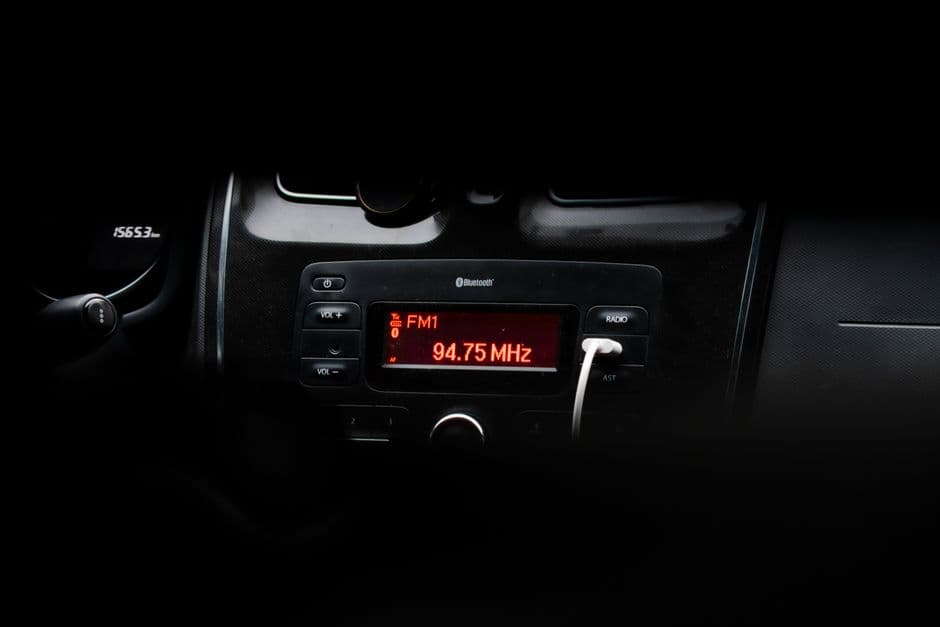
Look for a 3.5 mm headphone-style socket. It is usually on the head unit face, in the center console, or inside the armrest cubby, and it is often labeled AUX or marked with a headphone icon.
Some cars hide it. A few head units only show an aux source once something is plugged in, and some route the socket through a glovebox or armrest that is easy to miss. Plug any 3.5 mm cable in and cycle the source button before concluding you do not have one.
The signal path, which explains the ranking
Each option takes a different route from your phone to your speakers, and each additional conversion or transmission step costs quality.
| Route | Signal path | Hops |
|---|---|---|
| Factory Bluetooth | Phone → head unit → amplifier | One |
| Aux receiver | Phone → receiver → line-in → amplifier | Two |
| FM transmitter | Phone → transmitter → FM broadcast → tuner → amplifier | Four |
| Visor speakerphone | Phone → visor unit → its own speaker | Two, own speaker |
The FM transmitter's extra hops are not a small penalty. FM broadcast is a lossy, noise-prone medium by design — it is bandwidth-limited, it picks up interference, and in an urban area you are competing with actual radio stations for a clear frequency.
The aux route is genuinely good. A line-level signal into the amplifier is what the head unit does with its own inputs, so the ceiling is your speakers rather than the adapter.
The aux option, and the two products in it
Aux Bluetooth receivers split by how they are powered, and it is a real choice rather than a detail.
- Battery powered — the Anker Soundsync. 12 hours playback on a 180 mAh cell, nothing occupies a socket, and it can move between cars. Anker publishes an operating range of -10 C to 55 C, which almost nothing in this category states. That 55 C ceiling is also the lowest on this site, and a parked car reaches 60-70 C — take it indoors in summer
- Socket powered — the Besign BK01. Powers on with the ignition, auto reconnects, never needs charging, and gives back two USB ports. It occupies the 12V socket permanently, and its Bluetooth 4.1 radio is older
The Besign's genuine advantage is the included ground loop noise isolator. If you have ever heard a whine through an aux input that rises and falls with engine speed, that is a ground loop, and an isolator is the actual fix rather than a filter. Full comparison in best Bluetooth adapters for older cars.
The FM option, honestly
An FM transmitter broadcasts a very low-power signal on an unused frequency, which your car's radio then receives. It is the only route available to a car with no aux socket, and it works.
What it costs you is quality and consistency. Finding a genuinely clear frequency in a city is difficult, the clear frequency changes as you drive between areas, and interference appears as hiss, bleed-through from real stations, or a signal that drops in tunnels and near transmitters.
It has real advantages worth naming, though. It works in absolutely any car with a radio, the audio comes out of your actual speakers rather than a small unit, and many models include a 12V charger so you do not lose the socket for nothing. Best Bluetooth FM transmitters covers choosing one.
Calls are a separate decision
Everything above is about music. Calls invert part of the analysis, because what matters is the microphone rather than the speaker.
An aux receiver or FM transmitter puts the microphone in the console: low, behind you, next to the blower, surrounded by road noise. Your voice arrives quiet and the noise arrives at full strength.
A visor speakerphone puts the microphone near your mouth. Jabra publishes up to 20 dB of noise reduction with DSP on the Drive, along with 20 hours talk time — figures rather than adjectives. It sounds worse to you, because it drives a small speaker, and better to them. See best visor speakerphones.
Running both is entirely reasonable: a visor unit for calls and an aux receiver for music, with the phone routing each automatically.
When none of these is what you want
All three give you audio and basic call handling. None gives you navigation on the car's screen, steering wheel integration, or messages read aloud.
If that is what you are after, it is a head unit replacement or a standalone dash screen — and importantly, not a wireless CarPlay adapter, which converts existing wired CarPlay to wireless and cannot add CarPlay to a car that never had it. That is the most common mistaken purchase in this whole area, and we set it out in how to add CarPlay to an older car.
Deciding
- Aux socket, music matters: aux Bluetooth receiver. Battery version if the 12V socket is spoken for, socket version otherwise
- Aux socket and a whine: the socket-powered one with the ground loop isolator
- No aux socket: FM transmitter, and accept the quality
- Calls matter most: visor speakerphone, regardless of the above
- Want navigation on a screen: none of these — head unit or dash screen
And while you are upgrading an older car, the 12V socket is also a better charging source than most factory USB ports — how to add USB ports to an older car.
And if the audio still disappoints after the connection is sorted, the speakers were probably the limit rather than the link. Sensitivity in dB decides that on factory power, not the watts on the box — best car speakers for an easy upgrade.
Every pick, with the working
Each entry lists the specifications the maker publishes, the axis scores those specifications produce, and what you give up. Rows that read “Not published” are not omissions on our side: they are things the maker will not commit to in writing, and they cost the product points on the transparency axis. Specifications compiled September 4, 2026.
Our pickA car with a radio and nothing else
Nulaxy KM18 Bluetooth FM Transmitter
Skip this one. It is the correct answer for a car with no aux socket and the wrong one for a car that has one. An FM transmitter adds a radio broadcast and reception step that an aux adapter skips entirely, and every hop costs audio quality. Only buy it if the 3.5mm socket genuinely is not there.
Bluetooth 5.0 into the 87.5 to 108.0 MHz FM band, on a gooseneck with a 1.44-inch screen, running from 12 V or 24 V. It is the answer for a car too old for CarPlay, Android Auto or even an aux socket — and it is a genuinely different product from the CarPlay adapters, which need a car that already has CarPlay.
- Frequency range
- 87.5 - 108.0 MHz
- Bluetooth
- 5.0
- Display
- 1.44 in LCD
- Input voltage
- 12 V - 24 V
- Extra inputs
- TF card, aux
- Calls
- Hands-free supported
- Mounting
- Rotatable gooseneck in the 12V socket
- List price
- Not published
- Warranty
- Not published
What it gets right
- Works in literally any car with an FM radio, which no other connectivity product on this site can claim
- Published frequency range and Bluetooth version, and 12-24 V input so it works in a truck
- Screen shows battery voltage as well as the station, which is a genuinely useful extra on an old car
- Handles calls, plus TF card and aux input for when Bluetooth is not the answer
Flaws
- FM transmission is a lossy analog hop. It will never sound as good as a cable or a proper head unit
- You have to find a genuinely empty frequency, and in a city there may not be one
- Gooseneck mounted in the 12V socket means it occupies the socket and sticks out into the console
The working behind the 9.2
- Heat headroom: not scored (weight 22%)
- The maker publishes no operating-temperature ceiling, so this axis is dropped and the other weights are re-normalized.
- Install effort: 10.0 (weight 24%)
- Plugs into a 12V socket or a USB port. Nothing to mount, nothing to route, reversible in a second.
- Price against the ceiling: not scored (weight 24%)
- No published list price we could cite on the compile date, so this axis is dropped and the other weights are re-normalized.
- Written commitment: not scored (weight 15%)
- No warranty term published, so this axis is dropped and the other weights are re-normalized.
- Spec transparency: 7.8 (weight 15%)
- 7 of the 9 specifications we went looking for are published by the maker (78%). A blank row is never a guess here: it prints “Not published” and it costs the product points, because a figure nobody will commit to in writing is a figure you cannot check.
Axes with no published input are dropped and the remaining weights re-normalized, so a product is not punished for a category where an axis does not apply. Specifications compiled September 4, 2026 from Nulaxy's KM18 product page.
2An aux socket plus an alternator whine
Besign BK01 Bluetooth Car Kit
Socket-powered rather than battery-powered, so it wakes with the ignition and there is nothing to charge. The reason to pick it over the Anker is the included ground loop noise isolator, which is the fix for the whine that ruins aux audio in older cars.
- Bluetooth version
- 4.1 + EDR
- Power
- 12V socket, dual-port 2.1 A / 10 W charger included
- Multipoint
- Two devices simultaneously
- Noise handling
- Ground loop noise isolator included
- Behavior on start
- Auto power-on and auto reconnect to last device
- Included
- Kit, magnetic mounting plate, ground loop isolator, guide
- Operating temperature
- Not published
- Warranty
- Not published
What it gets right
- Ships with a ground loop noise isolator — the actual cure for engine-speed whine through an aux input
- Powers on with the car and auto-reconnects to the last phone, so there is no ritual
- Dual-port 2.1 A charger built into the 12V plug, so it does not cost you the socket
- Multipoint pairing to two devices
Flaws
- Bluetooth 4.1 + EDR, an older radio than the Anker's
- No published operating temperature range, which the Anker does publish
- Occupies the 12V socket permanently — you get two USB ports back, but the socket itself is gone
- No published warranty term
The working behind the 9.0
- Heat headroom: not scored (weight 22%)
- The maker publishes no operating-temperature ceiling, so this axis is dropped and the other weights are re-normalized.
- Install effort: 10.0 (weight 24%)
- Plugs into a 12V socket or a USB port. Nothing to mount, nothing to route, reversible in a second.
- Price against the ceiling: not scored (weight 24%)
- No published list price we could cite on the compile date, so this axis is dropped and the other weights are re-normalized.
- Written commitment: not scored (weight 15%)
- No warranty term published, so this axis is dropped and the other weights are re-normalized.
- Spec transparency: 7.5 (weight 15%)
- 6 of the 8 specifications we went looking for are published by the maker (75%). A blank row is never a guess here: it prints “Not published” and it costs the product points, because a figure nobody will commit to in writing is a figure you cannot check.
Axes with no published input are dropped and the remaining weights re-normalized, so a product is not punished for a category where an axis does not apply. Specifications compiled September 4, 2026 from Besign BK01 published specifications.
3Calls in a car with no hands-free at all
Jabra Drive Bluetooth Visor Speakerphone
Clips to the sun visor, which puts the microphone near your head instead of down in the console — the single reason it sounds better on calls than any aux adapter. It publishes 20 hours of talk time and 20 dB of noise reduction.
- Talk time
- Up to 20 hours
- Standby
- Up to 30 days
- Bluetooth
- 3.0
- Range
- 10 m / 33 ft
- Noise reduction
- Up to 20 dB with DSP
- Microphone
- Omni-directional
- Pairing
- 8 devices remembered, 2 connected at once
- Operating temperature
- Not published
- Warranty
- Not published
- List price
- Not published
What it gets right
- Microphone position is the whole product: on the visor, near your mouth, not in a footwell
- Publishes 20 hours talk time and up to 30 days standby
- Publishes 20 dB noise reduction with DSP, which is a figure rather than an adjective
- Pairs with two devices simultaneously and remembers up to eight
- Also passes music, podcasts and navigation prompts
Flaws
- Bluetooth 3.0 — an old radio, and it shows in pairing speed
- A visor speakerphone drives a small speaker, so music through it is worse than through the car's own
- One more thing to charge, and a flat one is silent
- No published operating temperature range, on a device clipped to a visor in direct sun
The working behind the 8.2
- Heat headroom: not scored (weight 22%)
- The maker publishes no operating-temperature ceiling, so this axis is dropped and the other weights are re-normalized.
- Install effort: 9.0 (weight 24%)
- Clips onto a vent blade or a headrest post. Two minutes, no tools, no adhesive, no residue.
- Price against the ceiling: not scored (weight 24%)
- No published list price we could cite on the compile date, so this axis is dropped and the other weights are re-normalized.
- Written commitment: not scored (weight 15%)
- No warranty term published, so this axis is dropped and the other weights are re-normalized.
- Spec transparency: 7.0 (weight 15%)
- 7 of the 10 specifications we went looking for are published by the maker (70%). A blank row is never a guess here: it prints “Not published” and it costs the product points, because a figure nobody will commit to in writing is a figure you cannot check.
Axes with no published input are dropped and the remaining weights re-normalized, so a product is not punished for a category where an axis does not apply. Specifications compiled September 4, 2026 from Jabra Drive published technical specifications.
4An older car with a working aux socket
Anker Soundsync A3352 Bluetooth Receiver
Skip this one. If your car has no aux socket this does nothing at all — check for the 3.5 mm jack before you buy, not after. An FM transmitter is the fallback for a car without one.
The cheapest real upgrade available to a car with an aux socket and no Bluetooth. It publishes an operating temperature range, which is genuinely rare, and it runs on its own battery so nothing has to be plugged in.
- Operating temperature
- -10 C to 55 C (14 F to 131 F)
- Battery
- 180 mAh
- Playback time
- Up to 12 hours
- Charge time
- About 2 hours
- Multipoint
- Two devices simultaneously
- Range
- 10 m / 33 ft
- Profiles
- HFP, A2DP, AVRCP
- Dimensions
- 50 x 29 x 10 mm
- Weight
- 12.2 g
- Direction
- Receiver only — cannot transmit
- Warranty
- Not published
- List price
- Not published
What it gets right
- Publishes an operating temperature range of -10 C to 55 C — almost nothing in this category publishes one at all
- 12 hours of playback on a 180 mAh battery, charging in about 2 hours
- Connects to two devices at once, so a second phone can take a call without unpairing the first
- 50 x 29 x 10 mm and 12.2 g — small enough to stick anywhere
Flaws
- 55 C ceiling is the lowest of any device on this site, and a parked car in summer runs 60-70 C. Take it inside
- Receiver only. It cannot send audio out of the car to headphones
- A battery device means one more thing to charge, unlike a socket-powered kit
- No published warranty term
The working behind the 8.1
- Heat headroom: 6.0 (weight 22%)
- Published operating ceiling 55 C (131 F). A car parked in summer sun runs roughly 60-70 C inside, so 65 C and up is real headroom, 60 C is living at the limit, and anything under 55 C is a summer problem waiting to happen.
- Install effort: 10.0 (weight 24%)
- Plugs into a 12V socket or a USB port. Nothing to mount, nothing to route, reversible in a second.
- Price against the ceiling: not scored (weight 24%)
- No published list price we could cite on the compile date, so this axis is dropped and the other weights are re-normalized.
- Written commitment: not scored (weight 15%)
- No warranty term published, so this axis is dropped and the other weights are re-normalized.
- Spec transparency: 8.3 (weight 15%)
- 10 of the 12 specifications we went looking for are published by the maker (83%). A blank row is never a guess here: it prints “Not published” and it costs the product points, because a figure nobody will commit to in writing is a figure you cannot check.
Axes with no published input are dropped and the remaining weights re-normalized, so a product is not punished for a category where an axis does not apply. Specifications compiled September 4, 2026 from Anker Soundsync A3352 manual specification table.
Prices last verified October 22, 2026. They move constantly; the figure on Amazon when you click is the real one.
Questions people actually ask
Is an FM transmitter worse than an aux adapter?
Yes, meaningfully. It adds a radio broadcast and reception step that an aux adapter skips, and FM is a lossy, interference-prone medium. It is the right choice only when there is no aux socket.
How do I find out if my car has an aux input?
Look for a 3.5 mm socket on the head unit, console or inside the armrest. Plug a cable in and cycle the source button — some head units only show the aux source when something is connected.
Why does my aux adapter whine?
A ground loop — a voltage difference between grounding points putting current through the audio shield, which is why the pitch tracks engine speed. A ground loop isolator fixes it properly; the Besign BK01 includes one.
Can I use two of these at once?
Yes, and a visor speakerphone for calls plus an aux receiver for music is a sensible pairing. Most phones route call audio and media independently, so each device does the job it is better at.