The best dash cams for cold weather
The number that matters in January is the published operating floor, and most of this category refuses to print one. Here is who does, what they commit to, and the one flagship that commits to less than its own budget model.
By Sawyer V. · Published · How we research
We have not tested any of this. Everything below is compiled from published manufacturer specifications, and the arithmetic is printed so you can check it. This page carries affiliate links: if you buy through one we earn a commission at no extra cost to you, and it does not change the order of the picks. Full disclosure.
The verdict
Buy the VIOFO A119 Mini 2. VIOFO publishes an operating floor of -20 C, it is in stock at around $100, and it uses a supercapacitor rather than a lithium battery — which is the part that actually decides whether a camera wakes up on a frozen morning. The Garmin Dash Cam Mini 3 publishes the same -20 C floor if you want the smallest possible camera, and Vantrue's E1 Lite matches it for less money. Prices as of October 11, 2026.
Who should skip the expensive one: the Vantrue N4 is the dearest camera here and publishes only -10 C — a floor ten degrees warmer than Vantrue's own budget models. If winter is your reason for buying, the flagship is the wrong flagship.
| # | Pick | Install | Score | Price |
|---|---|---|---|---|
| 1 | VIOFO A119 Mini 2 The one to buy if you only buy one | Adhesive | 6.7/10 | $99.98 - view on Amazon |
| 2 | Garmin Dash Cam Mini 3 Disappearing behind the mirror | Adhesive | 6.9/10 | $133.99 - view on Amazon |
| 3 | Vantrue E1 Lite The cheapest camera here worth owning | Adhesive | 7.6/10 | $95.99 - view on Amazon |
| 4 | Vantrue N4 Three channels, including the cabin | Adhesive | 6.6/10 | $169.99 - view on Amazon |
| 5 | REDTIGER F7N Front and rear with the hardwire kit in the box | Adhesive | 6.3/10 | $99.99 - view on Amazon |
Prices last verified October 11, 2026. They move constantly; the figure on Amazon when you click is the real one.
The published floor, and who prints one
Every page about dash cams in summer talks about heat. Almost nothing talks about the other end, which is the end that stops a camera booting at seven in the morning in February.
| Camera | Published floor | Published ceiling | Power store | List price |
|---|---|---|---|---|
| VIOFO A119 Mini 2 | -20 C | 65 C | Supercapacitor | $159.99 |
| Garmin Dash Cam Mini 3 | -20 C | 60 C | Supercapacitor | $99.99 |
| Vantrue E1 Lite | -20 C | 70 C | Supercapacitor | $79.99 |
| Vantrue N4 | -10 C | 70 C | Supercapacitor | $259.99 |
| REDTIGER F7N | Not published | Not published | Not published | $109.99 |
Three cameras commit to -20 C. One commits to -10 C. One commits to nothing at all. That spread is the entire ranking on this page, and it is why the order here is the author's rather than the site's usual rubric.
What actually fails in a frozen car
Cold does not kill a dash cam the way heat does. Heat degrades it permanently; cold stops it working this morning and then it is fine by noon. Three distinct failures, in the order you will meet them:
- The power store will not deliver current. This is the big one, and it is why the supercapacitor column above matters more than the floor. A lithium cell at -20 C has a fraction of its usable capacity; a supercapacitor is far less bothered. Every camera on this page uses a supercapacitor, which is not a coincidence — it is why they are the ones worth listing
- The suction mount lets go. Adhesive and gel both stiffen in cold and release from cold glass. A camera on the floor is a camera recording the carpet
- The lens fogs from the inside. A cold camera in a warming cabin condenses, exactly like your windshield does, and the first ten minutes of footage is a white blur. Nothing fixes this but time and cabin airflow
Who each one is for
- VIOFO A119 Mini 2 — most people in a cold climate. -20 C published, supercapacitor, STARVIS 2 sensor, reliably in stock around $100. Skip it if you need a rear channel; it is front-only and will never take one
- Garmin Dash Cam Mini 3 — if you want it invisible. Same published -20 C floor in the smallest body here, and it hides entirely behind a mirror. Skip it if you want to avoid Garmin's optional cloud subscription entirely — see best dash cams without a subscription
- Vantrue E1 Lite — the cheapest published -20 C floor. It also carries Vantrue's 70 C ceiling, which is the best heat figure in our ledger, so it is the strongest all-climate figure here on paper. Skip it if stock matters to you on the day; this listing runs thin
- Vantrue N4 — buy it for the cabin camera, not for winter. See the skip note
- REDTIGER F7N — not for a cold-climate buyer. See the skip note
Parking mode is the real cold-weather problem
A camera that runs while you drive has the alternator behind it. A camera in parking mode is running off the battery, and a car battery in deep cold has materially less to give.
Our own arithmetic on this is on the parking mode battery page: roughly 43 hours on a healthy 50 Ah battery in mild weather, and about 17 hours at -18 C. That is not a small adjustment. If you park outside overnight in winter and rely on parking mode, set the hardwire kit's low-voltage cutoff conservatively and expect shorter coverage — the hardwire guide covers the cutoff setting.
Four things that help more than the camera choice
- Re-seat the mount when the car is warm, not on a frozen windshield. A suction cup pressed onto cold glass is a cup that falls off at lunchtime
- Give it a minute before you judge the footage. Lens condensation clears as the cabin warms; it is not a fault
- Clear the whole windshield, not a porthole. A camera behind a scraped circle records a scraped circle — a windshield cover makes this a ten-second job
- Check the card in autumn. Cold is when a marginal memory card finally fails to mount, and you will not notice until you need the footage — best SD cards
The rest of the winter list, in the order worth buying it, is in best car accessories for winter.
Every pick, with the working
Each entry lists the specifications the maker publishes, the axis scores those specifications produce, and what you give up. Rows that read “Not published” are not omissions on our side: they are things the maker will not commit to in writing, and they cost the product points on the transparency axis. Specifications compiled September 4, 2026.
Our pickThe one to buy if you only buy one
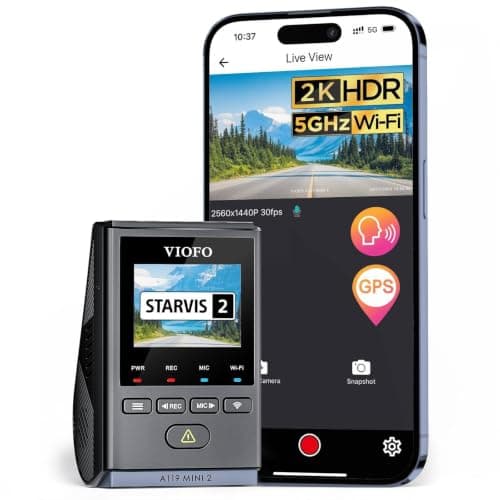
VIOFO A119 Mini 2
A Sony STARVIS 2 IMX675 sensor at 2K 60fps, a supercapacitor, a published 65 C ceiling, an 18-month warranty and three named parking modes including buffered recording. VIOFO publishes more about this camera than anyone else here publishes about anything, and that is the reason it wins: every claim on the page is one you can check.
- Front resolution
- 2560 x 1440 at 60fps
- Image sensor
- Sony STARVIS 2 IMX675, 5MP
- Field of view
- 140 degrees
- Aperture
- f/1.6
- Power store
- Supercapacitor, no battery
- Operating range
- -20 C to 65 C (-4 F to 149 F)
- Storage temperature
- -20 C to 70 C
- Max microSD
- 512 GB
- Wi-Fi
- 2.4 GHz and 5 GHz
- Parking modes
- Auto event detection, time lapse, low bitrate
- Dimensions
- 1.81 x 1.77 x 2.94 in
- Published current draw
- Not published
List price $159.99 per VIOFO's own store, captured on the compile date below. Not a live price and not what you will pay — the button is where the real number is.
What it gets right
- Sony STARVIS 2 IMX675 with an f/1.6 lens — the best published low-light hardware in this ledger
- 2K at 60fps, which reads plates on moving cars better than 4K at 30fps does
- Published 65 C ceiling and a supercapacitor, so summer is designed for rather than hoped about
- Three named parking modes, including buffered recording that keeps the seconds before a trigger
- 18-month warranty, longer than most of this category
Flaws
- Front only, and adding the rear camera means a different model entirely
- The list price is well above the sub-$100 bracket most people start in
- Parking mode needs the HK4 hardwire kit, which is a separate purchase and a separate afternoon
The working behind the 6.7
- Heat headroom: 9.0 (weight 22%)
- Published operating ceiling 65 C (149 F). A car parked in summer sun runs roughly 60-70 C inside, so 65 C and up is real headroom, 60 C is living at the limit, and anything under 55 C is a summer problem waiting to happen.
- Install effort: 6.0 (weight 24%)
- Adhesive pad onto the dashboard. Permanent in practice: repositioning means a new pad, and the pad is the part that fails first.
- Price against the ceiling: 3.5 (weight 24%)
- Listed at $159.99 on the compile date. This site's buyer has a practical ceiling around $150 for a single upgrade, so the scale rewards everything under $100 and falls away sharply past $150. The live price is very often different, and that is what the button is for.
- Written commitment: 7.0 (weight 15%)
- 18-month warranty. This is the only promise in the entire listing that a court would read, which is why it is scored and the marketing copy is not.
- Spec transparency: 9.2 (weight 15%)
- 11 of the 12 specifications we went looking for are published by the maker (92%). A blank row is never a guess here: it prints “Not published” and it costs the product points, because a figure nobody will commit to in writing is a figure you cannot check.
Axes with no published input are dropped and the remaining weights re-normalized, so a product is not punished for a category where an axis does not apply. Specifications compiled September 4, 2026 from VIOFO's A119 Mini 2 product page.
2Disappearing behind the mirror
Garmin Dash Cam Mini 3
Car-key sized, 1080p, 140 degrees, voice control, and a Parking Guard feature that now needs a paid Garmin Vault subscription and constant power. It is the camera to buy if the thing you dislike most about dash cams is looking at them. It is also the camera where you pay a real premium over the Vantrue and ROVE options for 1080p, and Garmin's advantage is the app and the support rather than the sensor.
- Front resolution
- 1080p HD
- Field of view
- 140 degrees
- Wireless
- 2.4 GHz Wi-Fi
- Max microSD
- 512 GB
- Voice control
- Yes
- Parking mode
- Parking Guard, needs a paid Vault subscription
- Operating range
- -4 F to 140 F (-20 C to 60 C)
- Power store
- Not published
List price $99.99 per Amazon listing, October 1, 2026, captured on the compile date below. Not a live price and not what you will pay — the button is where the real number is.
What it gets right
- Genuinely tiny — it hides behind the mirror and you forget it exists
- Voice control, so locking a clip does not mean reaching for the windshield
- Garmin Drive app with Live View, and Garmin actually maintains its apps for years
- Takes a 512GB card
Flaws
- 1080p at a price where 2K and 4K cameras exist
- Parking Guard needs Wi-Fi, the app and a paid Vault subscription, which is a different dependency from a plain hardwired parking mode
- No screen at all, so framing the shot is entirely a phone job
The working behind the 6.9
- Heat headroom: 7.5 (weight 22%)
- Published operating ceiling 60 C (140 F). A car parked in summer sun runs roughly 60-70 C inside, so 65 C and up is real headroom, 60 C is living at the limit, and anything under 55 C is a summer problem waiting to happen.
- Install effort: 6.0 (weight 24%)
- Adhesive pad onto the dashboard. Permanent in practice: repositioning means a new pad, and the pad is the part that fails first.
- Price against the ceiling: 7.0 (weight 24%)
- Listed at $99.99 on the compile date. This site's buyer has a practical ceiling around $150 for a single upgrade, so the scale rewards everything under $100 and falls away sharply past $150. The live price is very often different, and that is what the button is for.
- Written commitment: 5.5 (weight 15%)
- 12-month warranty. This is the only promise in the entire listing that a court would read, which is why it is scored and the marketing copy is not.
- Spec transparency: 8.8 (weight 15%)
- 7 of the 8 specifications we went looking for are published by the maker (88%). A blank row is never a guess here: it prints “Not published” and it costs the product points, because a figure nobody will commit to in writing is a figure you cannot check.
Axes with no published input are dropped and the remaining weights re-normalized, so a product is not punished for a category where an axis does not apply. Specifications compiled September 4, 2026 from Garmin's Dash Cam Mini 3 product page.
3The cheapest camera here worth owning
Vantrue E1 Lite
The same 70 C ceiling and the same supercapacitor as the E1, at 1080p and a lower list price. 1080p is enough to read a plate directly in front of you and not enough to read one two lanes over, and that trade is the entire decision. If the budget is the constraint, this is where to spend it rather than on a cheaper camera with an unpublished heat rating.
- Front resolution
- 1920 x 1080
- Power store
- Supercapacitor
- Operating range
- -20 C to 70 C (-4 F to 158 F)
- Wi-Fi
- Built in, app control
- GPS
- Not on this model
- Parking mode
- 24-hour, motion detection
- Max microSD
- Not published
- Field of view
- Not published
- Published current draw
- Not published
List price $79.99 per Vantrue's own store, sale price (regular $109.99), captured on the compile date below. Not a live price and not what you will pay — the button is where the real number is.
What it gets right
- 70 C published ceiling at the lowest list price in this ledger
- Supercapacitor, not a lithium cell
- Wi-Fi and app control at this money
- Small enough to hide behind the mirror, which is most of what a mini camera is for
Flaws
- 1080p. Plate legibility falls off fast at distance and at an angle
- No GPS on this model, so no speed or location stamp on the footage
- Parking mode needs a hardwire kit sold separately
The working behind the 7.6
- Heat headroom: 10.0 (weight 22%)
- Published operating ceiling 70 C (158 F). A car parked in summer sun runs roughly 60-70 C inside, so 65 C and up is real headroom, 60 C is living at the limit, and anything under 55 C is a summer problem waiting to happen.
- Install effort: 6.0 (weight 24%)
- Adhesive pad onto the dashboard. Permanent in practice: repositioning means a new pad, and the pad is the part that fails first.
- Price against the ceiling: 8.0 (weight 24%)
- Listed at $79.99 on the compile date. This site's buyer has a practical ceiling around $150 for a single upgrade, so the scale rewards everything under $100 and falls away sharply past $150. The live price is very often different, and that is what the button is for.
- Written commitment: 7.0 (weight 15%)
- 18-month warranty. This is the only promise in the entire listing that a court would read, which is why it is scored and the marketing copy is not.
- Spec transparency: 6.7 (weight 15%)
- 6 of the 9 specifications we went looking for are published by the maker (67%). A blank row is never a guess here: it prints “Not published” and it costs the product points, because a figure nobody will commit to in writing is a figure you cannot check.
Axes with no published input are dropped and the remaining weights re-normalized, so a product is not punished for a category where an axis does not apply. Specifications compiled September 4, 2026 from Vantrue's E1 Lite product page.
4Three channels, including the cabin
Vantrue N4
Skip this one. Vantrue publishes -10 C for the N4 — ten degrees warmer than the floor Vantrue publishes for its own much cheaper E1 and E1 Lite. It is the most expensive camera here and the weakest published cold figure of the ones that publish anything. Buy it for the third channel, not for winter.
Front, cabin and rear on one camera with infrared night vision on the interior channel and the same 70 C published ceiling as the rest of Vantrue's supercapacitor line. It is the camera for somebody who drives for a living or carries passengers they do not know. For a plain commute it is two channels more than you need and $170 more than you need to spend.
- Channels
- Three: front, interior, rear
- Resolution
- 1440p + 1080p + 1080p at 30fps, or 4K front only
- Night vision
- Sony STARVIS with infrared on the cabin channel
- Power store
- Supercapacitor
- Operating range
- -10 C to 70 C (14 F to 158 F)
- Max microSD
- 512 GB
- Parking mode
- 24-hour, motion and collision detection
- GPS
- Supported
- Published current draw
- Not published
List price $259.99 per Vantrue's own store, captured on the compile date below. Not a live price and not what you will pay — the button is where the real number is.
What it gets right
- Three channels recording at once, with IR illumination on the cabin camera
- 70 C published ceiling and a supercapacitor
- 512GB card support, which three channels genuinely need
- 24-hour parking mode with motion and collision detection
Flaws
- $259.99 list is far outside this site's usual bracket
- Three channels fill a card fast, so the running cost is a bigger card sooner
- The interior camera is pointless for most private drivers and creates a privacy question for passengers
The working behind the 6.6
- Heat headroom: 10.0 (weight 22%)
- Published operating ceiling 70 C (158 F). A car parked in summer sun runs roughly 60-70 C inside, so 65 C and up is real headroom, 60 C is living at the limit, and anything under 55 C is a summer problem waiting to happen.
- Install effort: 6.0 (weight 24%)
- Adhesive pad onto the dashboard. Permanent in practice: repositioning means a new pad, and the pad is the part that fails first.
- Price against the ceiling: 2.5 (weight 24%)
- Listed at $259.99 on the compile date. This site's buyer has a practical ceiling around $150 for a single upgrade, so the scale rewards everything under $100 and falls away sharply past $150. The live price is very often different, and that is what the button is for.
- Written commitment: 7.0 (weight 15%)
- 18-month warranty. This is the only promise in the entire listing that a court would read, which is why it is scored and the marketing copy is not.
- Spec transparency: 8.9 (weight 15%)
- 8 of the 9 specifications we went looking for are published by the maker (89%). A blank row is never a guess here: it prints “Not published” and it costs the product points, because a figure nobody will commit to in writing is a figure you cannot check.
Axes with no published input are dropped and the remaining weights re-normalized, so a product is not punished for a category where an axis does not apply. Specifications compiled September 4, 2026 from Vantrue's N4 product page.
5Front and rear with the hardwire kit in the box
REDTIGER F7N
Skip this one. A capable 4K camera, and REDTIGER publishes no operating floor and no operating ceiling for it. On a page about surviving cold, a camera with no published cold rating cannot be ranked above one that commits to -20 C in writing.
The only camera here that ships the hardwire kit rather than selling it separately, which is worth more than it sounds: the kit is the thing that turns parking mode from a spec-sheet feature into a working one, and buying it later costs both money and a second afternoon. Front 4K plus a 1080p rear, and the storage cap is 256GB rather than 512GB.
- Front resolution
- 3840 x 2160 (4K UHD)
- Rear resolution
- 1920 x 1080
- Front field of view
- 170 degrees
- Rear field of view
- 140 degrees
- Max microSD
- 256 GB
- GPS
- Built in
- Wi-Fi
- 5.8 GHz
- Hardwire kit
- Included in the box
- Operating range
- Not published
- Power store
- Not published
List price $109.99 per REDTIGER's own store, sale price (regular $139.99), captured on the compile date below. Not a live price and not what you will pay — the button is where the real number is.
What it gets right
- Hardwire kit included, so parking mode works without a second purchase
- Front and rear in one box, with a 170-degree front lens
- STARVIS 2 sensor and 5.8GHz Wi-Fi at a list price under $150
- Screen on the body, which makes aiming the camera a two-minute job rather than a phone-app job
Flaws
- 256GB storage cap, half what most of this ledger accepts. Two channels fill a card twice as fast, so this is the wrong way round
- No published operating-temperature range
- The rear camera is 1080p, so it is evidence of an impact rather than a plate reader
The working behind the 6.3
- Heat headroom: not scored (weight 22%)
- The maker publishes no operating-temperature ceiling, so this axis is dropped and the other weights are re-normalized.
- Install effort: 6.0 (weight 24%)
- Adhesive pad onto the dashboard. Permanent in practice: repositioning means a new pad, and the pad is the part that fails first.
- Price against the ceiling: 6.0 (weight 24%)
- Listed at $109.99 on the compile date. This site's buyer has a practical ceiling around $150 for a single upgrade, so the scale rewards everything under $100 and falls away sharply past $150. The live price is very often different, and that is what the button is for.
- Written commitment: 5.5 (weight 15%)
- 12-month warranty. This is the only promise in the entire listing that a court would read, which is why it is scored and the marketing copy is not.
- Spec transparency: 8.0 (weight 15%)
- 8 of the 10 specifications we went looking for are published by the maker (80%). A blank row is never a guess here: it prints “Not published” and it costs the product points, because a figure nobody will commit to in writing is a figure you cannot check.
Axes with no published input are dropped and the remaining weights re-normalized, so a product is not punished for a category where an axis does not apply. Specifications compiled September 4, 2026 from REDTIGER's F7N series page.
Prices last verified October 11, 2026. They move constantly; the figure on Amazon when you click is the real one.
Questions people actually ask
What temperature can a dash cam handle in winter?
It depends entirely on what the maker publishes, and most publish nothing. Of the cameras in our ledger, VIOFO's A119 Mini 2, Garmin's Dash Cam Mini 3 and Vantrue's E1 and E1 Lite all publish an operating floor of -20 C. Vantrue's N4 publishes -10 C. REDTIGER, ROVE and several others publish no floor at all.
Do dash cams work in cold weather?
Yes, with caveats. Below a camera's published floor it may refuse to boot until the cabin warms. Expect the lens to fog for the first few minutes as a cold camera meets warming air, and expect suction mounts to release more readily from cold glass. None of these is a permanent failure the way heat damage is.
Is a supercapacitor dash cam better in cold?
Yes, and it is more important than the published floor. A lithium cell loses a large share of its usable capacity at -20 C, which is what leaves a camera unable to start or to write its final file. A supercapacitor is far less affected. Every camera recommended on this page uses one.
Does parking mode drain the battery faster in winter?
Much faster, because the battery has less to give rather than because the camera takes more. Our arithmetic puts a typical parking-mode draw at around 43 hours on a healthy 50 Ah battery in mild conditions and about 17 hours at -18 C. Set the hardwire kit's low-voltage cutoff conservatively before winter.
Why does my dash cam lens fog up in the morning?
Condensation, for the same reason your windshield does it: a cold surface meeting warmer, damper air. It clears as the cabin warms and the camera comes up to temperature. It is normal, it is not a defect, and nothing on the camera fixes it faster than cabin airflow.