The best dash cams without a subscription
Recording, parking mode, GPS and getting footage off the card need no monthly fee on any camera here. What a subscription buys is cloud upload — and the real recurring cost is the memory card.
By Sawyer V. · Published · How we research
We have not tested any of this. Everything below is compiled from published manufacturer specifications, and the arithmetic is printed so you can check it. This page carries affiliate links: if you buy through one we earn a commission at no extra cost to you, and it does not change the order of the picks. Full disclosure.
The verdict
Buy the Vantrue E1 at a $89.99 list price. No Vantrue, VIOFO, ROVE or REDTIGER camera has a subscription, because none of those makers runs a cloud service — there is nothing to cancel and nothing to forget about. The E1 is the pick because it publishes a 70 C operating ceiling, the highest in our ledger, and heat is what actually kills dash cams.
And the correction this page exists to make: no dash cam requires a subscription to record. Looping, impact detection, parking mode, GPS stamping and copying files off the card are all local functions on every camera here. What a paid plan buys on the cameras that have one is automatic cloud upload — Garmin's own manual states the Vault feature requires an active subscription. If you never wanted remote access, you were never the customer for it.
| # | Pick | Install | Score | Price |
|---|---|---|---|---|
| 1 | Vantrue E1 The best heat rating under $100 | Adhesive | 7.6/10 | $79.99 - view on Amazon |
| 2 | VIOFO A119 Mini 2 The one to buy if you only buy one | Adhesive | 6.7/10 | $103.99 - view on Amazon |
| 3 | REDTIGER F7N Front and rear with the hardwire kit in the box | Adhesive | 6.3/10 | $89.99 - view on Amazon |
| 4 | ROVE R2-4K The most sensor for the money | Adhesive | 6.3/10 | $79.99 - view on Amazon |
| 5 | Garmin Dash Cam 57 A discontinued camera worth knowing about | Adhesive | 5.7/10 | $259.50 - view on Amazon |
Prices last verified October 7, 2026. They move constantly; the figure on Amazon when you click is the real one.
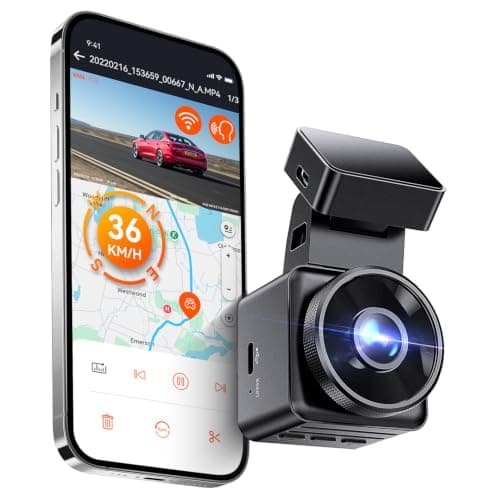
What a dash cam subscription actually buys
The fear in this search term is of a camera that stops working, or holds your footage hostage, unless you keep paying. That is not what happens, and it is worth being exact about what does.
Every function that makes a dash cam a dash cam runs on the camera:
- Loop recording. Writes to the card and overwrites the oldest files. Local
- Impact detection and file locking. A G-sensor marks a file so the loop cannot overwrite it. Local
- Parking mode. Motion or impact triggered recording while parked. Local, and it needs power rather than a plan — the battery arithmetic is here
- GPS speed and location stamping. From the camera's own receiver. Local
- Getting footage off it. Pull the card, or connect over the camera's own Wi-Fi to its app. Local, and free on all of them
What a subscription adds, on the cameras that offer one, is the cloud: footage uploaded automatically so you can see it from somewhere else, and in some cases a notification when the car is hit while you are not in it. That is a genuine feature. It is also the one thing on the list most owners discover they never use.
Which makers have a cloud service at all
This is the whole decision, and it is simpler than the search results suggest.
| Camera | Maker's cloud service | Subscription possible? | List price |
|---|---|---|---|
| Vantrue E1 | None | No — nothing to subscribe to | $89.99 |
| VIOFO A119 Mini 2 | None | No — nothing to subscribe to | $159.99 |
| ROVE R2-4K | None | No — nothing to subscribe to | $119.99 |
| REDTIGER F7N | None | No — nothing to subscribe to | $109.99 |
| Garmin Dash Cam 57 | Garmin Vault | Yes, for automatic cloud upload | $229.99 |
The separate category to watch for is the LTE-connected camera, which has a SIM in it. Those need a data plan to do the thing they exist for, and that is a recurring cost by design rather than an upsell. None of the cameras on this page is one.
Who each one is for
- Vantrue E1 — a car that parks outside, on a budget. A published 70 C ceiling, a supercapacitor rather than a lithium cell, GPS, under $100 list. Skip it if you want a rear channel, because it is front only
- VIOFO A119 Mini 2 — the best camera here, and no cloud at all. 65 C published, supercapacitor, and VIOFO's app over the camera's own Wi-Fi with no account to create. Skip it if the budget is under a hundred dollars
- ROVE R2-4K — the familiar name, no service behind it. Widely sold, 4K, app over Wi-Fi. Skip it if a published heat ceiling matters to you, because ROVE does not publish one
- REDTIGER F7N — front and rear with no plan. A two-channel set for a three-figure price and no cloud service in existence. Skip it if you park in extreme heat, because no operating ceiling is published
- Garmin Dash Cam 57 — the one with a plan available. On the page as the illustration. See the skip note
The recurring cost that is real
Here is the cost nobody puts on a comparison table: the memory card. A dash cam writes continuously, every drive, for years, which is the one workload that wears flash memory out.
That is not a subscription but it is a replacement cycle, and it is the thing that will actually cost you money over a camera's life. The gap between card types is enormous — the two mainstream endurance cards publish 70,080 rated hours against 10,000 — and a general-purpose card from a camera bag will fail long before the dash cam does, usually silently.
The full arithmetic, and which card to buy, is on best SD cards for dash cams. If you buy one thing after the camera, buy that.
Getting footage off a camera with no cloud
This is the practical worry behind the search, so here is the answer. Every camera here has Wi-Fi and an app. You park, open the app, the phone joins the camera's own network, and you download the clip you want. No account, no upload, no fee.
For anything that matters — an insurance claim, a police report — you will be copying the original file off the card to a computer anyway, because a re-encoded phone download is a worse piece of evidence than the original. That is the correct procedure whether or not a cloud exists, and it is covered step by step in how to save dash cam footage.
What else to ignore while you are at it
A subscription is one of several things sold as essential on a dash cam that is not. The full list, with what each one actually does, is in dash cam features you actually need.
The two that matter instead are the published heat ceiling, because a hot windshield is what kills these devices, and whether parking mode needs a hardwire kit. Those are covered in best dash cams for hot weather and best dash cams with parking mode. And if you are still deciding whether to buy one at all, are dash cams worth it is the honest version.
Every pick, with the working
Each entry lists the specifications the maker publishes, the axis scores those specifications produce, and what you give up. Rows that read “Not published” are not omissions on our side: they are things the maker will not commit to in writing, and they cost the product points on the transparency axis. Specifications compiled September 4, 2026.
Our pickThe best heat rating under $100
Vantrue E1
Vantrue publishes an operating range of -20 C to 70 C on this camera, which is the highest ceiling of anything here and 10 C above what the same company publishes for its own 4K model. It is a supercapacitor camera with GPS and a 2.7K sensor at a two-figure list price, which is an unusual combination, and it is the pick if your car sits in a sun-baked lot all day.
- Front resolution
- 2592 x 1944
- Alternate mode
- 1920 x 1080 at 60fps
- Power store
- Supercapacitor
- Operating range
- -20 C to 70 C (-4 F to 158 F)
- Max microSD
- 512 GB
- GPS
- Built in
- Wi-Fi
- Built in, app control
- Parking mode
- 24-hour, buffered motion detection
- Field of view
- Not published
- Published current draw
- Not published
List price $89.99 per Vantrue's own store, sale price (regular $129.99), captured on the compile date below. Not a live price and not what you will pay — the button is where the real number is.
What it gets right
- 70 C published ceiling — the highest of any camera in this ledger, and 10 C above Vantrue's own E1 Pro
- Supercapacitor rather than a lithium cell, which is the part that swells and dies in a hot cabin
- GPS and voice control at a list price under $100
- Takes a 512GB card, so a big endurance card will not be wasted on it
Flaws
- 2592x1944 is not 4K, and the marketing calls it 2.7K, which is a stretch of the usual naming
- Front only. A rear channel means a different camera
- Parking mode needs a hardwire kit that is not in the box
The working behind the 7.6
- Heat headroom: 10.0 (weight 22%)
- Published operating ceiling 70 C (158 F). A car parked in summer sun runs roughly 60-70 C inside, so 65 C and up is real headroom, 60 C is living at the limit, and anything under 55 C is a summer problem waiting to happen.
- Install effort: 6.0 (weight 24%)
- Adhesive pad onto the dashboard. Permanent in practice: repositioning means a new pad, and the pad is the part that fails first.
- Price against the ceiling: 7.0 (weight 24%)
- Listed at $89.99 on the compile date. This site's buyer has a practical ceiling around $150 for a single upgrade, so the scale rewards everything under $100 and falls away sharply past $150. The live price is very often different, and that is what the button is for.
- Written commitment: 7.0 (weight 15%)
- 18-month warranty. This is the only promise in the entire listing that a court would read, which is why it is scored and the marketing copy is not.
- Spec transparency: 8.0 (weight 15%)
- 8 of the 10 specifications we went looking for are published by the maker (80%). A blank row is never a guess here: it prints “Not published” and it costs the product points, because a figure nobody will commit to in writing is a figure you cannot check.
Axes with no published input are dropped and the remaining weights re-normalized, so a product is not punished for a category where an axis does not apply. Specifications compiled September 4, 2026 from Vantrue's E1 product page.
2The one to buy if you only buy one
VIOFO A119 Mini 2
A Sony STARVIS 2 IMX675 sensor at 2K 60fps, a supercapacitor, a published 65 C ceiling, an 18-month warranty and three named parking modes including buffered recording. VIOFO publishes more about this camera than anyone else here publishes about anything, and that is the reason it wins: every claim on the page is one you can check.
- Front resolution
- 2560 x 1440 at 60fps
- Image sensor
- Sony STARVIS 2 IMX675, 5MP
- Field of view
- 140 degrees
- Aperture
- f/1.6
- Power store
- Supercapacitor, no battery
- Operating range
- -20 C to 65 C (-4 F to 149 F)
- Storage temperature
- -20 C to 70 C
- Max microSD
- 512 GB
- Wi-Fi
- 2.4 GHz and 5 GHz
- Parking modes
- Auto event detection, time lapse, low bitrate
- Dimensions
- 1.81 x 1.77 x 2.94 in
- Published current draw
- Not published
List price $159.99 per VIOFO's own store, captured on the compile date below. Not a live price and not what you will pay — the button is where the real number is.
What it gets right
- Sony STARVIS 2 IMX675 with an f/1.6 lens — the best published low-light hardware in this ledger
- 2K at 60fps, which reads plates on moving cars better than 4K at 30fps does
- Published 65 C ceiling and a supercapacitor, so summer is designed for rather than hoped about
- Three named parking modes, including buffered recording that keeps the seconds before a trigger
- 18-month warranty, longer than most of this category
Flaws
- Front only, and adding the rear camera means a different model entirely
- The list price is well above the sub-$100 bracket most people start in
- Parking mode needs the HK4 hardwire kit, which is a separate purchase and a separate afternoon
The working behind the 6.7
- Heat headroom: 9.0 (weight 22%)
- Published operating ceiling 65 C (149 F). A car parked in summer sun runs roughly 60-70 C inside, so 65 C and up is real headroom, 60 C is living at the limit, and anything under 55 C is a summer problem waiting to happen.
- Install effort: 6.0 (weight 24%)
- Adhesive pad onto the dashboard. Permanent in practice: repositioning means a new pad, and the pad is the part that fails first.
- Price against the ceiling: 3.5 (weight 24%)
- Listed at $159.99 on the compile date. This site's buyer has a practical ceiling around $150 for a single upgrade, so the scale rewards everything under $100 and falls away sharply past $150. The live price is very often different, and that is what the button is for.
- Written commitment: 7.0 (weight 15%)
- 18-month warranty. This is the only promise in the entire listing that a court would read, which is why it is scored and the marketing copy is not.
- Spec transparency: 9.2 (weight 15%)
- 11 of the 12 specifications we went looking for are published by the maker (92%). A blank row is never a guess here: it prints “Not published” and it costs the product points, because a figure nobody will commit to in writing is a figure you cannot check.
Axes with no published input are dropped and the remaining weights re-normalized, so a product is not punished for a category where an axis does not apply. Specifications compiled September 4, 2026 from VIOFO's A119 Mini 2 product page.
3Front and rear with the hardwire kit in the box
REDTIGER F7N
The only camera here that ships the hardwire kit rather than selling it separately, which is worth more than it sounds: the kit is the thing that turns parking mode from a spec-sheet feature into a working one, and buying it later costs both money and a second afternoon. Front 4K plus a 1080p rear, and the storage cap is 256GB rather than 512GB.
- Front resolution
- 3840 x 2160 (4K UHD)
- Rear resolution
- 1920 x 1080
- Front field of view
- 170 degrees
- Rear field of view
- 140 degrees
- Max microSD
- 256 GB
- GPS
- Built in
- Wi-Fi
- 5.8 GHz
- Hardwire kit
- Included in the box
- Operating range
- Not published
- Power store
- Not published
List price $109.99 per REDTIGER's own store, sale price (regular $139.99), captured on the compile date below. Not a live price and not what you will pay — the button is where the real number is.
What it gets right
- Hardwire kit included, so parking mode works without a second purchase
- Front and rear in one box, with a 170-degree front lens
- STARVIS 2 sensor and 5.8GHz Wi-Fi at a list price under $150
- Screen on the body, which makes aiming the camera a two-minute job rather than a phone-app job
Flaws
- 256GB storage cap, half what most of this ledger accepts. Two channels fill a card twice as fast, so this is the wrong way round
- No published operating-temperature range
- The rear camera is 1080p, so it is evidence of an impact rather than a plate reader
The working behind the 6.3
- Heat headroom: not scored (weight 22%)
- The maker publishes no operating-temperature ceiling, so this axis is dropped and the other weights are re-normalized.
- Install effort: 6.0 (weight 24%)
- Adhesive pad onto the dashboard. Permanent in practice: repositioning means a new pad, and the pad is the part that fails first.
- Price against the ceiling: 6.0 (weight 24%)
- Listed at $109.99 on the compile date. This site's buyer has a practical ceiling around $150 for a single upgrade, so the scale rewards everything under $100 and falls away sharply past $150. The live price is very often different, and that is what the button is for.
- Written commitment: 5.5 (weight 15%)
- 12-month warranty. This is the only promise in the entire listing that a court would read, which is why it is scored and the marketing copy is not.
- Spec transparency: 8.0 (weight 15%)
- 8 of the 10 specifications we went looking for are published by the maker (80%). A blank row is never a guess here: it prints “Not published” and it costs the product points, because a figure nobody will commit to in writing is a figure you cannot check.
Axes with no published input are dropped and the remaining weights re-normalized, so a product is not punished for a category where an axis does not apply. Specifications compiled September 4, 2026 from REDTIGER's F7N series page.
4The most sensor for the money
ROVE R2-4K
Skip this one. If you are buying this specifically because it is a supercapacitor camera and you park in the sun, note that ROVE publishes no temperature ceiling at all. The Vantrue E1 publishes 70 C for less money.
4K, a 150-degree lens, an f/1.5 aperture and a supercapacitor at a list price close to $100. On paper it is the most camera per dollar in this ledger. What ROVE does not publish is an operating-temperature range, and on a camera whose whole selling point is that it uses a supercapacitor for heat tolerance, that omission is strange enough to cost it the top spot.
- Front resolution
- 3840 x 2160 (4K UHD)
- Field of view
- 150 degrees
- Aperture
- f/1.5
- Power store
- Supercapacitor
- Max microSD
- 512 GB
- GPS
- Built in
- Wi-Fi
- Dual band
- Parking mode
- 24-hour parking mode
- Operating range
- Not published
- Published current draw
- Not published
List price $119.99 per ROVE's own store, captured on the compile date below. Not a live price and not what you will pay — the button is where the real number is.
What it gets right
- 4K UHD with a 150-degree lens and an f/1.5 aperture, all published
- Supercapacitor rather than a lithium cell
- Dual-band Wi-Fi and GPS included at this price
- Takes a 512GB card
Flaws
- No published operating-temperature range, which is the one number a supercapacitor camera should be shouting about
- 4K on a small sensor is not automatically better than 2K on a good one; the bitrate matters more than the pixel count
- Parking mode needs a hardwire kit
The working behind the 6.3
- Heat headroom: not scored (weight 22%)
- The maker publishes no operating-temperature ceiling, so this axis is dropped and the other weights are re-normalized.
- Install effort: 6.0 (weight 24%)
- Adhesive pad onto the dashboard. Permanent in practice: repositioning means a new pad, and the pad is the part that fails first.
- Price against the ceiling: 6.0 (weight 24%)
- Listed at $119.99 on the compile date. This site's buyer has a practical ceiling around $150 for a single upgrade, so the scale rewards everything under $100 and falls away sharply past $150. The live price is very often different, and that is what the button is for.
- Written commitment: 5.5 (weight 15%)
- 12-month warranty. This is the only promise in the entire listing that a court would read, which is why it is scored and the marketing copy is not.
- Spec transparency: 8.0 (weight 15%)
- 8 of the 10 specifications we went looking for are published by the maker (80%). A blank row is never a guess here: it prints “Not published” and it costs the product points, because a figure nobody will commit to in writing is a figure you cannot check.
Axes with no published input are dropped and the remaining weights re-normalized, so a product is not punished for a category where an axis does not apply. Specifications compiled September 4, 2026 from ROVE's R2-4K product page.
5A discontinued camera worth knowing about
Garmin Dash Cam 57
Skip this one. Not a bad camera — it is a good one, and it is on this page as the illustration rather than the villain. But it is the only pick here with a cloud service behind a paid plan: Garmin's own manual states that automatic upload to the Vault requires an active Vault subscription. If a recurring fee is the thing you are avoiding, buy a camera whose maker runs no cloud service at all.
1440p, a 140-degree lens and a published operating range of -20 C to 60 C from Garmin's own owner's manual, which is more than most makers publish. It has also been discontinued, and that changes the calculation completely: remaining stock is real, and so is the fact that a discontinued camera's firmware support has a horizon.
- Front resolution
- 2560 x 1440 (1440p)
- Field of view
- 140 degrees
- Operating range
- -20 C to 60 C (-4 F to 140 F)
- Charging range
- 0 C to 45 C (32 F to 113 F)
- Input voltage
- 4.75 to 5.25 Vdc, 1 A
- Wireless
- 2.4 GHz at 16 dBm maximum
- Parking mode
- Parking Guard, via the Garmin Drive app
- Availability
- Discontinued
- Power store
- Not published
- Published current draw
- Not published
List price $229.99 per Garmin's listed price before discontinuation, captured on the compile date below. Not a live price and not what you will pay — the button is where the real number is.
What it gets right
- Garmin publishes the operating range, charging range and input voltage in the owner's manual, which almost nobody in this category does
- 1440p at 140 degrees in a body the size of a matchbox
- Voice control and the Garmin Drive app ecosystem
Flaws
- Discontinued. Firmware support has a horizon even if nobody will tell you where it is
- 60 C ceiling — the lowest published figure in this ledger, and below what a car in summer sun actually reaches
- Remaining stock is priced as new stock rather than as run-out stock
The working behind the 5.7
- Heat headroom: 7.5 (weight 22%)
- Published operating ceiling 60 C (140 F). A car parked in summer sun runs roughly 60-70 C inside, so 65 C and up is real headroom, 60 C is living at the limit, and anything under 55 C is a summer problem waiting to happen.
- Install effort: 6.0 (weight 24%)
- Adhesive pad onto the dashboard. Permanent in practice: repositioning means a new pad, and the pad is the part that fails first.
- Price against the ceiling: 2.5 (weight 24%)
- Listed at $229.99 on the compile date. This site's buyer has a practical ceiling around $150 for a single upgrade, so the scale rewards everything under $100 and falls away sharply past $150. The live price is very often different, and that is what the button is for.
- Written commitment: 5.5 (weight 15%)
- 12-month warranty. This is the only promise in the entire listing that a court would read, which is why it is scored and the marketing copy is not.
- Spec transparency: 8.0 (weight 15%)
- 8 of the 10 specifications we went looking for are published by the maker (80%). A blank row is never a guess here: it prints “Not published” and it costs the product points, because a figure nobody will commit to in writing is a figure you cannot check.
Axes with no published input are dropped and the remaining weights re-normalized, so a product is not punished for a category where an axis does not apply. Specifications compiled September 4, 2026 from Garmin Dash Cam 47/57/67W owner's manual, specifications page.
Prices last verified October 7, 2026. They move constantly; the figure on Amazon when you click is the real one.
Questions people actually ask
Do dash cams require a subscription?
No. Recording, loop overwriting, impact detection, parking mode, GPS stamping and copying files off the card are local functions on every camera. A subscription, where one exists, buys automatic cloud upload. Vantrue, VIOFO, ROVE and REDTIGER do not run a cloud service at all, so there is nothing to subscribe to.
What does a Garmin Vault subscription do?
Garmin's manual states that the Vault feature requires an active Vault subscription, and that with a paid subscription the camera uploads saved videos automatically while connected to Wi-Fi. The camera records, locks files and stamps GPS without it. The subscription is for the automatic offsite copy.
Which dash cam brands have no cloud service?
Of the cameras in our ledger, Vantrue, VIOFO, ROVE and REDTIGER run no cloud service. Their apps connect directly to the camera's own Wi-Fi to download clips, with no account and no fee. The category to be careful with is the LTE-connected camera, which has a SIM and needs a data plan by design.
How do I get footage off a dash cam with no subscription?
Two ways, both free. Connect your phone to the camera's own Wi-Fi and download the clip in the maker's app, or take the card out and read it on a computer. For an insurance claim or a police report, use the card — the original file is better evidence than a re-encoded phone download.
What is the real ongoing cost of a dash cam?
The memory card. A dash cam writes continuously for years, which is the workload that wears flash out, and the gap between card types is large: the two mainstream endurance cards publish 70,080 rated hours against 10,000. A general-purpose card will fail long before the camera does, and usually without telling you.
Sources
- Garmin's Vault Storage manual page, stating that the feature requires an active Vault subscription
- Vantrue's published operating-temperature range and feature list for the E1
- VIOFO's A119 Mini 2 product page, which lists no cloud service or subscription
- ROVE's R2-4K product page, which lists no cloud service or subscription