The best dash cams with GPS
GPS turns footage into a record of where you were and how fast. That is the strongest thing a camera can give you, and occasionally the last thing you want.
By Sawyer V. · Published · How we research
We have not tested any of this. Everything below is compiled from published manufacturer specifications, and the arithmetic is printed so you can check it. This page carries affiliate links: if you buy through one we earn a commission at no extra cost to you, and it does not change the order of the picks. Full disclosure.
The short answer
Buy the Garmin Dash Cam 57 if you want GPS that is genuinely usable. The difference between cameras is not whether they have a GPS receiver — it is whether you can get the data back out in a form you can read. Garmin's player overlays speed and position on the video and exports it. Before you buy, understand the trade: a GPS log records your speed as well as everything else, and that record exists whether it helps you or not.
| # | Pick | Install | Score | Price |
|---|---|---|---|---|
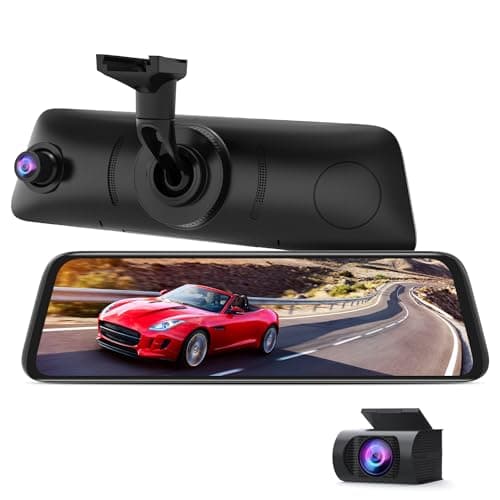
| 1 | AUTO-VOX V5PRO Mirror Dash Cam A car whose windshield is already crowded | Clips on | 8.3/10 | $209.99 - view on Amazon |
| 2 | Garmin Dash Cam 57 A discontinued camera worth knowing about | Adhesive | 5.7/10 | $259.50 - view on Amazon |
| 3 | VIOFO A119 V3 The older VIOFO that is still worth buying | Adhesive | 5.6/10 | $119.99 - view on Amazon |
| 4 | VIOFO A229 Plus 1CH A screen, voice control and room to add a rear camera | Adhesive | 5.5/10 | $189.99 - view on Amazon |
Prices last verified October 22, 2026. They move constantly; the figure on Amazon when you click is the real one.
What GPS actually adds to footage
Video shows what happened. GPS tells you where it happened, at what speed, and in which direction — three facts that video alone establishes only by inference.
In practice the useful cases are narrow but significant:
- Establishing your own speed. The most common dispute after a collision is how fast each party was going, and it is normally one person's word against another's
- Locating an incident precisely. “The junction after the bridge” becomes a coordinate
- Establishing a timeline across multiple clips. Loop recording splits footage into segments, and GPS timestamps tie them together
- Correcting the camera's clock. A GPS receiver sets the time automatically, which quietly solves the most common metadata problem in dash cam footage
The argument against, stated properly
A GPS log is a record of your speed at every moment it was running. If you were over the limit at the time of an incident — even if the incident was entirely someone else's fault — that fact is now recorded in your own camera.
We are not going to tell you what to do with that. It is a genuine trade-off and reasonable people land differently on it. What we will say is that it is rarely mentioned in reviews of GPS cameras, and it should be part of the decision rather than a surprise afterwards.
Most cameras let you disable GPS logging while keeping the camera. If you want the clock accuracy without the speed record, check whether your chosen model separates the two — many do not.
Having a receiver and having usable data are different things
This is the real differentiator and it is almost never in a spec table. The GPS data has to be written somewhere, and then you have to be able to read it.
Approaches vary. Some cameras burn the speed and coordinates directly into the video image as an overlay, which is simple and permanent but cannot be turned off after the fact. Some write a separate data track inside the video file. Some write a companion file alongside each clip, which is easy to lose if you copy only the video you care about.
| Camera | GPS | Data usable how | Heat ceiling |
|---|---|---|---|
| Garmin Dash Cam 57 | Built in | Garmin player overlays and exports | Published |
| VIOFO A119 V3 | Module included | VIOFO player, separate track | Published |
| VIOFO A229 Plus | Built in | VIOFO player | 65 C |
| AUTO-VOX V5PRO | Listed | Not published | Not published |
The practical lesson: copy the entire card, not just the video file you want. Companion GPS files are exactly the thing people leave behind, and once the card is overwritten they are gone. The full method is in how to save dash cam footage.
Built in versus a module
Some cameras include the receiver in the body; others put it in the mount or supply it as a separate module on a cable. VIOFO's approach on several models is a GPS-equipped mount, which has one real advantage and one real cost.
The advantage is that the receiver sits at the top of the windshield with a clear view of the sky, which is where GPS reception is best. The cost is that it is another part to lose, and replacing a broken GPS mount is a specific purchase rather than a generic one.
Reception itself is worth a thought. Metallic windshield coatings — common on cars with heated windshields or infrared-reflective glass — attenuate GPS signals noticeably, which is why some vehicles have a marked uncoated patch behind the mirror. If your camera struggles to get a fix, that patch is where the receiver wants to be.
Where the data goes, and where it does not
A dash cam GPS log lives on the memory card in your car. It is not uploaded anywhere, it is not shared with anyone, and nobody can query it remotely. This is worth stating because people conflate it with connected vehicle telematics, which is an entirely different thing.
The corollary is that the card is the whole record. If the camera is stolen the data goes with it, and if the card fails there was never anything anywhere else. That is another argument for a high-endurance card, covered in best microSD cards for a dash cam.
For the wider question of what is and is not legal to record — including audio, which varies considerably by state — see are dash cams legal.
Is it worth paying for
If you are choosing between two otherwise similar cameras and one has GPS, take the GPS model — the automatic clock setting alone is worth it, and the speed record is genuinely useful more often than not.
If GPS means stepping up a price tier, weigh it against the specifications that decide whether footage exists at all: the published heat ceiling, a supercapacitor rather than a battery, and a card large enough to reach back to yesterday. Those come first. GPS is a feature of good footage, not a substitute for it — dash cam features you actually need puts the whole list in order.
Every pick, with the working
Each entry lists the specifications the maker publishes, the axis scores those specifications produce, and what you give up. Rows that read “Not published” are not omissions on our side: they are things the maker will not commit to in writing, and they cost the product points on the transparency axis. Specifications compiled September 4, 2026.
Our pickA car whose windshield is already crowded
AUTO-VOX V5PRO Mirror Dash Cam
Skip this one. It lists GPS among its features and publishes nothing about how the data is stored or exported, which on this specific feature is the part that matters. A GPS log you cannot get out of the camera in a readable form is a checkbox rather than a capability.
A 9.35 inch laminated touchscreen that replaces the rear view mirror, recording front and rear while doubling as a backup camera display. It publishes the sensor — a Sony IMX307 STARVIS — which is the one specification that tells you how it behaves at night.
- Screen
- 9.35 in full-laminated touchscreen
- Front recording
- 1080p at 30 fps
- Rear recording
- 1080p at 25 fps
- Sensor
- Sony IMX307 STARVIS CMOS
- Aperture
- F/1.8
- Field of view
- 145 degrees front, 150 degrees rear
- Card support
- Class 10 microSD up to 64 GB
- Other
- GPS, G-sensor, parking mode
- Operating temperature
- Not published
- Warranty
- Not published
- List price
- Not published
What it gets right
- Publishes the actual image sensor (Sony IMX307 STARVIS) and aperture (F/1.8), which most mirror cams do not
- Full-laminated screen specifically to kill the glare that ruins cheaper mirror units in daylight
- Occupies the mirror position, so nothing new is stuck to the windshield
- The rear camera doubles as a live backup display — a real second function, unlike a normal dash cam rear channel
Flaws
- Card support is stated at Class 10 up to 64 GB, which is small for two channels and shortens your footage window considerably
- It replaces your mirror. If the screen fails you have lost a mirror as well as a camera
- No published operating-temperature ceiling, on a device that sits in the hottest part of the cabin
- Rear channel is 1080p at 25 fps rather than 30
The working behind the 8.3
- Heat headroom: not scored (weight 22%)
- The maker publishes no operating-temperature ceiling, so this axis is dropped and the other weights are re-normalized.
- Install effort: 9.0 (weight 24%)
- Clips onto a vent blade or a headrest post. Two minutes, no tools, no adhesive, no residue.
- Price against the ceiling: not scored (weight 24%)
- No published list price we could cite on the compile date, so this axis is dropped and the other weights are re-normalized.
- Written commitment: not scored (weight 15%)
- No warranty term published, so this axis is dropped and the other weights are re-normalized.
- Spec transparency: 7.3 (weight 15%)
- 8 of the 11 specifications we went looking for are published by the maker (73%). A blank row is never a guess here: it prints “Not published” and it costs the product points, because a figure nobody will commit to in writing is a figure you cannot check.
Axes with no published input are dropped and the remaining weights re-normalized, so a product is not punished for a category where an axis does not apply. Specifications compiled September 4, 2026 from AUTO-VOX V5PRO published specifications.
2A discontinued camera worth knowing about
Garmin Dash Cam 57
Skip this one. This is a discontinued product with the lowest published heat ceiling here. Unless you find it heavily discounted, the Garmin Dash Cam X110 is the current camera and the Vantrue E1 has 10 C more headroom for half the money.
1440p, a 140-degree lens and a published operating range of -20 C to 60 C from Garmin's own owner's manual, which is more than most makers publish. It has also been discontinued, and that changes the calculation completely: remaining stock is real, and so is the fact that a discontinued camera's firmware support has a horizon.
- Front resolution
- 2560 x 1440 (1440p)
- Field of view
- 140 degrees
- Operating range
- -20 C to 60 C (-4 F to 140 F)
- Charging range
- 0 C to 45 C (32 F to 113 F)
- Input voltage
- 4.75 to 5.25 Vdc, 1 A
- Wireless
- 2.4 GHz at 16 dBm maximum
- Parking mode
- Parking Guard, via the Garmin Drive app
- Availability
- Discontinued
- Power store
- Not published
- Published current draw
- Not published
List price $229.99 per Garmin's listed price before discontinuation, captured on the compile date below. Not a live price and not what you will pay — the button is where the real number is.
What it gets right
- Garmin publishes the operating range, charging range and input voltage in the owner's manual, which almost nobody in this category does
- 1440p at 140 degrees in a body the size of a matchbox
- Voice control and the Garmin Drive app ecosystem
Flaws
- Discontinued. Firmware support has a horizon even if nobody will tell you where it is
- 60 C ceiling — the lowest published figure in this ledger, and below what a car in summer sun actually reaches
- Remaining stock is priced as new stock rather than as run-out stock
The working behind the 5.7
- Heat headroom: 7.5 (weight 22%)
- Published operating ceiling 60 C (140 F). A car parked in summer sun runs roughly 60-70 C inside, so 65 C and up is real headroom, 60 C is living at the limit, and anything under 55 C is a summer problem waiting to happen.
- Install effort: 6.0 (weight 24%)
- Adhesive pad onto the dashboard. Permanent in practice: repositioning means a new pad, and the pad is the part that fails first.
- Price against the ceiling: 2.5 (weight 24%)
- Listed at $229.99 on the compile date. This site's buyer has a practical ceiling around $150 for a single upgrade, so the scale rewards everything under $100 and falls away sharply past $150. The live price is very often different, and that is what the button is for.
- Written commitment: 5.5 (weight 15%)
- 12-month warranty. This is the only promise in the entire listing that a court would read, which is why it is scored and the marketing copy is not.
- Spec transparency: 8.0 (weight 15%)
- 8 of the 10 specifications we went looking for are published by the maker (80%). A blank row is never a guess here: it prints “Not published” and it costs the product points, because a figure nobody will commit to in writing is a figure you cannot check.
Axes with no published input are dropped and the remaining weights re-normalized, so a product is not punished for a category where an axis does not apply. Specifications compiled September 4, 2026 from Garmin Dash Cam 47/57/67W owner's manual, specifications page.
3The older VIOFO that is still worth buying
VIOFO A119 V3
The generation before the Mini 2, still sold, still supported, and cheaper. It records 2560x1600 at 30fps rather than 2560x1440 at 60fps, which is more vertical pixels and half the temporal resolution. For a commuter that trade is usually the wrong way round, but the price difference is real and this camera has been in the field long enough that its firmware is settled.
- Front resolution
- 2560 x 1600 at 30fps
- GPS
- Built in
- Parking mode
- Supported with hardwire kit
- Operating range
- Not published
- Power store
- Not published
- Max microSD
- Not published
- Field of view
- Not published
List price $139.99 per VIOFO's own store, captured on the compile date below. Not a live price and not what you will pay — the button is where the real number is.
What it gets right
- Cheapest way onto VIOFO's parking-mode and hardwire ecosystem
- 2560x1600 gives more vertical coverage than a 16:9 2K sensor
- Long enough in the market that the firmware quirks are known and fixed
Flaws
- 30fps, so fast-moving plates smear in a way the 60fps cameras do not
- Older sensor generation than the STARVIS 2 cameras above it
- VIOFO does not publish an operating-temperature range for this model
The working behind the 5.6
- Heat headroom: not scored (weight 22%)
- The maker publishes no operating-temperature ceiling, so this axis is dropped and the other weights are re-normalized.
- Install effort: 6.0 (weight 24%)
- Adhesive pad onto the dashboard. Permanent in practice: repositioning means a new pad, and the pad is the part that fails first.
- Price against the ceiling: 5.0 (weight 24%)
- Listed at $139.99 on the compile date. This site's buyer has a practical ceiling around $150 for a single upgrade, so the scale rewards everything under $100 and falls away sharply past $150. The live price is very often different, and that is what the button is for.
- Written commitment: 7.0 (weight 15%)
- 18-month warranty. This is the only promise in the entire listing that a court would read, which is why it is scored and the marketing copy is not.
- Spec transparency: 4.3 (weight 15%)
- 3 of the 7 specifications we went looking for are published by the maker (43%). A blank row is never a guess here: it prints “Not published” and it costs the product points, because a figure nobody will commit to in writing is a figure you cannot check.
Axes with no published input are dropped and the remaining weights re-normalized, so a product is not punished for a category where an axis does not apply. Specifications compiled September 4, 2026 from VIOFO's 1-channel range page.
4A screen, voice control and room to add a rear camera
VIOFO A229 Plus 1CH
The same STARVIS 2 IMX675 sensor as the Mini 2 in a body with a screen, voice control and the option to add rear and interior channels later. You are paying roughly $40 over the Mini 2 for a display and an upgrade path, which is worth it if you expect to want a rear camera and not if you do not.
- Front resolution
- 2K HDR
- Image sensor
- Sony STARVIS 2 IMX675
- GPS
- Built in
- Voice control
- Yes
- Expandable
- Rear and interior channels available
- Operating range
- Not published
- Max microSD
- Not published
- Field of view
- Not published
List price $199.99 per VIOFO's own store, captured on the compile date below. Not a live price and not what you will pay — the button is where the real number is.
What it gets right
- Same STARVIS 2 IMX675 sensor as the Mini 2
- Screen on the body, so aiming and reviewing does not need the phone app
- Expandable to two and three channels without buying a whole new camera
- Voice control, which is the only genuinely safe way to lock a clip while moving
Flaws
- $200 list is well past this site's usual ceiling for a single upgrade
- A screen in the windshield is a screen in your eyeline; the Mini 2 hides behind the mirror
- Same hardwire requirement for parking mode as every other VIOFO
The working behind the 5.5
- Heat headroom: not scored (weight 22%)
- The maker publishes no operating-temperature ceiling, so this axis is dropped and the other weights are re-normalized.
- Install effort: 6.0 (weight 24%)
- Adhesive pad onto the dashboard. Permanent in practice: repositioning means a new pad, and the pad is the part that fails first.
- Price against the ceiling: 3.5 (weight 24%)
- Listed at $199.99 on the compile date. This site's buyer has a practical ceiling around $150 for a single upgrade, so the scale rewards everything under $100 and falls away sharply past $150. The live price is very often different, and that is what the button is for.
- Written commitment: 7.0 (weight 15%)
- 18-month warranty. This is the only promise in the entire listing that a court would read, which is why it is scored and the marketing copy is not.
- Spec transparency: 6.3 (weight 15%)
- 5 of the 8 specifications we went looking for are published by the maker (63%). A blank row is never a guess here: it prints “Not published” and it costs the product points, because a figure nobody will commit to in writing is a figure you cannot check.
Axes with no published input are dropped and the remaining weights re-normalized, so a product is not punished for a category where an axis does not apply. Specifications compiled September 4, 2026 from VIOFO's 1-channel range page.
Prices last verified October 22, 2026. They move constantly; the figure on Amazon when you click is the real one.
Questions people actually ask
Does dash cam GPS drain my battery?
The receiver draws a small amount on top of the camera's own consumption, which is already modest — published parking-mode figures for dash cams sit around 0.25 to 0.35 A. GPS is not the reason a camera flattens a battery.
Can I turn GPS off?
On most cameras yes, in settings. Check whether your model can disable speed logging while keeping the automatic clock setting — many treat them as a single switch.
Why won't my dash cam get a GPS fix?
Usually windshield coating. Heated and infrared-reflective windshields attenuate GPS signals, and many such cars have a marked uncoated patch behind the mirror specifically for receivers. Move the module there.
Is my GPS data uploaded anywhere?
No. It is written to the memory card in the camera and stays there. That is different from connected vehicle telematics, which is a manufacturer service and a separate thing entirely.