The best dash cams with parking mode
Parking mode is the feature most often advertised and least often working, because it needs a hardwire kit almost nobody buys. Five cameras ranked on which modes they name, and what the kit actually costs you.
By Sawyer V. · Published · How we research
We have not tested any of this. Everything below is compiled from published manufacturer specifications, and the arithmetic is printed so you can check it. This page carries affiliate links: if you buy through one we earn a commission at no extra cost to you, and it does not change the order of the picks. Full disclosure.
The short answer
The VIOFO A119 Mini 2 plus the HK4 hardwire kit is the combination to buy. VIOFO names three distinct parking modes — auto event detection, time lapse and low bitrate — and the HK4 has a selectable low-voltage cutoff at 11.8, 12.0, 12.2 or 12.4 volts, which is what stands between overnight recording and a car that will not start. If you want parking mode without an afternoon under the dash, the REDTIGER F7N ships its hardwire kit in the box.
| # | Pick | Install | Score | Price |
|---|---|---|---|---|
| 1 | Vantrue E1 The best heat rating under $100 | Adhesive | 7.6/10 | $99.99 - view on Amazon |
| 2 | VIOFO A119 Mini 2 The one to buy if you only buy one | Adhesive | 6.7/10 | $129.99 - view on Amazon |
| 3 | Vantrue N4 Three channels, including the cabin | Adhesive | 6.6/10 | Check price on Amazon |
| 4 | REDTIGER F7N Front and rear with the hardwire kit in the box | Adhesive | 6.3/10 | $99.99 - view on Amazon |
| 5 | VIOFO HK4 hardwire kit Turning parking mode from a feature into a working thing | Hardwire | 5.3/10 | $25.99 - view on Amazon |
Prices last verified October 19, 2026. They move constantly; the figure on Amazon when you click is the real one.
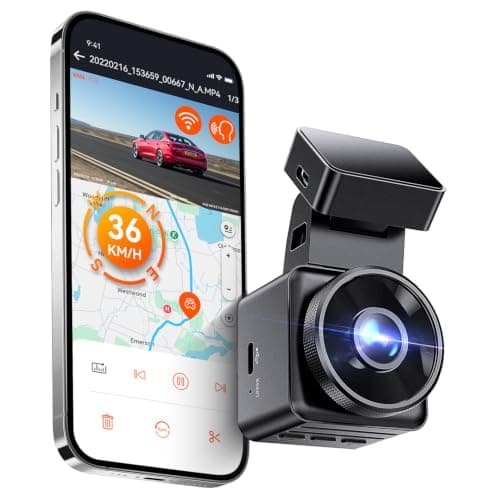
Parking mode is three features sharing one name
When a listing says “24-hour parking mode”, it can mean any of three things. They behave differently, they draw very different amounts of power, and only one of them reliably captures the thing you actually want.
- Motion or impact triggered. The camera idles in a low-power state and wakes when the G-sensor fires or something moves in frame. Lowest draw. Its flaw is that waking takes time, so a clip that starts at the trigger misses the approach.
- Buffered recording. The camera keeps a rolling few seconds in memory and prepends them when a trigger fires, so the saved clip includes the car reversing into you rather than starting at the bang. This is the one worth having and it is worth checking for by name.
- Time lapse. A frame every second or so, continuously, for the whole parking period. Nothing is missed and nothing is detailed: enough for a plate at a hit-and-run, not enough for anything subtle. Highest storage cost.
A camera that names its modes is telling you something. A camera that says “parking mode supported” and nothing more is telling you something too.
The hardwire kit is the real product
Your 12V socket stops supplying power when the ignition goes off. That is the whole problem: every parking mode needs power with the car switched off, and the socket does not provide it in most cars.
A hardwire kit takes power from a permanently-live fuse in the fuse box, takes a second signal from an ignition-switched fuse so the camera knows the engine is off, and — this is the part that matters — cuts itself off when the battery drops below a set voltage.
VIOFO's HK4 offers four cutoff settings on a 12V system: 11.8, 12.0, 12.2 and 12.4 volts. VIOFO also documents roughly 0.3 V of tolerance in the detection, and recommends the highest setting as the safest choice. Both of those facts should push you toward 12.4 unless you have a specific reason not to.
What it actually costs your battery
Published parking-mode draw figures sit around 0.25 to 0.35 amps for the cameras that publish them at all, and your car's own electronics add another 0.03 to 0.05 A on top. On a 50 Ah battery with roughly 15 Ah of genuinely usable capacity before cranking becomes doubtful, that is somewhere around 40 hours in mild weather.
Cold changes it substantially, and not by a little. The whole calculation, with the sources for every figure, is on the parking-mode battery page — it is the page this section is built around and it is worth reading before you buy anything here.
Do you actually need parking mode?
Honestly: many people do not, and this page would rather say so than sell you a hardwire kit. The question is what happens where your car sits when you are not in it.
- Street parking, or a shared apartment lot. Yes. This is the case parking mode exists for, and door dings and hit-and-runs are exactly what it catches.
- An open office lot during the day. Probably. Reversing incidents in workplace lots are common and rarely admitted.
- A private garage overnight and the same office lot every day. Marginal. You are wiring the car for a risk that is already low.
- A garage, always. No. Save the money and the afternoon.
Parking mode records what happened to a car that is still there. If the car itself is the thing you are worried about losing, that is a different device with a different failure mode, and most of what is sold for the job has no GPS receiver in it at all best car trackers.
The alternative nobody mentions
You can power a dash cam in parking mode from a dedicated auxiliary battery pack rather than the car's own battery. It removes the drain question entirely, it is more expensive than a hardwire kit, and it needs charging or its own wiring anyway.
We have not ranked one here because the field is thin and the published specifications are thinner. It is worth knowing the option exists if the car in question has a battery you do not trust, and it is the honest answer to “what if I do not want to touch the fuse box at all”.
Every pick, with the working
Each entry lists the specifications the maker publishes, the axis scores those specifications produce, and what you give up. Rows that read “Not published” are not omissions on our side: they are things the maker will not commit to in writing, and they cost the product points on the transparency axis. Specifications compiled September 4, 2026.
Our pickThe best heat rating under $100
Vantrue E1
Vantrue publishes an operating range of -20 C to 70 C on this camera, which is the highest ceiling of anything here and 10 C above what the same company publishes for its own 4K model. It is a supercapacitor camera with GPS and a 2.7K sensor at a two-figure list price, which is an unusual combination, and it is the pick if your car sits in a sun-baked lot all day.
- Front resolution
- 2592 x 1944
- Alternate mode
- 1920 x 1080 at 60fps
- Power store
- Supercapacitor
- Operating range
- -20 C to 70 C (-4 F to 158 F)
- Max microSD
- 512 GB
- GPS
- Built in
- Wi-Fi
- Built in, app control
- Parking mode
- 24-hour, buffered motion detection
- Field of view
- Not published
- Published current draw
- Not published
List price $89.99 per Vantrue's own store, sale price (regular $129.99), captured on the compile date below. Not a live price and not what you will pay — the button is where the real number is.
What it gets right
- 70 C published ceiling — the highest of any camera in this ledger, and 10 C above Vantrue's own E1 Pro
- Supercapacitor rather than a lithium cell, which is the part that swells and dies in a hot cabin
- GPS and voice control at a list price under $100
- Takes a 512GB card, so a big endurance card will not be wasted on it
Flaws
- 2592x1944 is not 4K, and the marketing calls it 2.7K, which is a stretch of the usual naming
- Front only. A rear channel means a different camera
- Parking mode needs a hardwire kit that is not in the box
The working behind the 7.6
- Heat headroom: 10.0 (weight 22%)
- Published operating ceiling 70 C (158 F). A car parked in summer sun runs roughly 60-70 C inside, so 65 C and up is real headroom, 60 C is living at the limit, and anything under 55 C is a summer problem waiting to happen.
- Install effort: 6.0 (weight 24%)
- Adhesive pad onto the dashboard. Permanent in practice: repositioning means a new pad, and the pad is the part that fails first.
- Price against the ceiling: 7.0 (weight 24%)
- Listed at $89.99 on the compile date. This site's buyer has a practical ceiling around $150 for a single upgrade, so the scale rewards everything under $100 and falls away sharply past $150. The live price is very often different, and that is what the button is for.
- Written commitment: 7.0 (weight 15%)
- 18-month warranty. This is the only promise in the entire listing that a court would read, which is why it is scored and the marketing copy is not.
- Spec transparency: 8.0 (weight 15%)
- 8 of the 10 specifications we went looking for are published by the maker (80%). A blank row is never a guess here: it prints “Not published” and it costs the product points, because a figure nobody will commit to in writing is a figure you cannot check.
Axes with no published input are dropped and the remaining weights re-normalized, so a product is not punished for a category where an axis does not apply. Specifications compiled September 4, 2026 from Vantrue's E1 product page.
2The one to buy if you only buy one
VIOFO A119 Mini 2
A Sony STARVIS 2 IMX675 sensor at 2K 60fps, a supercapacitor, a published 65 C ceiling, an 18-month warranty and three named parking modes including buffered recording. VIOFO publishes more about this camera than anyone else here publishes about anything, and that is the reason it wins: every claim on the page is one you can check.
- Front resolution
- 2560 x 1440 at 60fps
- Image sensor
- Sony STARVIS 2 IMX675, 5MP
- Field of view
- 140 degrees
- Aperture
- f/1.6
- Power store
- Supercapacitor, no battery
- Operating range
- -20 C to 65 C (-4 F to 149 F)
- Storage temperature
- -20 C to 70 C
- Max microSD
- 512 GB
- Wi-Fi
- 2.4 GHz and 5 GHz
- Parking modes
- Auto event detection, time lapse, low bitrate
- Dimensions
- 1.81 x 1.77 x 2.94 in
- Published current draw
- Not published
List price $159.99 per VIOFO's own store, captured on the compile date below. Not a live price and not what you will pay — the button is where the real number is.
What it gets right
- Sony STARVIS 2 IMX675 with an f/1.6 lens — the best published low-light hardware in this ledger
- 2K at 60fps, which reads plates on moving cars better than 4K at 30fps does
- Published 65 C ceiling and a supercapacitor, so summer is designed for rather than hoped about
- Three named parking modes, including buffered recording that keeps the seconds before a trigger
- 18-month warranty, longer than most of this category
Flaws
- Front only, and adding the rear camera means a different model entirely
- The list price is well above the sub-$100 bracket most people start in
- Parking mode needs the HK4 hardwire kit, which is a separate purchase and a separate afternoon
The working behind the 6.7
- Heat headroom: 9.0 (weight 22%)
- Published operating ceiling 65 C (149 F). A car parked in summer sun runs roughly 60-70 C inside, so 65 C and up is real headroom, 60 C is living at the limit, and anything under 55 C is a summer problem waiting to happen.
- Install effort: 6.0 (weight 24%)
- Adhesive pad onto the dashboard. Permanent in practice: repositioning means a new pad, and the pad is the part that fails first.
- Price against the ceiling: 3.5 (weight 24%)
- Listed at $159.99 on the compile date. This site's buyer has a practical ceiling around $150 for a single upgrade, so the scale rewards everything under $100 and falls away sharply past $150. The live price is very often different, and that is what the button is for.
- Written commitment: 7.0 (weight 15%)
- 18-month warranty. This is the only promise in the entire listing that a court would read, which is why it is scored and the marketing copy is not.
- Spec transparency: 9.2 (weight 15%)
- 11 of the 12 specifications we went looking for are published by the maker (92%). A blank row is never a guess here: it prints “Not published” and it costs the product points, because a figure nobody will commit to in writing is a figure you cannot check.
Axes with no published input are dropped and the remaining weights re-normalized, so a product is not punished for a category where an axis does not apply. Specifications compiled September 4, 2026 from VIOFO's A119 Mini 2 product page.
3Three channels, including the cabin
Vantrue N4
Skip this one. Three channels is three times the data and a cabin camera pointed at your passengers. For parking mode specifically that is a great deal of recording nobody will ever watch, and a privacy conversation you did not need to have. Buy it if you drive rideshare; skip it if you park at an office.
Front, cabin and rear on one camera with infrared night vision on the interior channel and the same 70 C published ceiling as the rest of Vantrue's supercapacitor line. It is the camera for somebody who drives for a living or carries passengers they do not know. For a plain commute it is two channels more than you need and $170 more than you need to spend.
- Channels
- Three: front, interior, rear
- Resolution
- 1440p + 1080p + 1080p at 30fps, or 4K front only
- Night vision
- Sony STARVIS with infrared on the cabin channel
- Power store
- Supercapacitor
- Operating range
- -10 C to 70 C (14 F to 158 F)
- Max microSD
- 512 GB
- Parking mode
- 24-hour, motion and collision detection
- GPS
- Supported
- Published current draw
- Not published
List price $259.99 per Vantrue's own store, captured on the compile date below. Not a live price and not what you will pay — the button is where the real number is.
What it gets right
- Three channels recording at once, with IR illumination on the cabin camera
- 70 C published ceiling and a supercapacitor
- 512GB card support, which three channels genuinely need
- 24-hour parking mode with motion and collision detection
Flaws
- $259.99 list is far outside this site's usual bracket
- Three channels fill a card fast, so the running cost is a bigger card sooner
- The interior camera is pointless for most private drivers and creates a privacy question for passengers
The working behind the 6.6
- Heat headroom: 10.0 (weight 22%)
- Published operating ceiling 70 C (158 F). A car parked in summer sun runs roughly 60-70 C inside, so 65 C and up is real headroom, 60 C is living at the limit, and anything under 55 C is a summer problem waiting to happen.
- Install effort: 6.0 (weight 24%)
- Adhesive pad onto the dashboard. Permanent in practice: repositioning means a new pad, and the pad is the part that fails first.
- Price against the ceiling: 2.5 (weight 24%)
- Listed at $259.99 on the compile date. This site's buyer has a practical ceiling around $150 for a single upgrade, so the scale rewards everything under $100 and falls away sharply past $150. The live price is very often different, and that is what the button is for.
- Written commitment: 7.0 (weight 15%)
- 18-month warranty. This is the only promise in the entire listing that a court would read, which is why it is scored and the marketing copy is not.
- Spec transparency: 8.9 (weight 15%)
- 8 of the 9 specifications we went looking for are published by the maker (89%). A blank row is never a guess here: it prints “Not published” and it costs the product points, because a figure nobody will commit to in writing is a figure you cannot check.
Axes with no published input are dropped and the remaining weights re-normalized, so a product is not punished for a category where an axis does not apply. Specifications compiled September 4, 2026 from Vantrue's N4 product page.
4Front and rear with the hardwire kit in the box
REDTIGER F7N
The only camera here that ships the hardwire kit rather than selling it separately, which is worth more than it sounds: the kit is the thing that turns parking mode from a spec-sheet feature into a working one, and buying it later costs both money and a second afternoon. Front 4K plus a 1080p rear, and the storage cap is 256GB rather than 512GB.
- Front resolution
- 3840 x 2160 (4K UHD)
- Rear resolution
- 1920 x 1080
- Front field of view
- 170 degrees
- Rear field of view
- 140 degrees
- Max microSD
- 256 GB
- GPS
- Built in
- Wi-Fi
- 5.8 GHz
- Hardwire kit
- Included in the box
- Operating range
- Not published
- Power store
- Not published
List price $109.99 per REDTIGER's own store, sale price (regular $139.99), captured on the compile date below. Not a live price and not what you will pay — the button is where the real number is.
What it gets right
- Hardwire kit included, so parking mode works without a second purchase
- Front and rear in one box, with a 170-degree front lens
- STARVIS 2 sensor and 5.8GHz Wi-Fi at a list price under $150
- Screen on the body, which makes aiming the camera a two-minute job rather than a phone-app job
Flaws
- 256GB storage cap, half what most of this ledger accepts. Two channels fill a card twice as fast, so this is the wrong way round
- No published operating-temperature range
- The rear camera is 1080p, so it is evidence of an impact rather than a plate reader
The working behind the 6.3
- Heat headroom: not scored (weight 22%)
- The maker publishes no operating-temperature ceiling, so this axis is dropped and the other weights are re-normalized.
- Install effort: 6.0 (weight 24%)
- Adhesive pad onto the dashboard. Permanent in practice: repositioning means a new pad, and the pad is the part that fails first.
- Price against the ceiling: 6.0 (weight 24%)
- Listed at $109.99 on the compile date. This site's buyer has a practical ceiling around $150 for a single upgrade, so the scale rewards everything under $100 and falls away sharply past $150. The live price is very often different, and that is what the button is for.
- Written commitment: 5.5 (weight 15%)
- 12-month warranty. This is the only promise in the entire listing that a court would read, which is why it is scored and the marketing copy is not.
- Spec transparency: 8.0 (weight 15%)
- 8 of the 10 specifications we went looking for are published by the maker (80%). A blank row is never a guess here: it prints “Not published” and it costs the product points, because a figure nobody will commit to in writing is a figure you cannot check.
Axes with no published input are dropped and the remaining weights re-normalized, so a product is not punished for a category where an axis does not apply. Specifications compiled September 4, 2026 from REDTIGER's F7N series page.
5Turning parking mode from a feature into a working thing
VIOFO HK4 hardwire kit
A USB-C hardwire cable with an adjustable low-voltage cutoff at 11.8, 12.0, 12.2 or 12.4 volts and an ACC lead that tells the camera the engine is off. The cutoff is the part that matters: it is what stands between overnight parking mode and a car that will not start, and it is a setting rather than a hope.
- Cutoff voltages (12V)
- 11.8 / 12.0 / 12.2 / 12.4 V
- Cutoff voltages (24V)
- 23.6 / 24.0 / 24.4 / 24.8 V
- Voltage detection tolerance
- Approximately 0.3 V
- ACC detection
- Yes, yellow lead to ignition
- System compatibility
- 12V and 24V vehicles
- Connector
- USB-C
- List price
- Not published
- Warranty
- Not published
What it gets right
- Four selectable cutoff voltages, so the tradeoff between recording time and starting the car is yours to make
- ACC detection switches the camera into parking mode automatically when the ignition goes off
- Works on 12V and 24V systems
- Ships with a full set of circuit fuse taps, so the fuse box is not a second shopping trip
Flaws
- It is a hardwire job. Trim tools, a fuse box and half an hour minimum
- VIOFO documents roughly 0.3V of tolerance on the voltage detection, so set it higher than feels necessary
- Only fits VIOFO's USB-C cameras
The working behind the 5.3
- Heat headroom: not scored (weight 22%)
- The maker publishes no operating-temperature ceiling, so this axis is dropped and the other weights are re-normalized.
- Install effort: 4.0 (weight 24%)
- Wires into the fuse box. Half an hour, a fuse tap, a trim tool and a willingness to be upside down under the dash. This is the real cost of parking mode.
- Price against the ceiling: not scored (weight 24%)
- No published list price we could cite on the compile date, so this axis is dropped and the other weights are re-normalized.
- Written commitment: not scored (weight 15%)
- No warranty term published, so this axis is dropped and the other weights are re-normalized.
- Spec transparency: 7.5 (weight 15%)
- 6 of the 8 specifications we went looking for are published by the maker (75%). A blank row is never a guess here: it prints “Not published” and it costs the product points, because a figure nobody will commit to in writing is a figure you cannot check.
Axes with no published input are dropped and the remaining weights re-normalized, so a product is not punished for a category where an axis does not apply. Specifications compiled September 4, 2026 from VIOFO support: choosing a cut-off protection voltage.
Prices last verified October 19, 2026. They move constantly; the figure on Amazon when you click is the real one.
Questions people actually ask
Can I get parking mode without hardwiring?
Only if your car keeps its 12V socket live with the ignition off, which some do and most do not, and even then the socket will happily flatten the battery because there is no cutoff. The cutoff is the actual feature of a hardwire kit; the power is the easy part.
How long will a dash cam record while parked?
Roughly 40 hours in mild weather on a healthy battery at a typical published draw, and substantially less when it is cold. The arithmetic, and where each figure comes from, is on the parking-mode battery page.
What cutoff voltage should I set?
The highest one, unless you have a specific reason otherwise. VIOFO recommends the highest setting itself and documents roughly 0.3 V of measurement tolerance, which means a nominal 11.8 V setting could actually be cutting at 11.5. Recording hours are cheap; batteries are not.
Will hardwiring void my car's warranty?
A fuse-tap installation is reversible and does not cut any factory wiring, which is why it is the standard method. If you are inside a warranty period and worried, an add-a-circuit fuse tap leaves the original fuse in place and the whole job comes out in five minutes.