The best dual channel dash cams
A rear camera changes what the footage is worth, because the crash you cannot see coming is the one behind you. It also doubles the install.
By Sawyer V. · Published · How we research
We have not tested any of this. Everything below is compiled from published manufacturer specifications, and the arithmetic is printed so you can check it. This page carries affiliate links: if you buy through one we earn a commission at no extra cost to you, and it does not change the order of the picks. Full disclosure.
The short answer
Buy the VIOFO A229 Plus. VIOFO publishes the rear channel resolution rather than burying it, publishes a 65 C operating ceiling, and uses a supercapacitor instead of a lithium battery — which is the correct choice for anything that lives on a windshield. Budget a full evening for the install: a rear camera means running a cable the entire length of the car, and that is the part people underestimate.
| # | Pick | Install | Score | Price |
|---|---|---|---|---|
| 1 | Vantrue N4 Three channels, including the cabin | Adhesive | 6.6/10 | Check price on Amazon |
| 2 | REDTIGER F7N Front and rear with the hardwire kit in the box | Adhesive | 6.3/10 | $99.99 - view on Amazon |
| 3 | ROVE R2-4K The most sensor for the money | Adhesive | 6.3/10 | $119.99 - view on Amazon |
| 4 | VIOFO A229 Plus 1CH A screen, voice control and room to add a rear camera | Adhesive | 5.5/10 | $189.99 - view on Amazon |
Prices last verified October 20, 2026. They move constantly; the figure on Amazon when you click is the real one.
What a rear camera actually catches
A front-only dash cam records the thing you were already looking at. That is genuinely useful — it settles who ran the light — but it is the half of the problem you had some chance of seeing coming.
The rear camera covers the two situations a front camera cannot help with at all. The first is being rear-ended, which is the most common multi-vehicle crash type and the one where fault is most often disputed after the fact. The second is what happens to a parked car: the door ding, the reversing van, the hit-and-run in a parking structure. Both of those happen behind you.
Rear resolution is the specification that gets hidden
Listings advertise the front channel. “4K dual dash cam” almost always means 4K at the front and something considerably less at the rear, and sometimes it means 4K front or 2K front-plus-rear, with the two modes mutually exclusive.
This matters more at the rear than the front, because the rear camera is shooting through a rear windshield, often a tinted one, at a plate that is further away and moving relative to you. Every one of those costs you legibility. A plate that a front camera reads at 20 feet may need the rear camera to be considerably closer.
| Camera | Front | Rear stated separately | Heat ceiling |
|---|---|---|---|
| VIOFO A229 Plus | 2K class | Yes | 65 C |
| Vantrue N4 | Three-channel | Yes | Published |
| REDTIGER F7N | 4K class | Yes | Published |
| Rove R2-4K | 4K | Not stated as clearly | Not published |
The cable run is the real cost
Every review of a dual-channel camera treats the install as a footnote. It is not. The rear camera connects to the front unit by a single thin cable that has to travel the entire length of the car, and doing that properly means tucking it into the headliner, down the rear pillar trim, and across to the rear glass.
Two things people get wrong here. The first is running the cable across the tailgate hinge on a hatchback or SUV without leaving a service loop — the cable then flexes every time the tailgate opens and fails, usually in a way that looks like a dead camera rather than a broken wire. The second is routing it through an airbag pillar. Curtain airbags deploy from the roof rail down the A, B and C pillars, and a cable pinned under that trim is a cable in the deployment path.
- Route along the headliner edge, not through the pillar trim, wherever you can
- Leave a service loop at any hinge the cable crosses
- If the trim needs force, stop. Pillar trim on a car with curtain airbags is not user-serviceable trim
- Test both channels before you tidy the cable, not after
If any of that sounds like more than you want to take on, our hardwire install guide covers the same territory for the power cable, and the honest answer is that a two-camera install is an afternoon rather than the ten minutes a single front camera takes.
Heat matters twice as much with two cameras
The rear camera sits against rear glass, which on most cars is more steeply raked and gets less airflow than the windshield. Whatever the cabin reaches, the rear camera module is at the top of that range.
Which is why the published operating ceiling is the axis this site weights most heavily on dash cams. A parked car in summer runs roughly 60-70 C inside. A camera rated to 65 C has headroom; a camera with no published ceiling at all has an unknown you get to discover in August. The same argument, at more length, is in best dash cams for hot weather.
This is also the reason to prefer a supercapacitor over a lithium battery in any two-camera setup. Both modules are heat-soaked; a supercapacitor tolerates that far better, and its only job is to hold enough charge to close the current file cleanly when power drops.
Two channels eat cards twice as fast
This is arithmetic people skip. Two streams write roughly twice the data of one, so a card that held a day of front-only footage holds half a day of both. Loop recording means you will not run out of space — it means the window of footage you still have gets shorter.
If a parking incident might not be discovered until the following morning, the card size decides whether the footage still exists when you look. Buy the largest card the camera supports, and buy a high-endurance card: consumer cards are specified for occasional writes, not for being overwritten continuously for years. The difference is stark and we set it out in best microSD cards for a dash cam.
Who should not buy dual channel
And if you are wondering whether to go further and add a cabin channel, dual channel against three channel covers who the third one is actually for.
If you park in a garage and drive a commute where your realistic risk is at the front, a single front camera at half the price and a quarter of the install is the better buy. A second channel you never review is a second channel that only cost you money and an afternoon.
And if the appeal of dual channel is really parking coverage, understand what that requires: parking mode needs constant power, which means a hardwire kit and a voltage cutoff, and it draws from your battery all night. We did that arithmetic in does parking mode drain your battery, and the answer is that it depends entirely on the state of the battery you already have.
Every pick, with the working
Each entry lists the specifications the maker publishes, the axis scores those specifications produce, and what you give up. Rows that read “Not published” are not omissions on our side: they are things the maker will not commit to in writing, and they cost the product points on the transparency axis. Specifications compiled September 4, 2026.
Our pickThree channels, including the cabin
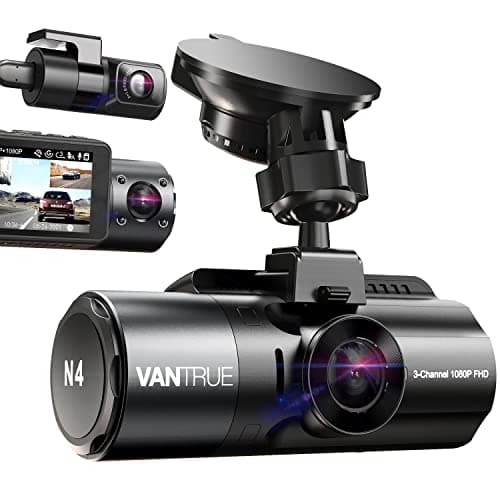
Vantrue N4
Skip this one. Unless you drive rideshare or carry passengers you do not know, the cabin channel is a cost with no benefit. A front camera plus a rear camera does the commuter job for less.
Front, cabin and rear on one camera with infrared night vision on the interior channel and the same 70 C published ceiling as the rest of Vantrue's supercapacitor line. It is the camera for somebody who drives for a living or carries passengers they do not know. For a plain commute it is two channels more than you need and $170 more than you need to spend.
- Channels
- Three: front, interior, rear
- Resolution
- 1440p + 1080p + 1080p at 30fps, or 4K front only
- Night vision
- Sony STARVIS with infrared on the cabin channel
- Power store
- Supercapacitor
- Operating range
- -10 C to 70 C (14 F to 158 F)
- Max microSD
- 512 GB
- Parking mode
- 24-hour, motion and collision detection
- GPS
- Supported
- Published current draw
- Not published
List price $259.99 per Vantrue's own store, captured on the compile date below. Not a live price and not what you will pay — the button is where the real number is.
What it gets right
- Three channels recording at once, with IR illumination on the cabin camera
- 70 C published ceiling and a supercapacitor
- 512GB card support, which three channels genuinely need
- 24-hour parking mode with motion and collision detection
Flaws
- $259.99 list is far outside this site's usual bracket
- Three channels fill a card fast, so the running cost is a bigger card sooner
- The interior camera is pointless for most private drivers and creates a privacy question for passengers
The working behind the 6.6
- Heat headroom: 10.0 (weight 22%)
- Published operating ceiling 70 C (158 F). A car parked in summer sun runs roughly 60-70 C inside, so 65 C and up is real headroom, 60 C is living at the limit, and anything under 55 C is a summer problem waiting to happen.
- Install effort: 6.0 (weight 24%)
- Adhesive pad onto the dashboard. Permanent in practice: repositioning means a new pad, and the pad is the part that fails first.
- Price against the ceiling: 2.5 (weight 24%)
- Listed at $259.99 on the compile date. This site's buyer has a practical ceiling around $150 for a single upgrade, so the scale rewards everything under $100 and falls away sharply past $150. The live price is very often different, and that is what the button is for.
- Written commitment: 7.0 (weight 15%)
- 18-month warranty. This is the only promise in the entire listing that a court would read, which is why it is scored and the marketing copy is not.
- Spec transparency: 8.9 (weight 15%)
- 8 of the 9 specifications we went looking for are published by the maker (89%). A blank row is never a guess here: it prints “Not published” and it costs the product points, because a figure nobody will commit to in writing is a figure you cannot check.
Axes with no published input are dropped and the remaining weights re-normalized, so a product is not punished for a category where an axis does not apply. Specifications compiled September 4, 2026 from Vantrue's N4 product page.
2Front and rear with the hardwire kit in the box
REDTIGER F7N
The only camera here that ships the hardwire kit rather than selling it separately, which is worth more than it sounds: the kit is the thing that turns parking mode from a spec-sheet feature into a working one, and buying it later costs both money and a second afternoon. Front 4K plus a 1080p rear, and the storage cap is 256GB rather than 512GB.
- Front resolution
- 3840 x 2160 (4K UHD)
- Rear resolution
- 1920 x 1080
- Front field of view
- 170 degrees
- Rear field of view
- 140 degrees
- Max microSD
- 256 GB
- GPS
- Built in
- Wi-Fi
- 5.8 GHz
- Hardwire kit
- Included in the box
- Operating range
- Not published
- Power store
- Not published
List price $109.99 per REDTIGER's own store, sale price (regular $139.99), captured on the compile date below. Not a live price and not what you will pay — the button is where the real number is.
What it gets right
- Hardwire kit included, so parking mode works without a second purchase
- Front and rear in one box, with a 170-degree front lens
- STARVIS 2 sensor and 5.8GHz Wi-Fi at a list price under $150
- Screen on the body, which makes aiming the camera a two-minute job rather than a phone-app job
Flaws
- 256GB storage cap, half what most of this ledger accepts. Two channels fill a card twice as fast, so this is the wrong way round
- No published operating-temperature range
- The rear camera is 1080p, so it is evidence of an impact rather than a plate reader
The working behind the 6.3
- Heat headroom: not scored (weight 22%)
- The maker publishes no operating-temperature ceiling, so this axis is dropped and the other weights are re-normalized.
- Install effort: 6.0 (weight 24%)
- Adhesive pad onto the dashboard. Permanent in practice: repositioning means a new pad, and the pad is the part that fails first.
- Price against the ceiling: 6.0 (weight 24%)
- Listed at $109.99 on the compile date. This site's buyer has a practical ceiling around $150 for a single upgrade, so the scale rewards everything under $100 and falls away sharply past $150. The live price is very often different, and that is what the button is for.
- Written commitment: 5.5 (weight 15%)
- 12-month warranty. This is the only promise in the entire listing that a court would read, which is why it is scored and the marketing copy is not.
- Spec transparency: 8.0 (weight 15%)
- 8 of the 10 specifications we went looking for are published by the maker (80%). A blank row is never a guess here: it prints “Not published” and it costs the product points, because a figure nobody will commit to in writing is a figure you cannot check.
Axes with no published input are dropped and the remaining weights re-normalized, so a product is not punished for a category where an axis does not apply. Specifications compiled September 4, 2026 from REDTIGER's F7N series page.
3The most sensor for the money
ROVE R2-4K
Skip this one. Rove publishes a 4K front figure and markets hard on it, but the specification that decides a dual-channel purchase is the REAR resolution and the operating-temperature ceiling, and neither is stated as clearly. On a two-camera camera, a headline front number is the least useful thing on the box.
4K, a 150-degree lens, an f/1.5 aperture and a supercapacitor at a list price close to $100. On paper it is the most camera per dollar in this ledger. What ROVE does not publish is an operating-temperature range, and on a camera whose whole selling point is that it uses a supercapacitor for heat tolerance, that omission is strange enough to cost it the top spot.
- Front resolution
- 3840 x 2160 (4K UHD)
- Field of view
- 150 degrees
- Aperture
- f/1.5
- Power store
- Supercapacitor
- Max microSD
- 512 GB
- GPS
- Built in
- Wi-Fi
- Dual band
- Parking mode
- 24-hour parking mode
- Operating range
- Not published
- Published current draw
- Not published
List price $119.99 per ROVE's own store, captured on the compile date below. Not a live price and not what you will pay — the button is where the real number is.
What it gets right
- 4K UHD with a 150-degree lens and an f/1.5 aperture, all published
- Supercapacitor rather than a lithium cell
- Dual-band Wi-Fi and GPS included at this price
- Takes a 512GB card
Flaws
- No published operating-temperature range, which is the one number a supercapacitor camera should be shouting about
- 4K on a small sensor is not automatically better than 2K on a good one; the bitrate matters more than the pixel count
- Parking mode needs a hardwire kit
The working behind the 6.3
- Heat headroom: not scored (weight 22%)
- The maker publishes no operating-temperature ceiling, so this axis is dropped and the other weights are re-normalized.
- Install effort: 6.0 (weight 24%)
- Adhesive pad onto the dashboard. Permanent in practice: repositioning means a new pad, and the pad is the part that fails first.
- Price against the ceiling: 6.0 (weight 24%)
- Listed at $119.99 on the compile date. This site's buyer has a practical ceiling around $150 for a single upgrade, so the scale rewards everything under $100 and falls away sharply past $150. The live price is very often different, and that is what the button is for.
- Written commitment: 5.5 (weight 15%)
- 12-month warranty. This is the only promise in the entire listing that a court would read, which is why it is scored and the marketing copy is not.
- Spec transparency: 8.0 (weight 15%)
- 8 of the 10 specifications we went looking for are published by the maker (80%). A blank row is never a guess here: it prints “Not published” and it costs the product points, because a figure nobody will commit to in writing is a figure you cannot check.
Axes with no published input are dropped and the remaining weights re-normalized, so a product is not punished for a category where an axis does not apply. Specifications compiled September 4, 2026 from ROVE's R2-4K product page.
4A screen, voice control and room to add a rear camera
VIOFO A229 Plus 1CH
The same STARVIS 2 IMX675 sensor as the Mini 2 in a body with a screen, voice control and the option to add rear and interior channels later. You are paying roughly $40 over the Mini 2 for a display and an upgrade path, which is worth it if you expect to want a rear camera and not if you do not.
- Front resolution
- 2K HDR
- Image sensor
- Sony STARVIS 2 IMX675
- GPS
- Built in
- Voice control
- Yes
- Expandable
- Rear and interior channels available
- Operating range
- Not published
- Max microSD
- Not published
- Field of view
- Not published
List price $199.99 per VIOFO's own store, captured on the compile date below. Not a live price and not what you will pay — the button is where the real number is.
What it gets right
- Same STARVIS 2 IMX675 sensor as the Mini 2
- Screen on the body, so aiming and reviewing does not need the phone app
- Expandable to two and three channels without buying a whole new camera
- Voice control, which is the only genuinely safe way to lock a clip while moving
Flaws
- $200 list is well past this site's usual ceiling for a single upgrade
- A screen in the windshield is a screen in your eyeline; the Mini 2 hides behind the mirror
- Same hardwire requirement for parking mode as every other VIOFO
The working behind the 5.5
- Heat headroom: not scored (weight 22%)
- The maker publishes no operating-temperature ceiling, so this axis is dropped and the other weights are re-normalized.
- Install effort: 6.0 (weight 24%)
- Adhesive pad onto the dashboard. Permanent in practice: repositioning means a new pad, and the pad is the part that fails first.
- Price against the ceiling: 3.5 (weight 24%)
- Listed at $199.99 on the compile date. This site's buyer has a practical ceiling around $150 for a single upgrade, so the scale rewards everything under $100 and falls away sharply past $150. The live price is very often different, and that is what the button is for.
- Written commitment: 7.0 (weight 15%)
- 18-month warranty. This is the only promise in the entire listing that a court would read, which is why it is scored and the marketing copy is not.
- Spec transparency: 6.3 (weight 15%)
- 5 of the 8 specifications we went looking for are published by the maker (63%). A blank row is never a guess here: it prints “Not published” and it costs the product points, because a figure nobody will commit to in writing is a figure you cannot check.
Axes with no published input are dropped and the remaining weights re-normalized, so a product is not punished for a category where an axis does not apply. Specifications compiled September 4, 2026 from VIOFO's 1-channel range page.
Prices last verified October 20, 2026. They move constantly; the figure on Amazon when you click is the real one.
Questions people actually ask
Can I add a rear camera to a front-only dash cam later?
Almost never. The rear channel is a designed-in feature with a dedicated port, and a front-only model does not have one. Buying a dual-channel unit up front is the only reliable path; the alternative is a second, entirely separate camera at the rear with its own power and its own card.
Does window tint ruin rear dash cam footage?
It degrades it, particularly at night. Factory privacy glass on the rear of an SUV is already dark, and aftermarket film on top of it costs you more. Mounting the camera as high on the glass as the tint band allows, and cleaning the inside of the glass, both help more than people expect.
Is a three-channel camera better than two?
Only for a specific job. The third channel points into the cabin, which is exactly what a rideshare driver needs and exactly what a private owner does not. If you carry passengers for money, see best dash cams for rideshare. If you do not, the interior channel is storage you are spending on nothing.
Do I need to tell my passengers they are being recorded?
A rear channel pointed out the back glass records the road, not the cabin, so this is mostly a question for interior-facing cameras. Audio is the part that varies by state. We cover the legal position, including two-party consent states, in are dash cams legal.