The best tire inflators for a car
The specification that decides which of these you want is not maximum pressure, which neither of you will ever approach. It is duty cycle and airflow, and both makers publish them.
By Sawyer V. · Published · How we research
We have not tested any of this. Everything below is compiled from published manufacturer specifications, and the arithmetic is printed so you can check it. This page carries affiliate links: if you buy through one we earn a commission at no extra cost to you, and it does not change the order of the picks. Full disclosure.
The short answer
For a normal car, buy the AstroAI. It plugs into the 12V socket, it has a digital gauge with automatic shutoff, and AstroAI publishes the two figures that matter: a duty cycle of 15 minutes on and 10 minutes cooling, and an inflation rate of a 195/65/R15 tire from 30 to 36 PSI in under a minute. That is four tires topped up. It is not one tire filled from flat — for that you want the VIAIR, which clamps to the battery and draws 20 amps.
| # | Pick | Install | Score | Price |
|---|---|---|---|---|
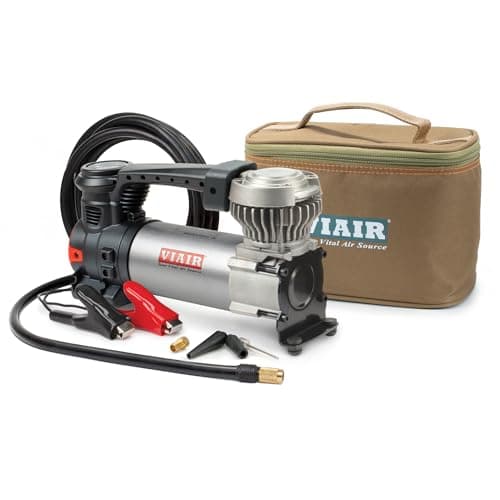
| 1 | VIAIR 88P Portable Compressor Actually filling a tire from flat | Plugs in | 9.2/10 | $89.89 - view on Amazon |
| 2 | AstroAI Portable Tire Inflator (150 PSI) Topping up four tires in a driveway | Plugs in | 9.1/10 | $26.99 - view on Amazon |
Prices last verified October 19, 2026. They move constantly; the figure on Amazon when you click is the real one.
Maximum PSI is the wrong number
Every inflator is sold on its maximum pressure, and a passenger car tire runs at around 32 to 36 PSI. A 150 PSI rating and a 120 PSI rating are equally irrelevant to a number you will never go near.
The numbers that actually decide which tool you want are how long it can run and how much air it moves. Both makers here publish them, which in this category is unusually good behavior.
| AstroAI 150 PSI | VIAIR 88P | |
|---|---|---|
| Maximum pressure | 150 PSI | 120 PSI |
| Airflow | Not published | 1.25 CFM at 30 PSI |
| Duty cycle | 15 min on, 10 min cooling | 25 min at 30 PSI |
| Power connection | 12V socket | Battery clamps, 20 A inline fuse |
| Maximum draw | Not published | 20 A |
| Weight | Not published | 4.75 lb |
| Hose | Not published | 16 ft air, 9 ft power |
What a duty cycle actually means
How long the pump can run before it needs to stop and cool. It is a thermal limit, not a suggestion, and running past it is how these fail.
AstroAI publishes 15 minutes on and 10 minutes cooling. Combined with its published inflation rate — a 195/65/R15 from 30 to 36 PSI in under a minute — that is comfortably four tires topped up in one session with time in hand.
What it is not is one tire filled from flat. A completely flat tire needs many minutes of continuous running, which is most of the duty cycle for one wheel. That is a genuinely different task and it is what the VIAIR exists for.
Why the CFM figure matters more than the PSI
Cubic feet per minute is how much air the pump actually moves, and it is the figure that determines how long you stand there. VIAIR publishes 1.25 CFM at 30 PSI. AstroAI publishes no CFM at all, only a worked example on a named tire size — which is arguably more useful to a normal buyer, and is not comparable between products.
The reason VIAIR can move that much air is the reason it clamps to the battery: it draws up to 20 amps, which is more than most 12V sockets are fused for.
Run the engine while you inflate
Either tool is a substantial load on the battery. Inflating four tires with the ignition off pulls straight from a battery you may already be uncertain about, and doing it in the cold on an aged battery is how a routine job becomes a jump start.
Run the engine. The alternator supplies the load and the battery is not touched. There is no downside and it takes no extra effort.
The gauge, and why the one on the pump matters
A digital gauge with automatic shutoff is the difference between setting a target and walking away, and standing over a dial guessing. AstroAI publishes both.
Worth knowing: inflator gauges are convenience instruments, not calibrated ones, and neither maker publishes an accuracy figure. If the exact pressure matters to you, keep a separate pencil or dial gauge in the glovebox and check against it. The gauge on a gas-station pump is generally the least trustworthy of all three.
When to actually use it
- Monthly, cold. Tires lose pressure continuously, roughly a pound a month, and more when temperature drops. Check when the car has been standing — pressure rises several PSI once tires are warm from driving.
- At the seasonal change. Pressure falls with ambient temperature, so the first cold snap is when the warning light appears across a whole neighbourhood at once.
- Before a long drive. Two minutes, and underinflated tires are both a fuel cost and a heat problem at sustained speed.
Your door jamb has the correct pressures on a sticker. Use those, not the number molded into the tire sidewall, which is the tire's maximum rather than your car's recommendation.
Combined units exist that pair a compressor with a jump pack, which covers both of the failures that strand a commuter in one trunk space — and the published figures worth reading on those are watt-hours and airflow rather than peak amps — best jump starter and inflator combos.
Every pick, with the working
Each entry lists the specifications the maker publishes, the axis scores those specifications produce, and what you give up. Rows that read “Not published” are not omissions on our side: they are things the maker will not commit to in writing, and they cost the product points on the transparency axis. Specifications compiled September 4, 2026.
Our pickActually filling a tire from flat
VIAIR 88P Portable Compressor
Skip this one. If your job is checking four car tires on a Sunday, this is more compressor than the task needs and it makes you open the hood to connect it to the battery every time. Real capability, wrong tool for a commuter — buy it if you run big tires or air down off-road.
120 PSI, 1.25 CFM at 30 PSI, a 20-amp draw and a duty cycle of 25 minutes at 30 PSI. It clamps to the battery rather than plugging into the 12V socket, which is why it can draw 20 amps and why it moves real air. This is the tool for a truck tire, an off-road airing-up, or anyone who has ever waited twenty minutes for a socket-powered pump.
- Maximum pressure
- 120 PSI
- Airflow
- 1.25 CFM at 30 PSI
- Maximum amp draw
- 20 A
- Duty cycle
- 25 minutes at 30 PSI
- Power
- 12 V DC via battery clamps, 20 A inline fuse
- Dimensions
- 9.80 x 3.20 x 5.60 in
- Weight
- 4.75 lb
- Hose
- 16 ft air hose, 9 ft power cord
- List price
- Not published
- Warranty
- Not published
What it gets right
- 1.25 CFM at 30 PSI, published — an actual airflow figure rather than a headline PSI
- 25-minute duty cycle at 30 PSI, more than double the socket-powered pumps
- Battery clamps with a 20-amp inline fuse, so it is not limited by a 15-amp socket
- 16 ft air hose and 9 ft power cord reaches every corner of a full-size truck
Flaws
- 20-amp draw means clamping to the battery, which means opening the hood every time
- 4.75 lb and 9.8 inches long — this lives in the trunk, not the glovebox
- Overkill for topping up a sedan once a month
The working behind the 9.2
- Heat headroom: not scored (weight 22%)
- The maker publishes no operating-temperature ceiling, so this axis is dropped and the other weights are re-normalized.
- Install effort: 10.0 (weight 24%)
- Plugs into a 12V socket or a USB port. Nothing to mount, nothing to route, reversible in a second.
- Price against the ceiling: not scored (weight 24%)
- No published list price we could cite on the compile date, so this axis is dropped and the other weights are re-normalized.
- Written commitment: not scored (weight 15%)
- No warranty term published, so this axis is dropped and the other weights are re-normalized.
- Spec transparency: 8.0 (weight 15%)
- 8 of the 10 specifications we went looking for are published by the maker (80%). A blank row is never a guess here: it prints “Not published” and it costs the product points, because a figure nobody will commit to in writing is a figure you cannot check.
Axes with no published input are dropped and the remaining weights re-normalized, so a product is not punished for a category where an axis does not apply. Specifications compiled September 4, 2026 from VIAIR's 88P product page.
2Topping up four tires in a driveway
AstroAI Portable Tire Inflator (150 PSI)
150 PSI maximum, a digital gauge, and AstroAI's own published figure of a 195/65/R15 tire going 30 to 36 PSI in under a minute. It also publishes the duty cycle honestly: fifteen minutes of continuous use and then ten minutes of cooling. That duty cycle is the specification that separates a topping-up tool from a tire-filling one.
- Maximum pressure
- 150 PSI
- Power
- 12 V DC
- Duty cycle
- 15 minutes continuous, then 10 minutes cooling
- Published inflation rate
- 195/65/R15 from 30 to 36 PSI in under 1 minute
- Gauge
- Digital, automatic shutoff
- Warranty
- Not published
- Operating range
- Not published
List price $37.99 per AstroAI's own store, captured on the compile date below. Not a live price and not what you will pay — the button is where the real number is.
What it gets right
- Published inflation rate on a named tire size, which is the only useful way to state this figure
- Published duty cycle: 15 minutes on, 10 minutes cooling
- Digital gauge with automatic shutoff at the set pressure
- Around $32 to $38 depending on the model
Flaws
- 15 minutes of continuous running is four tires topped up, not one tire filled from flat
- 150 PSI is a headline number a passenger car will never approach
- 12V socket powered, so a car with the ignition off will run its battery down doing this
The working behind the 9.1
- Heat headroom: not scored (weight 22%)
- The maker publishes no operating-temperature ceiling, so this axis is dropped and the other weights are re-normalized.
- Install effort: 10.0 (weight 24%)
- Plugs into a 12V socket or a USB port. Nothing to mount, nothing to route, reversible in a second.
- Price against the ceiling: 9.5 (weight 24%)
- Listed at $37.99 on the compile date. This site's buyer has a practical ceiling around $150 for a single upgrade, so the scale rewards everything under $100 and falls away sharply past $150. The live price is very often different, and that is what the button is for.
- Written commitment: not scored (weight 15%)
- No warranty term published, so this axis is dropped and the other weights are re-normalized.
- Spec transparency: 7.1 (weight 15%)
- 5 of the 7 specifications we went looking for are published by the maker (71%). A blank row is never a guess here: it prints “Not published” and it costs the product points, because a figure nobody will commit to in writing is a figure you cannot check.
Axes with no published input are dropped and the remaining weights re-normalized, so a product is not punished for a category where an axis does not apply. Specifications compiled September 4, 2026 from AstroAI's 150 PSI tire inflator page.
Prices last verified October 19, 2026. They move constantly; the figure on Amazon when you click is the real one.
Questions people actually ask
Can a 12V tire inflator fill a completely flat tire?
Not comfortably. A published duty cycle of 15 minutes on and 10 minutes cooling gets you part-way and then needs a break. Socket-powered inflators are topping-up tools; filling from flat is what the battery-clamped compressors are for.
Should the engine be running while I inflate?
Yes. The alternator supplies the load and the battery is not drawn down. There is no downside, and doing it with the ignition off on a cold morning with an aged battery is how a routine job turns into a jump start.
How accurate are inflator gauges?
Neither maker publishes an accuracy figure, so treat them as convenience instruments. Keep a separate pencil or dial gauge if the exact pressure matters. The gauge on a gas-station pump is usually the least reliable of the three.
What pressure should my tires be?
The figure on the sticker in your driver's door jamb, not the number molded into the tire sidewall. The sidewall figure is the tire's maximum; the door jamb is your car's recommendation.