What to keep in your car in winter
Cold does three specific things: it takes capacity out of your battery, it takes pressure out of your tires, and it makes being stuck outside genuinely dangerous rather than merely annoying. Each has a cheap answer.
By Sawyer V. · Published · How we research
We have not tested any of this. Everything below is compiled from published manufacturer specifications, and the arithmetic is printed so you can check it. This page carries affiliate links: if you buy through one we earn a commission at no extra cost to you, and it does not change the order of the picks. Full disclosure.
The short version
Cold does three things and each has an answer. It removes battery capacity — published derating is about 35% at 0 C and 60% at -18 C, so carry a jump starter and charge it in October. It removes tire pressure — roughly 1 PSI per 10 F drop, so carry a gauge and check monthly. And it makes being stuck genuinely dangerous rather than annoying — so carry a blanket, a real flashlight, and enough clothing to stand outside the car for an hour.
| # | Pick | Install | Score | Price |
|---|---|---|---|---|
| 1 | AstroAI Portable Tire Inflator (150 PSI) Topping up four tires in a driveway | Plugs in | 9.1/10 | $26.99 - view on Amazon |
| 2 | Anker Bolder LC90 Flashlight A light that is not your phone | Drops in | 8.8/10 | Check price on Amazon |
| 3 | AstroAI Digital Tire Gauge (150 PSI) Knowing what your tires are actually at | Drops in | 8.4/10 | $6.99 - view on Amazon |
| 4 | NOCO Boost Plus GB40 Not needing anybody else's car | Plugs in | 8.0/10 | Check price on Amazon |
Prices last verified October 19, 2026. They move constantly; the figure on Amazon when you click is the real one.
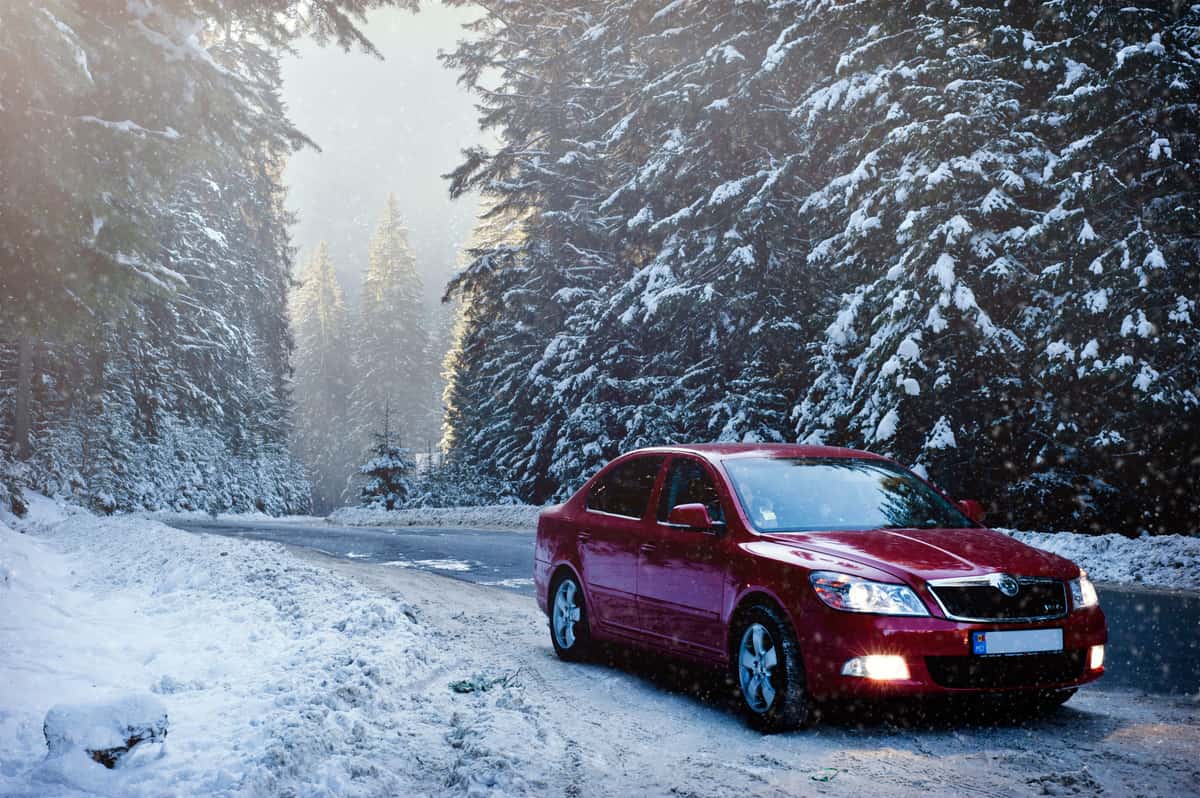
1. Cold takes capacity out of your battery
This is the big one, and it is why breakdown call volumes spike on the first genuinely cold morning of the year rather than being spread through the winter.
Published cold-cranking derating figures are steep: no loss at 21 C, about 35% reduction at 0 C, and about 60% at -18 C. At the same time the engine is harder to turn because the oil is thicker, so the battery is asked for more at exactly the moment it can deliver less.
Cold does not cause a battery failure. It exposes one that was already there — a battery that was marginal in September fails in December, and it fails on the coldest morning because that is when the margin finally runs out.
2. Cold takes pressure out of your tires
Roughly 1 PSI for every 10 degrees Fahrenheit the ambient temperature drops. A car set to 35 PSI on a warm October afternoon is meaningfully underinflated on a freezing December morning, with no leak involved at all.
That is why tire pressure warning lights appear across an entire neighborhood on the same day. It is not a coincidence and it is usually not a puncture.
Two consequences: check pressures monthly through the winter, and check them cold — meaning the car has been standing, not that the weather is cold. The gauge page covers why the published accuracy figure matters and why TPMS is not a substitute for checking.
3. Cold makes being stuck genuinely dangerous
In summer, a breakdown is a wait. In winter, in the wrong place, it is a different category of problem — and a car with a dead battery has no heater.
This is the part where the list stops being about the car and starts being about you:
- A blanket. The single most useful cold-weather item, and the one people take out in spring and forget to put back.
- A hat and gloves that live in the car. Not the ones you are wearing — the ones that are always there, for the day you left home without them.
- A proper coat if you commute in a suit. Standing on a shoulder in a jacket you chose for an office is genuinely miserable.
- Water and something to eat. Both keep in a trunk.
- A real flashlight. It gets dark at four o'clock, and your phone is the thing you call for help with — the flashlight page covers the published runtime and IP figures worth checking.
The winter-only additions
| Item | Why | Note |
|---|---|---|
| Ice scraper and snow brush | The obvious one, and the one bought at 7am in a panic | Buy it in October |
| Blanket | A dead battery means no heater | Also useful for kneeling on |
| Hat and gloves | For standing outside, not driving | Keep a spare set permanently |
| Small shovel | Only if you get real snow | Folding, in the trunk |
| Cat litter or sand | Traction under a spinning wheel | A small bag is enough |
| De-icer | Frozen locks and washer jets | Not hot water, ever |
Traction devices are the one winter item with a legal question attached. Some jurisdictions accept textile socks as a chain alternative and some require actual chains, and plenty of modern cars have no wheel-well clearance for chains at all best snow socks and tire chains.
The October checklist
Twenty minutes, once, before the first cold snap:
- Charge the jump starter and the flashlight. Both are lithium, both self-discharge, and both have just spent a summer in a hot trunk. This is one of the two annual charges those items need.
- Have the battery tested if it is over three years old. A test in October is free at most parts shops; a failure in January is not.
- Check all four tire pressures, cold, against the door-jamb sticker.
- Top up washer fluid with a winter-rated mix. Summer fluid freezes in the reservoir and in the jets, and you find out on the first salted road.
- Clean the inside of the windshield. The plasticizer film gives water vapor something to condense onto, so a clean screen fogs far less — the two-cloth method is here.
- Swap carpet mats for all-weather liners. A saturated carpet mat is a reservoir of water inside a sealed cabin, and that is the other half of the fogging problem — covered here.
Two things not to do
Never pour hot water on a frozen windshield. The thermal shock can crack glass, and the water refreezes in the wiper mechanism.
Do not run the engine to keep warm in an enclosed space, and if you are stationary in snow, check that the exhaust is clear before running it at all. Blocked exhausts are a genuine carbon monoxide risk.
That is the kit list. The purchases that stop you needing it — ordered by what actually fails first in cold, which is the battery rather than the traction — are in best car accessories for winter.
Every pick, with the working
Each entry lists the specifications the maker publishes, the axis scores those specifications produce, and what you give up. Rows that read “Not published” are not omissions on our side: they are things the maker will not commit to in writing, and they cost the product points on the transparency axis. Specifications compiled September 4, 2026.
Our pickTopping up four tires in a driveway
AstroAI Portable Tire Inflator (150 PSI)
Skip this one. Genuinely useful in winter and the one item on this list that gets harder to use in it — standing at a roadside for fifteen minutes of duty cycle in the cold is unpleasant, and the pump itself is slower when everything is stiff. Check pressures at home in the warm instead, which is the whole argument for the gauge above it.
150 PSI maximum, a digital gauge, and AstroAI's own published figure of a 195/65/R15 tire going 30 to 36 PSI in under a minute. It also publishes the duty cycle honestly: fifteen minutes of continuous use and then ten minutes of cooling. That duty cycle is the specification that separates a topping-up tool from a tire-filling one.
- Maximum pressure
- 150 PSI
- Power
- 12 V DC
- Duty cycle
- 15 minutes continuous, then 10 minutes cooling
- Published inflation rate
- 195/65/R15 from 30 to 36 PSI in under 1 minute
- Gauge
- Digital, automatic shutoff
- Warranty
- Not published
- Operating range
- Not published
List price $37.99 per AstroAI's own store, captured on the compile date below. Not a live price and not what you will pay — the button is where the real number is.
What it gets right
- Published inflation rate on a named tire size, which is the only useful way to state this figure
- Published duty cycle: 15 minutes on, 10 minutes cooling
- Digital gauge with automatic shutoff at the set pressure
- Around $32 to $38 depending on the model
Flaws
- 15 minutes of continuous running is four tires topped up, not one tire filled from flat
- 150 PSI is a headline number a passenger car will never approach
- 12V socket powered, so a car with the ignition off will run its battery down doing this
The working behind the 9.1
- Heat headroom: not scored (weight 22%)
- The maker publishes no operating-temperature ceiling, so this axis is dropped and the other weights are re-normalized.
- Install effort: 10.0 (weight 24%)
- Plugs into a 12V socket or a USB port. Nothing to mount, nothing to route, reversible in a second.
- Price against the ceiling: 9.5 (weight 24%)
- Listed at $37.99 on the compile date. This site's buyer has a practical ceiling around $150 for a single upgrade, so the scale rewards everything under $100 and falls away sharply past $150. The live price is very often different, and that is what the button is for.
- Written commitment: not scored (weight 15%)
- No warranty term published, so this axis is dropped and the other weights are re-normalized.
- Spec transparency: 7.1 (weight 15%)
- 5 of the 7 specifications we went looking for are published by the maker (71%). A blank row is never a guess here: it prints “Not published” and it costs the product points, because a figure nobody will commit to in writing is a figure you cannot check.
Axes with no published input are dropped and the remaining weights re-normalized, so a product is not punished for a category where an axis does not apply. Specifications compiled September 4, 2026 from AstroAI's 150 PSI tire inflator page.
2A light that is not your phone
Anker Bolder LC90 Flashlight
900 lumens from a CREE LED, a published 6-hour runtime, IPX5 water resistance and five modes including strobe and SOS, on a rechargeable 18650. Using a phone as a flashlight at the roadside drains the one device you need to call for help, which is the entire argument for keeping a real one in the car.
- Output
- 900 lumens, CREE LED
- Runtime
- Up to 6 hours
- Ingress rating
- IPX5
- Modes
- High, medium, low, strobe, SOS
- Beam
- Zoomable
- Battery
- Rechargeable 18650, included
- Stated beam distance
- Over 660 ft
- Operating range
- Not published
What it gets right
- Published lumens (900), runtime (6 h) and ingress rating (IPX5) — all three, which is rare at this price
- Rechargeable 18650 included, so there is no scramble for AAs
- Zoomable from flood to spot, which covers both 'find the dropped bolt' and 'signal from the shoulder'
- SOS and strobe modes, which are exactly the modes a roadside light needs
Flaws
- IPX5 is rain resistance, not submersion. Fine for a breakdown, not for dropping in a puddle
- A lithium cell in a hot trunk self-discharges, so it needs charging on a schedule like the jump starter does
- 900 lumens on high for 6 hours is not the same as 900 lumens for 6 hours; brightness steps down between modes
The working behind the 8.8
- Heat headroom: not scored (weight 22%)
- The maker publishes no operating-temperature ceiling, so this axis is dropped and the other weights are re-normalized.
- Install effort: 10.0 (weight 24%)
- Drops in and sits there. No fixing of any kind, and it comes out again when you sell the car.
- Price against the ceiling: not scored (weight 24%)
- No published list price we could cite on the compile date, so this axis is dropped and the other weights are re-normalized.
- Written commitment: 7.0 (weight 15%)
- 18-month warranty. This is the only promise in the entire listing that a court would read, which is why it is scored and the marketing copy is not.
- Spec transparency: 8.8 (weight 15%)
- 7 of the 8 specifications we went looking for are published by the maker (88%). A blank row is never a guess here: it prints “Not published” and it costs the product points, because a figure nobody will commit to in writing is a figure you cannot check.
Axes with no published input are dropped and the remaining weights re-normalized, so a product is not punished for a category where an axis does not apply. Specifications compiled September 4, 2026 from Anker Bolder LC90 published specifications.
3Knowing what your tires are actually at
AstroAI Digital Tire Gauge (150 PSI)
0 to 150 PSI, factory calibrated to plus or minus 1 PSI, reading in 0.1 increments across four units with a backlit screen. The gas-station gauge you have been trusting is almost certainly worse than this, and this costs about the same as one tank of fuel.
- Range
- 0-150 PSI / 0-10 Bar / 0-10 Kgf/cm2 / 0-1000 kPa
- Accuracy
- Plus or minus 1 PSI
- Calibration standard
- ANSI B40.7, AstroAI UK listing only
- Resolution
- 0.1 PSI
- Display
- Backlit LCD, 4 selectable units
- Auto shut-off
- 30 seconds
- List price
- Not published
- Warranty
- 1 year, stated
What it gets right
- Published accuracy of plus or minus 1 PSI, stated in the listing title — almost nothing else in this category states an accuracy figure at all
- Reads to 0.1 PSI, which matters because a 3 PSI error is the difference between correct and noticeably underinflated
- Backlit screen, because tire pressures get checked in the dark more often than not
- Auto shut-off after 30 seconds, so the battery lasts
Flaws
- 150 PSI range is far beyond a passenger car, so the useful part of the scale is the bottom fifth
- A digital gauge has a battery, and a battery in a glovebox is a battery you will find dead
- It measures. It does not inflate — that is a separate tool
The working behind the 8.4
- Heat headroom: not scored (weight 22%)
- The maker publishes no operating-temperature ceiling, so this axis is dropped and the other weights are re-normalized.
- Install effort: 10.0 (weight 24%)
- Drops in and sits there. No fixing of any kind, and it comes out again when you sell the car.
- Price against the ceiling: not scored (weight 24%)
- No published list price we could cite on the compile date, so this axis is dropped and the other weights are re-normalized.
- Written commitment: 5.5 (weight 15%)
- 12-month warranty. This is the only promise in the entire listing that a court would read, which is why it is scored and the marketing copy is not.
- Spec transparency: 8.8 (weight 15%)
- 7 of the 8 specifications we went looking for are published by the maker (88%). A blank row is never a guess here: it prints “Not published” and it costs the product points, because a figure nobody will commit to in writing is a figure you cannot check.
Axes with no published input are dropped and the remaining weights re-normalized, so a product is not punished for a category where an axis does not apply. Specifications compiled September 4, 2026 from AstroAI 150 PSI gauge published specifications.
4Not needing anybody else's car
NOCO Boost Plus GB40
1,000 peak amps out of a 24 watt-hour lithium pack that weighs 2.4 pounds, rated for gasoline engines to 6.0 liters and diesel to 3.0, with spark-proof clamps and reverse-polarity protection. It is the single accessory here that changes what happens on the worst morning of your year, and it fits in a glovebox.
- Peak amps
- 1,000 A
- Battery
- 24 Wh lithium-ion
- Engine ceiling
- Gasoline to 6.0 L, diesel to 3.0 L
- Starts per charge
- Up to 20
- Dimensions
- 7.7 x 3.2 x 1.7 in
- Weight
- 2.4 lb with clamps
- Light
- 100 lumens
- Safety
- Spark proof, reverse polarity protected
- Operating range
- Not published
List price $99.95 per NOCO's listed price, captured on the compile date below. Not a live price and not what you will pay — the button is where the real number is.
What it gets right
- 1,000 peak amps and up to 20 starts on one charge, both published
- Spark-proof and reverse-polarity protected, which matters when you are doing this in the dark
- 2.4 lb and 7.7 inches long — it genuinely lives in the car rather than the garage
- USB port and a 100-lumen light, so it is also the thing you reach for in a power cut
Flaws
- Lithium, so it self-discharges and needs topping up every few months or it is a brick when you need it
- 6.0 L gasoline and 3.0 L diesel is the published ceiling — a big diesel needs the bigger model
- $99.95 for something you hope never to use
The working behind the 8.0
- Heat headroom: not scored (weight 22%)
- The maker publishes no operating-temperature ceiling, so this axis is dropped and the other weights are re-normalized.
- Install effort: 10.0 (weight 24%)
- Plugs into a 12V socket or a USB port. Nothing to mount, nothing to route, reversible in a second.
- Price against the ceiling: 7.0 (weight 24%)
- Listed at $99.95 on the compile date. This site's buyer has a practical ceiling around $150 for a single upgrade, so the scale rewards everything under $100 and falls away sharply past $150. The live price is very often different, and that is what the button is for.
- Written commitment: 5.5 (weight 15%)
- 12-month warranty. This is the only promise in the entire listing that a court would read, which is why it is scored and the marketing copy is not.
- Spec transparency: 8.9 (weight 15%)
- 8 of the 9 specifications we went looking for are published by the maker (89%). A blank row is never a guess here: it prints “Not published” and it costs the product points, because a figure nobody will commit to in writing is a figure you cannot check.
Axes with no published input are dropped and the remaining weights re-normalized, so a product is not punished for a category where an axis does not apply. Specifications compiled September 4, 2026 from NOCO Boost Plus GB40 published specifications.
Prices last verified October 19, 2026. They move constantly; the figure on Amazon when you click is the real one.
Questions people actually ask
Why does my tire pressure light come on in winter?
Air contracts as it cools — roughly 1 PSI per 10 F drop. A car set correctly in October is genuinely underinflated on a freezing morning, with no leak involved. Check cold against the door-jamb figure and top up.
Why do batteries fail in cold weather?
Cold reduces a battery's deliverable capacity substantially — published derating is about 35% at 0 C — while thicker oil makes the engine harder to turn. Cold does not cause the failure; it exposes a battery that was already marginal.
What is the one thing I should add for winter?
A blanket, if you already carry a jump starter. A dead battery means no heater, and the item that matters most when you are stuck in the cold is the one that keeps you warm rather than the one that fixes the car.
Should I warm the car up before driving?
Modern engines do not need extended idling, and idling in an enclosed space is dangerous. If you are stationary in snow, check the exhaust is clear before running the engine at all.