AstroAI 150 PSI digital tire gauge review
The cheapest instrument in the car, and the only one whose entire job is to be right. The accuracy figure still stands. The named standard behind it has quietly gone.
By Sawyer V. · Published · How we research
We have not tested any of this. Everything below is compiled from published manufacturer specifications, and the arithmetic is printed so you can check it. This page carries affiliate links: if you buy through one we earn a commission at no extra cost to you, and it does not change the order of the picks. Full disclosure.
The verdict
Still the one to buy, for a figure you can still check. AstroAI states 1 PSI of error in the listing title itself, and almost nothing else in this category states an accuracy figure at all. Two things to know before you trust it further than that. The ANSI B40.7 calibration standard this gauge is widely credited with no longer appears on its US listing, or on AstroAI’s own US product page — only the UK listing still carries the wording. And plus or minus 1 PSI is an absolute band rather than a percentage, so at a 35 PSI target it is nearly 3% of the reading. Buy it anyway. Buy it for what is published.
| # | Pick | Install | Score | Price |
|---|---|---|---|---|
| 1 | AstroAI Digital Tire Gauge (150 PSI) Knowing what your tires are actually at | Drops in | 8.4/10 | $6.58 - view on Amazon |
Prices last verified October 1, 2026. They move constantly; the figure on Amazon when you click is the real one.
What it is
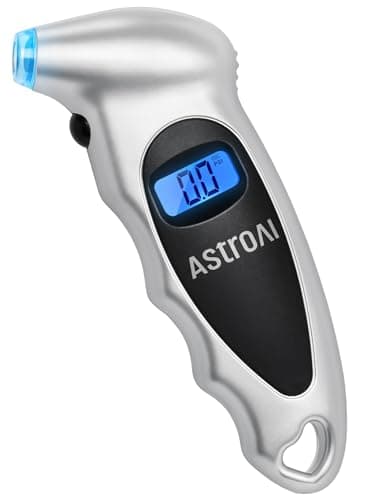
A single-digit-price digital gauge that does one thing: press it onto a valve stem and read a number. There is no install, nothing to mount and nothing to wire, which is why it scores where it does on this site. AstroAI publishes the part number as GL-0801A and a release date of September 2017, and it sells that same part under several color variants whose listing titles are now word-for-word identical — so the “different” silver, red and blue gauges are one instrument.
The published range is 0 to 150 PSI across four units, with a backlit LCD, a separately illuminated nozzle, auto shut-off and batteries in the box. It fits standard Schrader valves, which is what a car has.
What AstroAI publishes, and where
This is a review of an instrument, so the sourcing matters more than usual. The two places a buyer would look do not say the same things.
| Figure | US Amazon listing | AstroAI's own site |
|---|---|---|
| Accuracy | Plus or minus 1 PSI, in the title | Plus or minus 1 PSI, in an FAQ answer |
| Calibration standard | Not stated | Not stated on the US page; named on the UK listing |
| Resolution | Not stated in the bullets | 0.1 increment |
| Range | 0-150 PSI / 0-10 Bar / 0-10 Kgf/cm2 / 0-1000 kPa | 0-150 PSI |
| Battery | 2 x AAA, included | 4 lithium metal, included |
| Auto shut-off | 30 seconds | 30 to 40 seconds |
| Warranty | 1 year, manufacturer | Not stated |
| Weight | 0.15 lb | 2.88 oz |
The standard that is no longer there
This site has credited this gauge with ANSI B40.7 for a year, and so does most of the internet. Search for it today and you will still see listing titles reading “Calibrated to ANSI B40.7 +/-1PSI”. Those titles are cached.
Checked directly: the US Amazon listing for this ASIN says only that it is “factory-calibrated to plus or minus 1 PSI” and names no standard. AstroAI’s own US product page for the 150 PSI gauge names no standard either. The one page still carrying the wording is AstroAI’s UK listing for the same gauge, where it is still in the product title.
Nothing about the hardware changed. Same part number, same stated accuracy, same price bracket. The documentation changed, and that is a different thing — but on a site that ranks products by what their makers will put in writing, it is not a small thing. We have corrected this site’s spec table to say exactly where the standard is published.
Plus or minus 1 PSI is a band, not a percentage
This is the part of the specification most buyers read backwards. Plus or minus 1 PSI is an absolute figure, so as a share of the number you are actually reading it gets worse as the pressure gets lower. The arithmetic is yours to check:
| Reading | As a share of the reading | What it is |
|---|---|---|
| 35 PSI | Plus or minus 2.9% | A typical car door-jamb figure |
| 44 PSI | Plus or minus 2.3% | A loaded car or a light truck |
| 60 PSI | Plus or minus 1.7% | A temporary spare |
| 150 PSI | Plus or minus 0.7% | Full scale, where nothing on a car lives |
So the gauge is at its proportionally worst exactly where you use it. That is not a reason not to buy it — a one-pound band at car pressures is still comfortably inside the range where the error changes nothing, and the roundup sets out how much error actually matters. It is a reason not to read the figure as though it were a percentage-of-reading spec, which is what a tighter instrument would publish.
The display shows a digit the specification does not support
It reads in 0.1 PSI increments and it is specified to plus or minus 1 PSI. Those are different claims, and the gap between them is the most useful thing to understand about any digital gauge: resolution is not accuracy. The tenths digit tells you the gauge is repeatable. It does not tell you it is right.
Two practical consequences. Do not chase a tenth of a pound — two readings 0.3 apart are the same reading, and topping up to hit 35.0 exactly is a waste of a morning. Second, and more usefully: because it is repeatable, this gauge is better at detecting change than at establishing truth. If it read 34.2 last month and 31.1 today, that three-pound loss is real even if each absolute number is off by a pound. Slow loss is what a gauge is for, because a factory TPMS light will not mention it until the tire is far lower than this.
The line in AstroAI’s own copy we would not have written
The first bullet on the listing ends: “consistent results every time, cold or warm.” Read strictly, that is a claim about the instrument, and it is probably fair. Read the way a buyer will read it, it says checking warm is fine. It is not.
Pressure rises as a tire heats from driving, so a warm reading compared against a cold door-jamb figure leads people to bleed air out of correctly inflated tires, which are then genuinely low once the car cools. To AstroAI’s credit, the same bullet tells you to check the door jamb sticker, which is the right number to use. The roundup covers what “cold” means and why the sidewall number is not your target.
The feature worth more than the backlit screen
There are two lights on this gauge and the listings treat them as one feature. The backlit LCD is the one everybody advertises. The illuminated nozzle is the one that earns its place, because the screen is in your hand where there is usually some light, and the valve stem is low down behind a wheel in shadow. Checking pressures in a dark driveway before work is the normal case rather than the exception, and most cheap gauges light the display only.
Where the published figures disagree
Four of them do, and one is consequential. The battery. The Amazon listing says two AAA cells, included. AstroAI’s own page says four lithium metal cells, included. Those are different things to keep a spare of.
Part of the explanation is visible in AstroAI’s catalog, which sells “Replaceable AAA Battery” versions as separate products, implying the base gauge is not the AAA one. But the listing for this ASIN says AAA, so the published data contradicts itself and this page will not guess which is right. The other three are minor: auto shut-off is 30 seconds on the listing and 30 to 40 on AstroAI’s page, the weight is given as 0.15 lb in one place and 2.88 oz in the other, and the thickness differs by four hundredths of an inch.
None of that will hurt you. Together it is a fair picture of how loosely the paperwork on a very cheap accessory is maintained, which is the same thing the missing standard tells you.
What nobody publishes
- Any recalibration interval. “Factory-calibrated” describes the day it was made, and nothing states how long that holds.
- A calibration certificate, or any claim of individual testing. The figure is a specification for the model, not a measurement of your unit.
- Drift over time. Nothing addresses accuracy after two years of being dropped into a door pocket.
- An operating temperature range. On this site that costs points on its own, and a glovebox in August is one of the hotter places a sensor lives.
- Anything checkable behind “trusted by over 70,000 drivers.” That is a marketing line, and this page does not score marketing lines.
You can still sanity-check your own gauge without any of that. Read the same tire twice: if the two readings differ by more than a couple of tenths, either the gauge or your seal on the valve is the problem. Then compare it against a second gauge. Two independent gauges agreeing within a pound is a real cross-check — it still will not tell you which one is closer to true, because that needs a reference neither of you has.
Buy it if
- You do not own a gauge, which is the situation this product mostly solves. It costs less than a tank of fuel, and the forecourt gauge you have been trusting lives outdoors, gets dropped daily and is calibrated never.
- You want a stated accuracy figure, which is rare enough in this category to be a reason to pick a brand at all.
- You check pressures in the dark, where the lit nozzle does more than the lit screen.
- You want to track slow loss month to month, which is what its repeatability is genuinely good for.
Buy something else if
- You want four live numbers rather than one you went and fetched — that is an aftermarket TPMS, which is a different purchase rather than a better gauge.
- You also need to put air in, which this does not do. An inflator has a gauge built in; this is the instrument you check that gauge with.
- You run truck, trailer or RV pressures, where the heavy-duty model’s longer scale is the point — though note on the roundup that it now publishes no accuracy figure at all.
- You need a traceable calibration certificate for work. Nothing in this price bracket offers one, and nobody here is pretending otherwise.
Every pick, with the working
Each entry lists the specifications the maker publishes, the axis scores those specifications produce, and what you give up. Rows that read “Not published” are not omissions on our side: they are things the maker will not commit to in writing, and they cost the product points on the transparency axis. Specifications compiled September 4, 2026.
Our pickKnowing what your tires are actually at
AstroAI Digital Tire Gauge (150 PSI)
0 to 150 PSI, factory calibrated to plus or minus 1 PSI, reading in 0.1 increments across four units with a backlit screen. The gas-station gauge you have been trusting is almost certainly worse than this, and this costs about the same as one tank of fuel.
- Range
- 0-150 PSI / 0-10 Bar / 0-10 Kgf/cm2 / 0-1000 kPa
- Accuracy
- Plus or minus 1 PSI
- Calibration standard
- ANSI B40.7, AstroAI UK listing only
- Resolution
- 0.1 PSI
- Display
- Backlit LCD, 4 selectable units
- Auto shut-off
- 30 seconds
- List price
- Not published
- Warranty
- 1 year, stated
What it gets right
- Published accuracy of plus or minus 1 PSI, stated in the listing title — almost nothing else in this category states an accuracy figure at all
- Reads to 0.1 PSI, which matters because a 3 PSI error is the difference between correct and noticeably underinflated
- Backlit screen, because tire pressures get checked in the dark more often than not
- Auto shut-off after 30 seconds, so the battery lasts
Flaws
- 150 PSI range is far beyond a passenger car, so the useful part of the scale is the bottom fifth
- A digital gauge has a battery, and a battery in a glovebox is a battery you will find dead
- It measures. It does not inflate — that is a separate tool
The working behind the 8.4
- Heat headroom: not scored (weight 22%)
- The maker publishes no operating-temperature ceiling, so this axis is dropped and the other weights are re-normalized.
- Install effort: 10.0 (weight 24%)
- Drops in and sits there. No fixing of any kind, and it comes out again when you sell the car.
- Price against the ceiling: not scored (weight 24%)
- No published list price we could cite on the compile date, so this axis is dropped and the other weights are re-normalized.
- Written commitment: 5.5 (weight 15%)
- 12-month warranty. This is the only promise in the entire listing that a court would read, which is why it is scored and the marketing copy is not.
- Spec transparency: 8.8 (weight 15%)
- 7 of the 8 specifications we went looking for are published by the maker (88%). A blank row is never a guess here: it prints “Not published” and it costs the product points, because a figure nobody will commit to in writing is a figure you cannot check.
Axes with no published input are dropped and the remaining weights re-normalized, so a product is not punished for a category where an axis does not apply. Specifications compiled September 4, 2026 from AstroAI 150 PSI gauge published specifications.
Prices last verified October 1, 2026. They move constantly; the figure on Amazon when you click is the real one.
Questions people actually ask
Is the AstroAI tire pressure gauge accurate?
AstroAI states plus or minus 1 PSI, in the listing title itself, which is more than almost any competitor states at all. Treat it as an absolute band rather than a percentage: at a 35 PSI target it works out at roughly 3% of the reading, which is still well inside the range where the error changes nothing on a car.
Is the AstroAI gauge calibrated to ANSI B40.7?
Not according to any US source we can find today. The US Amazon listing and AstroAI’s own US product page both state plus or minus 1 PSI and name no standard. AstroAI’s UK listing for the same gauge still carries “Calibrated to ANSI B40.7” in its title. Search results showing that wording on US listings are cached older titles.
What batteries does the AstroAI tire gauge take?
The published figures disagree, so this page will not pick one for you: the Amazon listing says two AAA cells and AstroAI’s own page says four lithium metal cells, both stated as included. AstroAI also sells AAA versions as separate products, which suggests the base gauge is not the AAA one. Check the listing you are actually buying from before you buy a spare.
Do digital tire gauges need recalibrating?
Nobody in this price bracket publishes a recalibration interval, and AstroAI does not either — “factory-calibrated” is a statement about the day it was made. The practical substitute is a cross-check: read one tire twice to confirm the gauge repeats, then compare it against a second gauge. Agreement within a pound is reassuring, though it cannot tell you which gauge is closer to true.
Sources
- AstroAI 150 PSI gauge US Amazon listing: published accuracy, range, units, auto shut-off, battery, warranty and part number
- AstroAI US product page: published increment, battery type, auto shut-off and dimensions, and no named calibration standard
- AstroAI UK listing: the only AstroAI page still naming ANSI B40.7 for this gauge