The best tire pressure gauges
The cheapest instrument in the car and the only one whose whole job is to be accurate — so the only sensible way to rank them is on the accuracy figure, which almost nobody publishes.
By Sawyer V. · Published · How we research
We have not tested any of this. Everything below is compiled from published manufacturer specifications, and the arithmetic is printed so you can check it. This page carries affiliate links: if you buy through one we earn a commission at no extra cost to you, and it does not change the order of the picks. Full disclosure.
The short answer
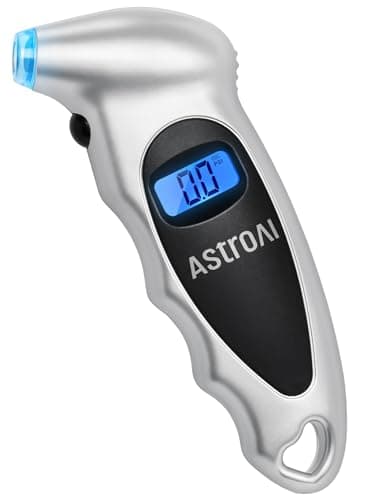
Buy the compact AstroAI 150 PSI. It publishes an accuracy figure of plus or minus 1 PSI — in the listing title itself — reads to 0.1 PSI, and has a backlit screen — because tire valves are always in the dark. Almost nothing else in this category publishes an accuracy figure at all, and the gauge on a gas-station pump is very likely worse than this one. It measures only; inflating is a separate tool.
| # | Pick | Install | Score | Price |
|---|---|---|---|---|
| 1 | AstroAI Digital Tire Gauge (150 PSI) Knowing what your tires are actually at | Drops in | 8.4/10 | $6.99 - view on Amazon |
| 2 | AstroAI Heavy Duty Tire Gauge (230 PSI) Truck and RV pressures | Drops in | 8.1/10 | $23.99 - view on Amazon |
| 3 | AstroAI Portable Tire Inflator (150 PSI) Topping up four tires in a driveway | Plugs in | 9.1/10 | $26.99 - view on Amazon |
Prices last verified October 19, 2026. They move constantly; the figure on Amazon when you click is the real one.
Accuracy is the only specification that matters
A gauge does one thing. Everything else on a listing — the backlight, the units, the grip, the auto-shutoff — is convenience around a single number, and if that number is wrong the product has failed at its only job.
So it is genuinely strange how few gauges publish an accuracy figure. AstroAI publishes plus or minus 1 PSI on the compact model and, as of this update, nothing at all on the heavy-duty one. Most competitors publish a pressure range and stop.
A pressure range is not an accuracy claim. “0 to 150 PSI” tells you what the display can show, not how close to true it is.
We went back to the sources on the winner for this update and the paperwork had moved. The full AstroAI gauge review sets out which figures AstroAI still publishes, which it has quietly stopped publishing, and the four places its own pages disagree with its listing.
How much error actually matters
Manufacturers specify car tire pressures to the PSI, and the pressures on your door jamb sticker are chosen for handling, wear and fuel consumption together.
| Error | On a 35 PSI target | Consequence |
|---|---|---|
| ±1 PSI | 34 - 36 | Within normal variation. Fine |
| ±3 PSI | 32 - 38 | Noticeably soft or hard; measurable wear and fuel effect |
| ±5 PSI | 30 - 40 | Enough to change how the car handles |
A published plus-or-minus 1 PSI is comfortably inside the range where the error does not matter. An unpublished figure could be anywhere.
Check cold, and what cold actually means
Tire pressures are specified cold, and “cold” means the car has been standing for several hours or has driven less than a mile or so — not that it is a cold day.
Driving heats the air inside the tire and the pressure rises with it, typically by several PSI. Check a warm tire against the door-jamb figure and you will conclude it is overinflated and let air out, and then it will be genuinely underinflated when it cools.
Practically: check in the morning before you drive anywhere. That is the whole rule.
Use the door jamb, not the sidewall
Two numbers exist and people routinely use the wrong one:
- The sticker in the driver's door jamb is your car manufacturer's recommendation for that vehicle. This is the number to use.
- The number molded into the tire sidewall is the tire's maximum safe pressure. It is not a recommendation and it is usually well above what your car wants.
Inflating to the sidewall figure gives you a hard ride, reduced grip and accelerated wear down the center of the tread.
Why TPMS is not a substitute
Modern cars have tire pressure monitoring, and it is genuinely useful. It is also not a gauge. If you want four live numbers rather than one warning light, an aftermarket TPMS shows each corner continuously — though it still does not replace checking with a gauge.
Most TPMS systems are legally required to warn at roughly 25% below the recommended pressure. On a 35 PSI target that is a warning at around 26 PSI — by which point the tire has been meaningfully underinflated for a long time, costing fuel and wearing unevenly the whole way down.
Indirect systems, which infer pressure from wheel rotation speed rather than measuring it, are less precise still and cannot detect all four tires losing pressure together — which is exactly what a seasonal temperature drop does.
TPMS catches a puncture. A gauge catches the slow loss that TPMS is not designed to see.
When to check
- Monthly. Tires lose roughly a pound a month through the rubber itself, with no leak involved.
- At the first cold snap. Pressure falls with ambient temperature, which is why warning lights appear across a whole neighborhood on the same morning.
- Before a long drive. Two minutes, and underinflated tires at sustained highway speed are both a fuel cost and a heat problem — the long-drives checklist has it as the first item.
Digital or dial
Digital reads to 0.1 PSI, switches units, and lights up. It also has a battery, and a battery in a glovebox is a battery you will find dead on the one morning you needed it.
A pencil gauge never goes flat and is far less precise. The sensible answer is a digital gauge you actually use, plus the awareness that it has a battery. Both AstroAI models publish auto shut-off, which is what makes the battery last.
Every pick, with the working
Each entry lists the specifications the maker publishes, the axis scores those specifications produce, and what you give up. Rows that read “Not published” are not omissions on our side: they are things the maker will not commit to in writing, and they cost the product points on the transparency axis. Specifications compiled September 4, 2026.
Our pickKnowing what your tires are actually at
AstroAI Digital Tire Gauge (150 PSI)
0 to 150 PSI, factory calibrated to plus or minus 1 PSI, reading in 0.1 increments across four units with a backlit screen. The gas-station gauge you have been trusting is almost certainly worse than this, and this costs about the same as one tank of fuel.
- Range
- 0-150 PSI / 0-10 Bar / 0-10 Kgf/cm2 / 0-1000 kPa
- Accuracy
- Plus or minus 1 PSI
- Calibration standard
- ANSI B40.7, AstroAI UK listing only
- Resolution
- 0.1 PSI
- Display
- Backlit LCD, 4 selectable units
- Auto shut-off
- 30 seconds
- List price
- Not published
- Warranty
- 1 year, stated
What it gets right
- Published accuracy of plus or minus 1 PSI, stated in the listing title — almost nothing else in this category states an accuracy figure at all
- Reads to 0.1 PSI, which matters because a 3 PSI error is the difference between correct and noticeably underinflated
- Backlit screen, because tire pressures get checked in the dark more often than not
- Auto shut-off after 30 seconds, so the battery lasts
Flaws
- 150 PSI range is far beyond a passenger car, so the useful part of the scale is the bottom fifth
- A digital gauge has a battery, and a battery in a glovebox is a battery you will find dead
- It measures. It does not inflate — that is a separate tool
The working behind the 8.4
- Heat headroom: not scored (weight 22%)
- The maker publishes no operating-temperature ceiling, so this axis is dropped and the other weights are re-normalized.
- Install effort: 10.0 (weight 24%)
- Drops in and sits there. No fixing of any kind, and it comes out again when you sell the car.
- Price against the ceiling: not scored (weight 24%)
- No published list price we could cite on the compile date, so this axis is dropped and the other weights are re-normalized.
- Written commitment: 5.5 (weight 15%)
- 12-month warranty. This is the only promise in the entire listing that a court would read, which is why it is scored and the marketing copy is not.
- Spec transparency: 8.8 (weight 15%)
- 7 of the 8 specifications we went looking for are published by the maker (88%). A blank row is never a guess here: it prints “Not published” and it costs the product points, because a figure nobody will commit to in writing is a figure you cannot check.
Axes with no published input are dropped and the remaining weights re-normalized, so a product is not punished for a category where an axis does not apply. Specifications compiled September 4, 2026 from AstroAI 150 PSI gauge published specifications.
2Truck and RV pressures
AstroAI Heavy Duty Tire Gauge (230 PSI)
Skip this one. It is the bigger, pricier gauge and it no longer publishes an accuracy figure at all, where the compact model states plus or minus 1 PSI in its own title. On a car running at 35 PSI you are also only ever in the bottom seventh of its scale. Buy it if you run truck or RV tires. Otherwise the compact gauge is the same job for less.
0 to 230 PSI in a stainless body, reading in 0.1 increments, with a flashlight in the handle that sounds like a gimmick until the first time you check pressures at night. The listing no longer states an accuracy figure of any kind, which is the problem: it costs several times what the compact gauge does and commits to less about how close to true it reads.
- Range
- 0-230 PSI / 0-16 Bar / 0-16 Kg/cm2 / 0-1585 kPa
- Calibration standard
- Not published
- Body
- Stainless steel
- Display
- Backlit LCD with flashlight
- Units
- PSI, Bar, Kgf/cm2, kPa
- Resolution
- 0.1 PSI
- List price
- Not published
- Warranty
- 1 year, stated
What it gets right
- Reads in 0.1 increments across a published 0-230 PSI / 0-16 Bar / 0-16 Kg/cm2 / 0-1585 kPa range
- Stainless steel body rather than plastic, which survives a glovebox
- Built-in flashlight and backlit LCD, and tire valves are always in the dark
- Covers truck and RV pressures as well, so one gauge does every vehicle you own
Flaws
- 230 PSI on a car that runs at 35 means you are using the bottom seventh of the scale
- Bigger and pricier than the compact gauge, which is the one that states its accuracy
- Still a battery device that will be flat when you need it if you never check
The working behind the 8.1
- Heat headroom: not scored (weight 22%)
- The maker publishes no operating-temperature ceiling, so this axis is dropped and the other weights are re-normalized.
- Install effort: 10.0 (weight 24%)
- Drops in and sits there. No fixing of any kind, and it comes out again when you sell the car.
- Price against the ceiling: not scored (weight 24%)
- No published list price we could cite on the compile date, so this axis is dropped and the other weights are re-normalized.
- Written commitment: 5.5 (weight 15%)
- 12-month warranty. This is the only promise in the entire listing that a court would read, which is why it is scored and the marketing copy is not.
- Spec transparency: 7.5 (weight 15%)
- 6 of the 8 specifications we went looking for are published by the maker (75%). A blank row is never a guess here: it prints “Not published” and it costs the product points, because a figure nobody will commit to in writing is a figure you cannot check.
Axes with no published input are dropped and the remaining weights re-normalized, so a product is not punished for a category where an axis does not apply. Specifications compiled September 4, 2026 from AstroAI 230 PSI heavy duty gauge published specifications.
3Topping up four tires in a driveway
AstroAI Portable Tire Inflator (150 PSI)
150 PSI maximum, a digital gauge, and AstroAI's own published figure of a 195/65/R15 tire going 30 to 36 PSI in under a minute. It also publishes the duty cycle honestly: fifteen minutes of continuous use and then ten minutes of cooling. That duty cycle is the specification that separates a topping-up tool from a tire-filling one.
- Maximum pressure
- 150 PSI
- Power
- 12 V DC
- Duty cycle
- 15 minutes continuous, then 10 minutes cooling
- Published inflation rate
- 195/65/R15 from 30 to 36 PSI in under 1 minute
- Gauge
- Digital, automatic shutoff
- Warranty
- Not published
- Operating range
- Not published
List price $37.99 per AstroAI's own store, captured on the compile date below. Not a live price and not what you will pay — the button is where the real number is.
What it gets right
- Published inflation rate on a named tire size, which is the only useful way to state this figure
- Published duty cycle: 15 minutes on, 10 minutes cooling
- Digital gauge with automatic shutoff at the set pressure
- Around $32 to $38 depending on the model
Flaws
- 15 minutes of continuous running is four tires topped up, not one tire filled from flat
- 150 PSI is a headline number a passenger car will never approach
- 12V socket powered, so a car with the ignition off will run its battery down doing this
The working behind the 9.1
- Heat headroom: not scored (weight 22%)
- The maker publishes no operating-temperature ceiling, so this axis is dropped and the other weights are re-normalized.
- Install effort: 10.0 (weight 24%)
- Plugs into a 12V socket or a USB port. Nothing to mount, nothing to route, reversible in a second.
- Price against the ceiling: 9.5 (weight 24%)
- Listed at $37.99 on the compile date. This site's buyer has a practical ceiling around $150 for a single upgrade, so the scale rewards everything under $100 and falls away sharply past $150. The live price is very often different, and that is what the button is for.
- Written commitment: not scored (weight 15%)
- No warranty term published, so this axis is dropped and the other weights are re-normalized.
- Spec transparency: 7.1 (weight 15%)
- 5 of the 7 specifications we went looking for are published by the maker (71%). A blank row is never a guess here: it prints “Not published” and it costs the product points, because a figure nobody will commit to in writing is a figure you cannot check.
Axes with no published input are dropped and the remaining weights re-normalized, so a product is not punished for a category where an axis does not apply. Specifications compiled September 4, 2026 from AstroAI's 150 PSI tire inflator page.
Prices last verified October 19, 2026. They move constantly; the figure on Amazon when you click is the real one.
Questions people actually ask
How accurate does a tire gauge need to be?
Plus or minus 1 PSI is comfortably good enough — that is inside normal variation on a 35 PSI target. The problem is that most gauges publish no accuracy figure at all, so you have no idea what you are getting.
Should I use the pressure on the tire sidewall?
No. That is the tire's maximum safe pressure, not a recommendation. Use the sticker in the driver's door jamb, which is your car maker's figure for that vehicle.
My car has TPMS. Do I still need a gauge?
Yes. TPMS typically warns only at around 25% below the recommended pressure — about 26 PSI on a 35 PSI target — by which point you have been driving underinflated for a long time. TPMS catches punctures; a gauge catches slow loss.
When should I check pressures?
Cold, meaning the car has been standing for a few hours — so in the morning before you drive. Driving heats the air and raises the reading by several PSI, which leads people to let air out of correctly-inflated tires.