The best aftermarket TPMS sensors
The light on your dash is a legal minimum, not a gauge. It is allowed to stay dark until a tire is a quarter flat, and it never tells you which one.
By Sawyer V. · Published · How we research
We have not tested any of this. Everything below is compiled from published manufacturer specifications, and the arithmetic is printed so you can check it. This page carries affiliate links: if you buy through one we earn a commission at no extra cost to you, and it does not change the order of the picks. Full disclosure.
The short answer
Buy the Masoll M13 or the Tymate TM7. Both publish an accuracy figure of 1.5 PSI, which most of this category does not. Choose the Masoll if you want it to set its own alarm thresholds from your correct pressures and run on solar. Choose the TM7 if you tow, because its 0 to 144 PSI range is the only one here that reaches trailer pressures. Federal rules only require your factory light to come on at 25% below placard pressure, which is why seeing the actual numbers is worth this much.
| # | Pick | Install | Score | Price |
|---|---|---|---|---|
| 1 | Masoll M13 Tire Pressure Monitoring System Setting the alarm thresholds without reading a manual | Drops in | 9.5/10 | $39.99 - view on Amazon |
| 2 | Tymate TM7 Tire Pressure Monitoring System A pressure reading on the dash of a car that never had one | Plugs in | 9.5/10 | $39.99 - view on Amazon |
| 3 | VAOYAO Solar Universal TPMS with 4 External Sensors The cheapest way to see four pressures at once | Drops in | 8.9/10 | $16.39 - view on Amazon |
| 4 | Tymate TM2 Tire Pressure Monitoring System A truck and trailer combination, up to ten tires | Drops in | 8.6/10 | $69.99 - view on Amazon |
Prices last verified September 24, 2026. They move constantly; the figure on Amazon when you click is the real one.
What your factory warning light is actually promising
Every light vehicle sold in the US since the FMVSS No. 138 phase-in has a tire pressure monitoring system. The standard applies to passenger cars, multipurpose passenger vehicles, trucks and buses with a gross vehicle weight rating of 10,000 pounds or less, and what it requires is narrower than most drivers assume.
The system must warn the driver within 20 minutes when one or more tires is 25 percent or more below the vehicle manufacturer’s recommended cold inflation pressure, or a minimum level specified in the standard, whichever is higher.
NHTSA is clear about the status of these systems in its own guidance, describing TPMS as an aid to maintaining proper inflation pressure rather than a replacement for checking. It also notes that indirect systems — the kind that infer pressure from wheel speed rather than measuring it — typically cannot detect under-inflation until a tire is about 30 percent below the others, and cannot detect all four tires losing pressure equally.
What an aftermarket system adds
- Four live numbers instead of one light. You see the pressure in each tire, continuously, rather than a binary warning at a threshold somebody else chose.
- Temperature as well as pressure. Every system here reports both. A tire running hot when the other three are not is the early signal of a problem that pressure alone will not show.
- Which tire. The factory light on many cars does not say. That matters at the roadside in the dark.
- Slow-leak detection. Both Tymate systems and the VAOYAO publish separate fast-leak and slow-leak alarm modes rather than a single low-pressure trip point.
The four systems on published figures
| System | Accuracy | Pressure range | Power | Warranty |
|---|---|---|---|---|
| Masoll M13 | 1.5 PSI | 0 to 87 PSI | Solar | Not published |
| Tymate TM7 | 1.5 PSI | 0 to 144 PSI | 12V socket | Not published |
| VAOYAO Solar | Not published | Up to 3.5 bar (about 51 PSI) | Solar and USB | 12 months |
| Tymate TM2 | Not published | 0 to 87 PSI | Solar and wired | Not published |
The pressure range column is the one that quietly decides fitness for purpose. A passenger car placarded in the thirties is comfortable on any of these. A travel trailer or a light truck running eighty PSI is not — and the VAOYAO states its own ceiling honestly at 3.5 bar, roughly 51 PSI, which rules it out of exactly the job its listing photos suggest.
External cap sensors, and the valve stem problem
All four systems here use external sensors that screw onto the valve stem in place of the cap. That is what makes them a ten-minute fit rather than a tire shop visit, and it comes with two consequences worth knowing before you order.
- Weight on the stem. Tymate recommends metal valve stems for stability and safety with its sensors. If your car has the common rubber snap-in stems, that is a recommendation from the maker to have them changed, which is a tire shop job.
- They are removable, which cuts both ways. A cap sensor is a small electronic device sitting on the outside of your wheel. Most kits ship with anti-theft lock nuts; use them.
- Batteries eventually die. External sensors run on replaceable cells. This is a maintenance item, not a fit-and-forget.
Where the display gets its power
This looks like a footnote and it is not. The Tymate TM7 plugs into the 12V socket, which on a car with one socket means you have just spent it — though it does offer dual USB pass-through, so you get charging ports back. The Masoll, the VAOYAO and the Tymate TM2 all charge by solar, which frees the socket entirely but requires the display to sit somewhere that actually sees daylight.
On a car where the 12V socket is already committed to a dash cam or a charger, solar is the answer. If your dashboard is deeply recessed or you have a heavy tint on the windshield, it is not.
You still need a gauge
NHTSA recommends monthly inspection of inflation pressure, treadwear and tire damage, and notes that under-inflated tires are visually difficult to detect. A monitoring system tells you when something changes; a gauge tells you whether the baseline was right in the first place — which matters especially with the Masoll, since it learns its alarm thresholds from whatever pressure the tires happen to be at when you set it up.
Set the tires correctly with a proper gauge first, then let the monitor watch them. A 12V inflator in the trunk closes the loop, because knowing a tire is low at 6 am is only useful if you can do something about it.
Every pick, with the working
Each entry lists the specifications the maker publishes, the axis scores those specifications produce, and what you give up. Rows that read “Not published” are not omissions on our side: they are things the maker will not commit to in writing, and they cost the product points on the transparency axis. Specifications compiled September 4, 2026.
Our pickSetting the alarm thresholds without reading a manual
Masoll M13 Tire Pressure Monitoring System
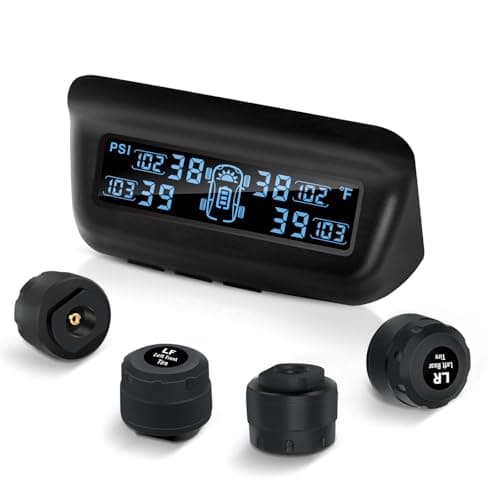
Masoll's argument is the setup: inflate the tires to the correct pressure, and the system learns that as the baseline and sets its own alarm thresholds. Stated accuracy is 1.5 PSI over a 0 to 87 PSI range, with solar charging plus overheat and overcharge protection on the panel.
- Sensors
- 4 external
- Stated accuracy
- 1.5 PSI
- Pressure range
- 0 to 87 PSI
- Power
- Solar, with overheat and overcharge protection
- Threshold setting
- Automatic from current pressure
- Display
- Color LCD, automatic backlight
- Warranty
- Not published
List price $39.99 per Amazon listing, September 24, 2026, captured on the compile date below. Not a live price and not what you will pay — the button is where the real number is.
What it gets right
- Self-calibrating: set the tires correctly once and the thresholds set themselves
- Stated accuracy of 1.5 PSI, matching the Tymate TM7
- Solar charging with stated overheat and overcharge protection
- Auto wake and sleep, so it is not drawing power in a parked car
Flaws
- 0 to 87 PSI ceiling, same limitation as the TM2
- Automatic threshold setting is wrong if you inflate to the wrong pressure to begin with
- No published warranty term
The working behind the 9.5
- Heat headroom: not scored (weight 22%)
- The maker publishes no operating-temperature ceiling, so this axis is dropped and the other weights are re-normalized.
- Install effort: 10.0 (weight 24%)
- Drops in and sits there. No fixing of any kind, and it comes out again when you sell the car.
- Price against the ceiling: 9.5 (weight 24%)
- Listed at $39.99 on the compile date. This site's buyer has a practical ceiling around $150 for a single upgrade, so the scale rewards everything under $100 and falls away sharply past $150. The live price is very often different, and that is what the button is for.
- Written commitment: not scored (weight 15%)
- No warranty term published, so this axis is dropped and the other weights are re-normalized.
- Spec transparency: 8.6 (weight 15%)
- 6 of the 7 specifications we went looking for are published by the maker (86%). A blank row is never a guess here: it prints “Not published” and it costs the product points, because a figure nobody will commit to in writing is a figure you cannot check.
Axes with no published input are dropped and the remaining weights re-normalized, so a product is not punished for a category where an axis does not apply. Specifications compiled September 4, 2026 from the Masoll M13 listing.
2A pressure reading on the dash of a car that never had one
Tymate TM7 Tire Pressure Monitoring System
Four external cap sensors and a color display that plugs straight into the 12V socket, with a stated accuracy of 1.5 PSI and a detection range of 0 to 144 PSI. That upper figure is the widest here and it is the one that matters if you tow anything with high-pressure trailer tires. Setup is stated at five minutes.
- Sensors
- 4 external cap sensors
- Stated accuracy
- 1.5 PSI
- Pressure range
- 0 to 144 PSI
- Power
- 12V socket, dual USB pass-through
- Display
- Color LCD, adjustable backlight
- Stated setup time
- 5 minutes
- Valve stem requirement
- Metal recommended
- Warranty
- Not published
List price $39.99 per Amazon listing, September 24, 2026, captured on the compile date below. Not a live price and not what you will pay — the button is where the real number is.
What it gets right
- Stated accuracy of 1.5 PSI, and Tymate publishes the figure rather than implying it
- 0 to 144 PSI detection range, wide enough for light truck and trailer pressures
- Powers from the 12V socket with dual USB pass-through, so it does not cost you a charging port
- Color LCD with adjustable backlight, readable day and night
Flaws
- Occupies the 12V socket permanently, which on a one-socket car is a real cost
- Tymate recommends metal valve stems, which is a garage visit if your car has rubber ones
- Cap sensors have replaceable batteries that will eventually need replacing
The working behind the 9.5
- Heat headroom: not scored (weight 22%)
- The maker publishes no operating-temperature ceiling, so this axis is dropped and the other weights are re-normalized.
- Install effort: 10.0 (weight 24%)
- Plugs into a 12V socket or a USB port. Nothing to mount, nothing to route, reversible in a second.
- Price against the ceiling: 9.5 (weight 24%)
- Listed at $39.99 on the compile date. This site's buyer has a practical ceiling around $150 for a single upgrade, so the scale rewards everything under $100 and falls away sharply past $150. The live price is very often different, and that is what the button is for.
- Written commitment: not scored (weight 15%)
- No warranty term published, so this axis is dropped and the other weights are re-normalized.
- Spec transparency: 8.8 (weight 15%)
- 7 of the 8 specifications we went looking for are published by the maker (88%). A blank row is never a guess here: it prints “Not published” and it costs the product points, because a figure nobody will commit to in writing is a figure you cannot check.
Axes with no published input are dropped and the remaining weights re-normalized, so a product is not punished for a category where an axis does not apply. Specifications compiled September 4, 2026 from the Tymate TM7 listing.
3The cheapest way to see four pressures at once
VAOYAO Solar Universal TPMS with 4 External Sensors
Sixteen dollars for four sealed cap sensors and a solar display with six alarm modes, and it is the only system on this page that publishes a warranty term at all: a stated 12-month money-back or replacement guarantee. VAOYAO also states the limit honestly, that the system suits tire pressures under 3.5 bar, roughly 51 PSI.
- Sensors
- 4 external cap sensors, sealed
- Pressure ceiling
- 3.5 bar (about 51 PSI)
- Alarm modes
- 6
- Power
- Solar and USB
- Display
- Backlit LCD, bar/PSI and C/F
- Warranty
- 12 months, stated
- Stated accuracy
- Not published
List price $16.39 per Amazon listing, September 24, 2026, captured on the compile date below. Not a live price and not what you will pay — the button is where the real number is.
What it gets right
- The only system here with a published warranty term: stated 12 months
- Six alarm modes, matching systems at four times the price
- Solar and USB charging, so it does not occupy the 12V socket
- Sensors stated sealed against dust, snow and water
Flaws
- Rated only to 3.5 bar (about 51 PSI), so it is a passenger-car system and not a trailer one
- No stated accuracy figure, which the Tymate and Masoll systems both publish
- Monochrome LCD rather than the color displays the pricier systems use
The working behind the 8.9
- Heat headroom: not scored (weight 22%)
- The maker publishes no operating-temperature ceiling, so this axis is dropped and the other weights are re-normalized.
- Install effort: 10.0 (weight 24%)
- Drops in and sits there. No fixing of any kind, and it comes out again when you sell the car.
- Price against the ceiling: 10.0 (weight 24%)
- Listed at $16.39 on the compile date. This site's buyer has a practical ceiling around $150 for a single upgrade, so the scale rewards everything under $100 and falls away sharply past $150. The live price is very often different, and that is what the button is for.
- Written commitment: 5.5 (weight 15%)
- 12-month warranty. This is the only promise in the entire listing that a court would read, which is why it is scored and the marketing copy is not.
- Spec transparency: 8.6 (weight 15%)
- 6 of the 7 specifications we went looking for are published by the maker (86%). A blank row is never a guess here: it prints “Not published” and it costs the product points, because a figure nobody will commit to in writing is a figure you cannot check.
Axes with no published input are dropped and the remaining weights re-normalized, so a product is not punished for a category where an axis does not apply. Specifications compiled September 4, 2026 from the VAOYAO solar TPMS listing.
4A truck and trailer combination, up to ten tires
Tymate TM2 Tire Pressure Monitoring System
Solar charging plus a wired option, so the display never touches your 12V socket, and support for up to ten tires with the screen switching between the tow vehicle and the trailer. Six alarm modes covering fast leak, slow leak, high and low pressure, high temperature and sensor faults. The pressure ceiling is 87 PSI, well below the TM7.
- Sensors
- 4 external, expandable
- Max tires monitored
- 10
- Pressure range
- 0 to 87 PSI
- Power
- Solar with wired backup
- Alarm modes
- 6
- Display
- Color LCD, automatic backlight
- Stated accuracy
- Not published
- Warranty
- Not published
List price $69.99 per Amazon listing, September 24, 2026, captured on the compile date below. Not a live price and not what you will pay — the button is where the real number is.
What it gets right
- Solar charging with a wired backup, so it frees the 12V socket entirely
- Monitors up to 10 tires and switches the display between tow vehicle and trailer
- Six alarm modes including fast leak, slow leak and sensor fault
- Stated low-power external sensors and automatic backlight adjustment
Flaws
- 0 to 87 PSI only, which is short of what many trailer tires are inflated to
- Most expensive system here, and the extra spend buys tire count rather than accuracy
- Solar means the display has to live somewhere that sees daylight, which is not every dash
The working behind the 8.6
- Heat headroom: not scored (weight 22%)
- The maker publishes no operating-temperature ceiling, so this axis is dropped and the other weights are re-normalized.
- Install effort: 10.0 (weight 24%)
- Drops in and sits there. No fixing of any kind, and it comes out again when you sell the car.
- Price against the ceiling: 8.0 (weight 24%)
- Listed at $69.99 on the compile date. This site's buyer has a practical ceiling around $150 for a single upgrade, so the scale rewards everything under $100 and falls away sharply past $150. The live price is very often different, and that is what the button is for.
- Written commitment: not scored (weight 15%)
- No warranty term published, so this axis is dropped and the other weights are re-normalized.
- Spec transparency: 7.5 (weight 15%)
- 6 of the 8 specifications we went looking for are published by the maker (75%). A blank row is never a guess here: it prints “Not published” and it costs the product points, because a figure nobody will commit to in writing is a figure you cannot check.
Axes with no published input are dropped and the remaining weights re-normalized, so a product is not punished for a category where an axis does not apply. Specifications compiled September 4, 2026 from the Tymate TM2 listing.
Prices last verified September 24, 2026. They move constantly; the figure on Amazon when you click is the real one.
Questions people actually ask
At what pressure does the factory TPMS light come on?
FMVSS No. 138 requires a warning within 20 minutes when a tire is 25 percent or more below the vehicle maker’s recommended cold inflation pressure, or a minimum specified in the standard, whichever is higher. On a car placarded at 35 PSI that is around 26 PSI. Your car may warn earlier; it is not required to.
Do I need an aftermarket TPMS if my car already has one?
Need, no. The value is seeing four live numbers instead of one threshold light, knowing which tire is low, and getting temperature as well as pressure. On a trailer, an older vehicle outside the FMVSS 138 scope, or a car whose light does not identify the tire, the case is much stronger.
Will external cap sensors damage my valve stems?
Tymate recommends installing its sensors with metal valve stems for stability and safety. Rubber snap-in stems are common on passenger cars and are less suited to carrying the extra mass at speed. Treat a stem change as part of the cost if that is what your car has.
Does a TPMS replace checking tires with a gauge?
No, and NHTSA says so directly, describing tire pressure monitoring systems as an aid to maintaining proper inflation rather than a substitute for inspection. It recommends monthly checks of pressure, treadwear and damage.
Which system works for a trailer or an RV?
Of these four, the Tymate TM7 with its 0 to 144 PSI range is the only one that reaches typical trailer pressures. The TM2 tops out at 87 PSI but monitors up to ten tires and switches the display between tow vehicle and trailer. The VAOYAO is rated to about 51 PSI and is a passenger-car system.
Sources
- NHTSA, Tire Pressure Monitoring System (FMVSS No. 138) requirements
- NHTSA tire safety guidance: monthly checks and TPMS limitations
- Tymate TM7 published 1.5 PSI accuracy and 0 to 144 PSI range
- Masoll M13 published accuracy, range and automatic threshold setting
- Tymate TM2 published alarm modes, ten-tire support and 0 to 87 PSI range
- VAOYAO solar TPMS published 3.5 bar ceiling and 12-month guarantee