The best jump starter and inflator combos
One device covers the two failures that strand a commuter. It also doubles the number of ways one dead device leaves you stuck.
By Sawyer V. · Published · How we research
We have not tested any of this. Everything below is compiled from published manufacturer specifications, and the arithmetic is printed so you can check it. This page carries affiliate links: if you buy through one we earn a commission at no extra cost to you, and it does not change the order of the picks. Full disclosure.
The short answer
Peak amps are the number on the box and the one you should ignore. No maker in this category publishes a test standard for peak current, and claims run from 2000A to 8000A on similar hardware. The figures that can actually be checked are capacity in watt-hours, airflow in liters per minute at a stated pressure, and a continuous duty limit. HULKMAN publishes all three; most of the category publishes none.
| # | Pick | Install | Score | Price |
|---|---|---|---|---|
| 1 | HULKMAN Alpha Storm Jump Starter with Air Compressor The most checkable figures in roadside gear | Plugs in | 9.0/10 | $309.99 - view on Amazon |
| 2 | AstroAI Digital Tire Gauge (150 PSI) Knowing what your tires are actually at | Drops in | 8.4/10 | $6.99 - view on Amazon |
| 3 | AVAPOW Jump Starter with Air Compressor A 150 PSI compressor, if the peak-amp number does not bother you | Plugs in | 7.6/10 | $89.99 - view on Amazon |
Prices last verified October 26, 2026. They move constantly; the figure on Amazon when you click is the real one.
The peak amp problem, stated plainly
Every jump starter is sold on a peak amp figure. It is printed largest on the box, it is in the product title, and it is the number buyers compare.
There is no published test standard for it. Not from these makers, not from the category. It is not defined how long the current must be sustained, at what temperature, into what load, or at what terminal voltage — all of which change the answer by a large multiple.
The practical evidence is in the product lines themselves. AVAPOW sells units at 2000A, 3000A, 4000A, 6000A and 8000A peak, in comparable physical packages with the same 150 PSI compressor. A figure that quadruples across similar hardware without a stated method is a marketing number.
Reading the compressor half
Maximum PSI is the specification everyone quotes and it is nearly irrelevant. Car tires run somewhere around 30 to 36 PSI; a compressor rated to 120 and one rated to 150 both reach that comfortably.
Three other figures decide whether the compressor is any use:
- Airflow with a pressure attached. HULKMAN publishes 48 LPM at 40 PSI. Airflow quoted with no pressure is meaningless, because flow collapses as pressure rises
- Continuous duty limit. HULKMAN publishes up to 25 minutes at 30 PSI. Small compressors overheat and cut out, and this is the figure that tells you it will finish the tire
- Auto shut-off at a set pressure. Both units have it. It is what lets you set a target and stop watching a gauge in the dark
| HULKMAN Alpha Storm | AVAPOW combo | |
|---|---|---|
| Battery capacity | 64Wh | Not published |
| Peak current claim | 2500A | 2000-8000A by model |
| Published test standard for peak | None | None |
| Maximum pressure | 120 PSI | 150 PSI |
| Airflow | 48 LPM at 40 PSI | Not published |
| Continuous duty | Up to 25 min at 30 PSI | Not published |
| Engine rating | 9.0L gas / 6.5L diesel | Up to 10.0L gas / 8.0L diesel |
HULKMAN goes one further and publishes a worked example: a 265/70R17 SUV tire from 0 to 36.5 PSI in about 4 minutes 10 seconds. Naming the tire size is what makes that figure usable — inflation time without a tire size is another number that means nothing.
One device, two failures — and the argument against
The case for a combo is straightforward. Flat battery and flat tire are the two failures that strand a commuter, and one device in one trunk space covers both. It is less to buy, less to store and less to forget to charge.
The case against is the same sentence read differently. It is also one device to have gone flat, and when it has, you have lost both capabilities at once rather than one.
There is a second, subtler version of the problem: running the compressor hard uses the same battery that does the jump. On a 64Wh pack, inflating a tire from flat leaves meaningfully less in reserve for the start you actually stopped for. If you expect to need both on the same night, separate devices are genuinely the safer architecture — best portable jump starters and best tire inflators.
The failure mode that catches everybody
A jump pack that has been in a trunk for eighteen months is flat. Lithium cells self-discharge, and heat accelerates it — a parked car reaches roughly 60-70 C inside in summer, which is a hostile place to store a battery.
- Charge it every three to six months whether or not you have used it. Put it in a calendar; nobody remembers otherwise
- Check the charge level before a long trip, which is the moment you would actually want it
- Store it in the cabin rather than the trunk if you can. Marginally cooler, and far more likely to get noticed
- Do not store it fully flat. Lithium cells left at zero for months can drop below the voltage at which the protection circuit will allow a recharge
Neither unit here publishes an operating temperature range, which is a real gap on a device designed to live in a car. The same omission runs across portable power — best power banks for car travel.
Using one without damaging anything
Modern jump packs have reverse polarity protection and most will simply refuse to work if the clamps are wrong. That is a safety net, not a license to guess.
- Red to the positive terminal on the dead battery
- Black to an unpainted metal ground point on the engine or chassis, away from the battery — not to the negative terminal. Batteries vent hydrogen and the final connection is the one that can spark
- Wait for the pack's ready indicator before cranking
- Crank in short attempts, a few seconds each, with pauses. Continuous cranking overheats the starter
- Disconnect in reverse order once running, and then drive for long enough to put something back in
The full procedure, including the cases where a jump is the wrong answer, is in how to jump start a car.
Treat the cause, not the morning
A jump pack is a symptom device. If you are using it more than once, something is wrong that it is not fixing.
Test before you replace anything — a flat battery with a healthy charging system is a worn battery, and a flat battery with a low charging reading is an alternator — best car battery testers. If the cause is short trips or a car that sits, a maintenance charger overnight solves it properly — best car battery chargers.
And if pressures are the recurring problem rather than the battery, a gauge is a more accurate tool than any compressor's built-in readout — best tire pressure gauges.
Every pick, with the working
Each entry lists the specifications the maker publishes, the axis scores those specifications produce, and what you give up. Rows that read “Not published” are not omissions on our side: they are things the maker will not commit to in writing, and they cost the product points on the transparency axis. Specifications compiled September 4, 2026.
Our pickThe most checkable figures in roadside gear
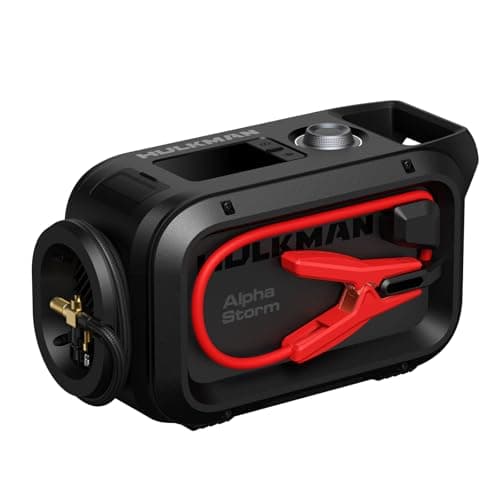
HULKMAN Alpha Storm Jump Starter with Air Compressor
Publishes what the rest of this category will not: a battery capacity in watt-hours, an airflow rate at a stated pressure, a continuous-run limit, and a measured inflation time for a named tire size. Peak amps are unverifiable marketing; watt-hours and liters per minute are not.
- Battery capacity
- 64Wh
- Peak current
- 2500A (no published test standard)
- Maximum pressure
- 120 PSI
- Airflow
- 48 LPM at 40 PSI
- Continuous duty
- Up to 25 minutes at 30 PSI
- Engine rating
- Up to 9.0L gas / 6.5L diesel
- Operating temperature
- Not published
- List price
- Not published
What it gets right
- Publishes capacity in watt-hours — 64Wh — rather than only a peak-amp number nobody can verify
- Publishes airflow with the pressure attached: 48 LPM at 40 PSI, and a 120 PSI maximum
- Publishes a continuous duty limit: up to 25 minutes at 30 PSI, which is the figure that tells you it will not overheat mid-tire
- Publishes a worked example — a 265/70R17 SUV tire from 0 to 36.5 PSI in about 4 minutes 10 seconds
- Rated for engines up to 9.0L gas and 6.5L diesel, with a stated 2500A peak
Flaws
- One device doing two jobs is one device to have failed or flat when you need either
- 64Wh is modest; running the compressor hard leaves less in reserve for the jump you actually stopped for
- Peak amp figures across this whole category have no published test standard behind them, including this one
- No published operating temperature range, on a device stored in a trunk
The working behind the 9.0
- Heat headroom: not scored (weight 22%)
- The maker publishes no operating-temperature ceiling, so this axis is dropped and the other weights are re-normalized.
- Install effort: 10.0 (weight 24%)
- Plugs into a 12V socket or a USB port. Nothing to mount, nothing to route, reversible in a second.
- Price against the ceiling: not scored (weight 24%)
- No published list price we could cite on the compile date, so this axis is dropped and the other weights are re-normalized.
- Written commitment: not scored (weight 15%)
- No warranty term published, so this axis is dropped and the other weights are re-normalized.
- Spec transparency: 7.5 (weight 15%)
- 6 of the 8 specifications we went looking for are published by the maker (75%). A blank row is never a guess here: it prints “Not published” and it costs the product points, because a figure nobody will commit to in writing is a figure you cannot check.
Axes with no published input are dropped and the remaining weights re-normalized, so a product is not punished for a category where an axis does not apply. Specifications compiled September 4, 2026 from HULKMAN Alpha Storm published capacity, airflow and duty cycle.
2Knowing what your tires are actually at
AstroAI Digital Tire Gauge (150 PSI)
0 to 150 PSI, factory calibrated to plus or minus 1 PSI, reading in 0.1 increments across four units with a backlit screen. The gas-station gauge you have been trusting is almost certainly worse than this, and this costs about the same as one tank of fuel.
- Range
- 0-150 PSI / 0-10 Bar / 0-10 Kgf/cm2 / 0-1000 kPa
- Accuracy
- Plus or minus 1 PSI
- Calibration standard
- ANSI B40.7, AstroAI UK listing only
- Resolution
- 0.1 PSI
- Display
- Backlit LCD, 4 selectable units
- Auto shut-off
- 30 seconds
- List price
- Not published
- Warranty
- 1 year, stated
What it gets right
- Published accuracy of plus or minus 1 PSI, stated in the listing title — almost nothing else in this category states an accuracy figure at all
- Reads to 0.1 PSI, which matters because a 3 PSI error is the difference between correct and noticeably underinflated
- Backlit screen, because tire pressures get checked in the dark more often than not
- Auto shut-off after 30 seconds, so the battery lasts
Flaws
- 150 PSI range is far beyond a passenger car, so the useful part of the scale is the bottom fifth
- A digital gauge has a battery, and a battery in a glovebox is a battery you will find dead
- It measures. It does not inflate — that is a separate tool
The working behind the 8.4
- Heat headroom: not scored (weight 22%)
- The maker publishes no operating-temperature ceiling, so this axis is dropped and the other weights are re-normalized.
- Install effort: 10.0 (weight 24%)
- Drops in and sits there. No fixing of any kind, and it comes out again when you sell the car.
- Price against the ceiling: not scored (weight 24%)
- No published list price we could cite on the compile date, so this axis is dropped and the other weights are re-normalized.
- Written commitment: 5.5 (weight 15%)
- 12-month warranty. This is the only promise in the entire listing that a court would read, which is why it is scored and the marketing copy is not.
- Spec transparency: 8.8 (weight 15%)
- 7 of the 8 specifications we went looking for are published by the maker (88%). A blank row is never a guess here: it prints “Not published” and it costs the product points, because a figure nobody will commit to in writing is a figure you cannot check.
Axes with no published input are dropped and the remaining weights re-normalized, so a product is not punished for a category where an axis does not apply. Specifications compiled September 4, 2026 from AstroAI 150 PSI gauge published specifications.
3A 150 PSI compressor, if the peak-amp number does not bother you
AVAPOW Jump Starter with Air Compressor
Skip this one. The compressor is the better half — 150 PSI with preset modes and auto shut-off is genuinely useful. The problem is the other half. AVAPOW sells physically comparable units badged 2000A, 3000A, 4000A, 6000A and 8000A peak, with no published test standard behind any of them. An 8000A claim on a device this size is not a specification, and a number that escalates across a product line without a test method is one to discount entirely.
The compressor side is the stronger half — 150 PSI with preset modes and auto shut-off, which is a real convenience when inflating to a target. The jump-starter side is where this page's caution lives: AVAPOW sells physically similar units rated at 2000A, 3000A, 4000A, 6000A and 8000A peak, and publishes no test standard for any of them.
- Battery capacity
- Not published
- Peak current
- 2000-8000A depending on model (no published test standard)
- Maximum pressure
- 150 PSI
- Airflow
- Not published
- Continuous duty
- Not published
- Engine rating
- Up to 10.0L gas / 8.0L diesel on the larger models
- Operating temperature
- Not published
- List price
- Not published
What it gets right
- Published 150 PSI maximum pressure, higher than the alternative here
- Preset inflation modes with auto shut-off, so it stops at the pressure you set rather than needing watching
- Digital display on the compressor rather than an analogue gauge you read by flashlight
- Published engine ratings scale with the model, up to 10.0L gas and 8.0L diesel
Flaws
- Peak-amp ratings across the AVAPOW range run from 2000A to 8000A on comparable hardware with no published test method — an 8000A claim on a consumer jump pack is not a specification
- No published watt-hour capacity on most models, which is the figure that actually predicts how many starts you get
- No published airflow rate, so inflation speed cannot be compared with anything
- No published continuous duty limit for the compressor
The working behind the 7.6
- Heat headroom: not scored (weight 22%)
- The maker publishes no operating-temperature ceiling, so this axis is dropped and the other weights are re-normalized.
- Install effort: 10.0 (weight 24%)
- Plugs into a 12V socket or a USB port. Nothing to mount, nothing to route, reversible in a second.
- Price against the ceiling: not scored (weight 24%)
- No published list price we could cite on the compile date, so this axis is dropped and the other weights are re-normalized.
- Written commitment: not scored (weight 15%)
- No warranty term published, so this axis is dropped and the other weights are re-normalized.
- Spec transparency: 3.8 (weight 15%)
- 3 of the 8 specifications we went looking for are published by the maker (38%). A blank row is never a guess here: it prints “Not published” and it costs the product points, because a figure nobody will commit to in writing is a figure you cannot check.
Axes with no published input are dropped and the remaining weights re-normalized, so a product is not punished for a category where an axis does not apply. Specifications compiled September 4, 2026 from AVAPOW published pressure, modes and engine ratings.
Prices last verified October 26, 2026. They move constantly; the figure on Amazon when you click is the real one.
Questions people actually ask
Are peak amps on a jump starter meaningful?
Not as published. No maker in this category states a test standard for peak current — how long it is sustained, at what temperature or into what load — and claims run from 2000A to 8000A on comparable hardware. Read watt-hours and the engine displacement rating instead.
Is a jump starter with a built-in compressor worth it?
For most commuters yes — it covers the two failures that actually strand people, in one trunk space. The trade is that one dead device costs you both capabilities, and running the compressor draws down the same pack that does the jump.
How often should I charge a jump starter?
Every three to six months regardless of use. Lithium cells self-discharge and heat accelerates it, and a parked car reaches roughly 60-70 C inside in summer. A pack left flat for months may drop below the voltage its protection circuit will recharge from.
Where do I clamp the black lead?
To an unpainted metal ground point on the engine or chassis, away from the battery — not to the negative terminal. Batteries vent hydrogen and the last connection made is the one that can spark.