UGREEN 130W Car Charger review
One hundred and thirty watts, and a published table showing that two of the three ports collapse to 12W each the moment you share them. Which makes this a laptop charger that tolerates a phone, not a three-phone charger.
By Sawyer V. · Published · How we research
We have not tested any of this. Everything below is compiled from published manufacturer specifications, and the arithmetic is printed so you can check it. This page carries affiliate links: if you buy through one we earn a commission at no extra cost to you, and it does not change the order of the picks. Full disclosure.
The verdict
Buy it if you charge a laptop in your car. Do not buy it to charge three phones. The 100 W USB-C port is real and it keeps its full 100 W no matter what else is plugged in — that is the reason this charger exists and it genuinely runs a laptop at full speed. But UGREEN also publishes what happens to the other two ports when you share them, and the answer is 12 W each. Not 30. Not 22.5. Twelve.
So the honest shape of this product is one laptop plus one phone, not three devices. At a street price in the low twenties with a 100 W cable already in the box, that is still good value — the cable alone is most of the price gap to a cheaper charger. Buy the Anker 323 instead if there is no laptop in the picture, because 30 W is all a phone will take anyway.
| # | Pick | Install | Score | Price |
|---|---|---|---|---|
| 1 | UGREEN 130W 3-Port Car Charger A laptop and two phones at once | Plugs in | 9.5/10 | $21.99 - view on Amazon |
Prices last verified October 8, 2026. They move constantly; the figure on Amazon when you click is the real one.
What it is
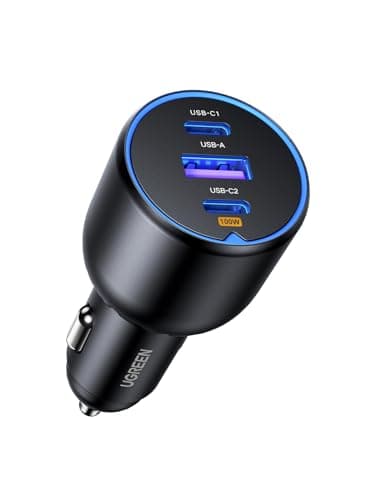
UGREEN model EC705, also sold under SKU 90889. Three ports — two USB-C and one USB-A — in a 12V socket plug, rated 130 W total, with a 1 meter 5 A USB-C cable in the box. Input is published as 12 to 24 V, so it works in a truck as well as a car.
A 5 A cable is an E-marked cable: above 3 A, USB-C requires a chip in the connector telling the charger it is safe to go higher, and a cable without one caps you at 60 W no matter what the charger can supply. Including one is a real part of the value here — it is the thing the cables page exists to warn people about, and most chargers in this class ship no cable at all.
The reason this product earns a page of its own is not the 130 W. It is that UGREEN publishes a per-port distribution table, which almost nobody in this category does, and that table contradicts the headline in a way worth reading before you buy.
The table, which is the whole review
Here is what each port is rated for on its own, and then what each one actually delivers when you use more than one at a time.
| Ports in use | USB-C1 | USB-C2 | USB-A |
|---|---|---|---|
| C1 alone | 30 W | — | — |
| C2 alone | — | 100 W | — |
| USB-A alone | — | — | 22.5 W (SCP) / 18 W (QC) |
| C1 + C2 | 30 W | 100 W | — |
| C2 + USB-A | — | 100 W | 18 W |
| C1 + USB-A | 12 W | — | 12 W |
| C1 + C2 + USB-A | 12 W | 100 W | 12 W |
Read the bottom two rows twice. The moment USB-C1 and USB-A are both occupied, they stop being a 30 W port and a 22.5 W port and become two 12 W ports. That happens whether or not the big port is in use — it is a property of those two sharing a rail, not of the charger running out of headroom.
The 100W port is the product
Everything good about this charger is on USB-C2. It is rated 100 W on its own and the published table shows it holding 100 W in every combination, including with both other ports occupied. It is a dedicated rail rather than a share of a pool.
That matters because 100 W is a real laptop charge. A 13-inch ultrabook typically asks for 45 to 65 W and a 16-inch machine 96 to 100 W, so this is the rare car charger that will hold a big laptop at full speed rather than slowing its discharge. What that does and does not solve is worked through in can you charge a laptop in your car.
And it is the reason to pick this over an inverter. An inverter converts 12V DC up to 110V AC so your laptop's own brick can convert it back down to DC — two conversions, both lossy, both producing heat, to arrive where a USB-C PD port starts. If your laptop charges over USB-C, the inverter is a worse answer at a higher price; car power inverters explained has the arithmetic.
130W in a socket that may not supply it
This is the constraint the box does not mention. A 12V accessory socket is typically fused at 10 to 15 amps, and on a lot of cars two sockets share one fuse.
Drawing 130 W out of a 12 V supply means pulling more than 10.8 amps before you count conversion losses — so a fully loaded charger sits at or past a 10 A fuse and uncomfortably close to a 15 A one. In a 24V truck the same130 W is only about 5.4 amps, which is why the 12-24 V input is more than a footnote: this charger is much happier in a truck than in a small car.
- Check the fuse before you load all three ports. The owner's manual lists it, usually as "accessory socket" or "cigar lighter"
- A laptop alone is fine. 100 W is about 8.3 A at 12 V, inside a 10 A fuse with a little room
- Do not run it through a splitter. A socket splitter does not create more fuse, and this charger can use the whole of one on its own
Why there is still a USB-A port
USB-A on a 2026 charger looks like a legacy fitting, and on this one it is the port that drags C1 down to 12 W when both are used. So is it dead weight?
Not quite. It is the port for the things in a car that never moved to USB-C: an older dashcam's power lead, a tire inflator, a passenger's hand-me-down phone, the cable already living in the door pocket. Its 22.5 W SCP rating is also genuinely useful on Huawei and Honor handsets, which is a protocol most chargers skip. The trade-offs between the two connectors are in USB-A vs USB-C in the car.
What it is not is a second fast port. If you want two phones charging properly at once, you want two independent USB-C ports, which is a different product — best multi-port car chargers.
Protocol support, and the one that matters for Samsung
UGREEN lists PD 3.0, QC 4.0, QC 3.0, SCP, AFC and PPS. The one worth singling out is PPS, because Samsung's fastest charging modes need PPS specifically rather than plain USB Power Delivery, and plenty of chargers marketed on wattage alone do not publish PPS support at all.
If you carry a recent Galaxy, PPS is the line on the spec sheet to look for, and this charger has it. The fuller explanation is on best car chargers for Android.
What we cannot tell you
We have not tested this charger. Everything above is UGREEN's own published figures and the arithmetic on top of them. Three things are missing from those figures and we are not going to fill them in:
- No operating-temperature range. This is a power supply that lives in a cabin reaching 60 to 70 C in summer sun, and UGREEN publishes no ceiling for it. Most of this category publishes none either, which is why the site scores that silence rather than ignoring it
- No warranty term. UGREEN does not publish a length for this product on the pages we could read
- No efficiency figure. A charger delivering 100 W is dissipating real heat into a plastic body in a hot socket, and nobody publishes how much
We also found UGREEN's own regional pages and its retail listings disagreeing about USB-C1: most sources publish 30 W, one lists 20 W. The 30 W figure is the one that appears on UGREEN's own listings and in the distribution table, so that is the figure used above — but if the 30 W port is the reason you are buying, check the listing in front of you rather than trusting this page.
Buy it if
- You charge a laptop in the car. This is the case it is built for, and the 100 W port holds its rating no matter what else is connected
- You drive a truck or anything on a 24V system. The published 12-24 V input covers it, and 130 W at 24 V is an easy load
- You do not already own a 100W USB-C cable. One is in the box, and buying it separately is a meaningful fraction of the charger's price
- You carry a recent Samsung. PPS is published, which is the protocol its fastest mode actually needs
Buy something else if
- You are charging two or three phones. The published table puts two of them at 12 W each. A two-port charger where each port keeps its rating is faster and cheaper — see best USB-C car chargers
- There is no laptop. Thirty watts is at or above what any phone accepts, so you are paying for headroom nothing in your pocket can use. The Anker 323 does the phone job for less
- Your car's accessory socket is on a 10A fuse and you intend to load all three ports. Work out the draw first — how many watts do you need
- You need the charger to disappear. This is a three-port body with a light ring, not a flush-fit plug
Every pick, with the working
Each entry lists the specifications the maker publishes, the axis scores those specifications produce, and what you give up. Rows that read “Not published” are not omissions on our side: they are things the maker will not commit to in writing, and they cost the product points on the transparency axis. Specifications compiled September 4, 2026.
Our pickA laptop and two phones at once
UGREEN 130W 3-Port Car Charger
Three ports totaling 130W with one USB-C rated at 100W on its own, a 100W E-marked cable in the box, and a published 45-gram weight. It is the only charger here that will genuinely run a laptop at full speed, and it costs less than the 67W chargers do because UGREEN prices aggressively.
- Ports
- 2 x USB-C, 1 x USB-A
- Total output
- 130 W
- USB-C 1 maximum
- 30 W
- USB-C 2 maximum
- 100 W
- USB-A maximum
- 22.5 W (SCP) / 18 W (QC 3.0)
- Protocols
- PD 3.0, QC 4.0, QC 3.0, SCP, AFC, PPS
- In the box
- 100 W E-marked USB-C to USB-C cable
- Weight
- 45 g
- Warranty
- Not published
- Operating range
- Not published
List price $22.49 per UGREEN's own store, sale price (regular $39.99), captured on the compile date below. Not a live price and not what you will pay — the button is where the real number is.
What it gets right
- 100 W on a single USB-C port, which is a real laptop charge rather than a trickle
- A 100 W E-marked USB-C cable is included, and that cable alone is often $15
- Publishes both per-port ceilings separately (30 W and 100 W) instead of one combined figure
- Broad protocol support: PD 3.0, QC 4.0, QC 3.0, SCP, AFC and PPS
Flaws
- 130 W in a 12V socket is close to what many car circuits are fused for; check your fuse rating
- The second USB-C port is only 30 W, so it is not two laptop ports
- UGREEN publishes no warranty term and no operating-temperature range
The working behind the 9.5
- Heat headroom: not scored (weight 22%)
- The maker publishes no operating-temperature ceiling, so this axis is dropped and the other weights are re-normalized.
- Install effort: 10.0 (weight 24%)
- Plugs into a 12V socket or a USB port. Nothing to mount, nothing to route, reversible in a second.
- Price against the ceiling: 10.0 (weight 24%)
- Listed at $22.49 on the compile date. This site's buyer has a practical ceiling around $150 for a single upgrade, so the scale rewards everything under $100 and falls away sharply past $150. The live price is very often different, and that is what the button is for.
- Written commitment: not scored (weight 15%)
- No warranty term published, so this axis is dropped and the other weights are re-normalized.
- Spec transparency: 8.0 (weight 15%)
- 8 of the 10 specifications we went looking for are published by the maker (80%). A blank row is never a guess here: it prints “Not published” and it costs the product points, because a figure nobody will commit to in writing is a figure you cannot check.
Axes with no published input are dropped and the remaining weights re-normalized, so a product is not punished for a category where an axis does not apply. Specifications compiled September 4, 2026 from UGREEN's 130W car charger product page.
Prices last verified October 8, 2026. They move constantly; the figure on Amazon when you click is the real one.
Questions people actually ask
Does the UGREEN 130W car charger really deliver 130W?
As a total, across ports, yes — but not in the way the number suggests. UGREEN's own distribution table shows USB-C2 holding 100 W in every combination while USB-C1 and USB-A fall to 12 W each whenever both are in use. So 130 W is one big port plus two small ones, not three large ones.
Can the UGREEN 130W charger charge a laptop in a car?
Yes, on the 100 W USB-C2 port, and that port keeps its full rating even with the other two occupied. A 13-inch ultrabook asks for 45 to 65 W and a 16-inch machine up to 100 W, so this holds most laptops at full charging speed rather than merely slowing the drain.
Will a 130W car charger blow my fuse?
It can. 130 W at 12 V is more than 10.8 A before conversion losses, and a 12V accessory socket is typically fused at 10 to 15 A, often shared between two sockets. A laptop alone draws about 8.3 A and is fine. Check the fuse rating in your owner's manual before loading all three ports.
Is the included cable any good?
It is a 1 meter 5 A USB-C cable, which means it carries an E-marker chip — the thing that allows more than 3 A and therefore more than 60 W. Without an E-marked cable the 100 W port cannot deliver 100 W, so including one is not a token accessory.
UGREEN 130W or Anker 323 for a car?
Laptop: UGREEN. Phones only: Anker. Thirty watts is at or above what any current phone will accept, so the Anker's smaller headline does the phone job just as fast for less money, and its two ports each keep their own rating instead of sharing one.
Sources
- UGREEN's 130W car charger product page, for total output, ports and protocol list
- Published per-port maxima and the multi-port power distribution table for the UGREEN 130W car charger
- UGREEN EC705 listing publishing the model number, 130W maximum, 12-24V input and the 1m 5A cable in the box
- UGREEN 130W current Amazon listing, checked for availability