The best accessories for pickup trucks
Three things about a truck change what you should buy: the cab is higher, the bed is open, and the tires need more air than a car compressor can supply.
By Sawyer V. · Published · How we research
We have not tested any of this. Everything below is compiled from published manufacturer specifications, and the arithmetic is printed so you can check it. This page carries affiliate links: if you buy through one we earn a commission at no extra cost to you, and it does not change the order of the picks. Full disclosure.
The short answer
The compressor first. Light truck tires run higher pressures and larger volumes than a car, and most cheap inflators cannot fill them in a sensible time or at all. The VIAIR 88P is built for it. Then a three-channel dash cam that covers the bed as well as the road, then a cup holder mount because a truck dash is further away than a car dash, then a cargo net — because everything in an open box is trying to leave.
| # | Pick | Install | Score | Price |
|---|---|---|---|---|
| 1 | Rhino USA Recovery Tow Strap (3 in x 20 ft) Being pulled out of mud or snow | Drops in | 9.5/10 | $39.90 - view on Amazon |
| 2 | WeatherTech CupFone A car with no vent or dash position that works | Drops in | 9.5/10 | $53.95 - view on Amazon |
| 3 | VIAIR 88P Portable Compressor Actually filling a tire from flat | Plugs in | 9.2/10 | $89.89 - view on Amazon |
| 4 | Rightline Gear Bungee Cargo Net Stopping the trunk redistributing itself | Drops in | 8.6/10 | $54.99 - view on Amazon |
| 5 | TrunkCratePro Collapsible Trunk Organizer Compartments rather than one open box | Drops in | 7.3/10 | Check price on Amazon |
| 6 | Vantrue N4 Three channels, including the cabin | Adhesive | 6.6/10 | $169.99 - view on Amazon |
Prices last verified September 24, 2026. They move constantly; the figure on Amazon when you click is the real one.
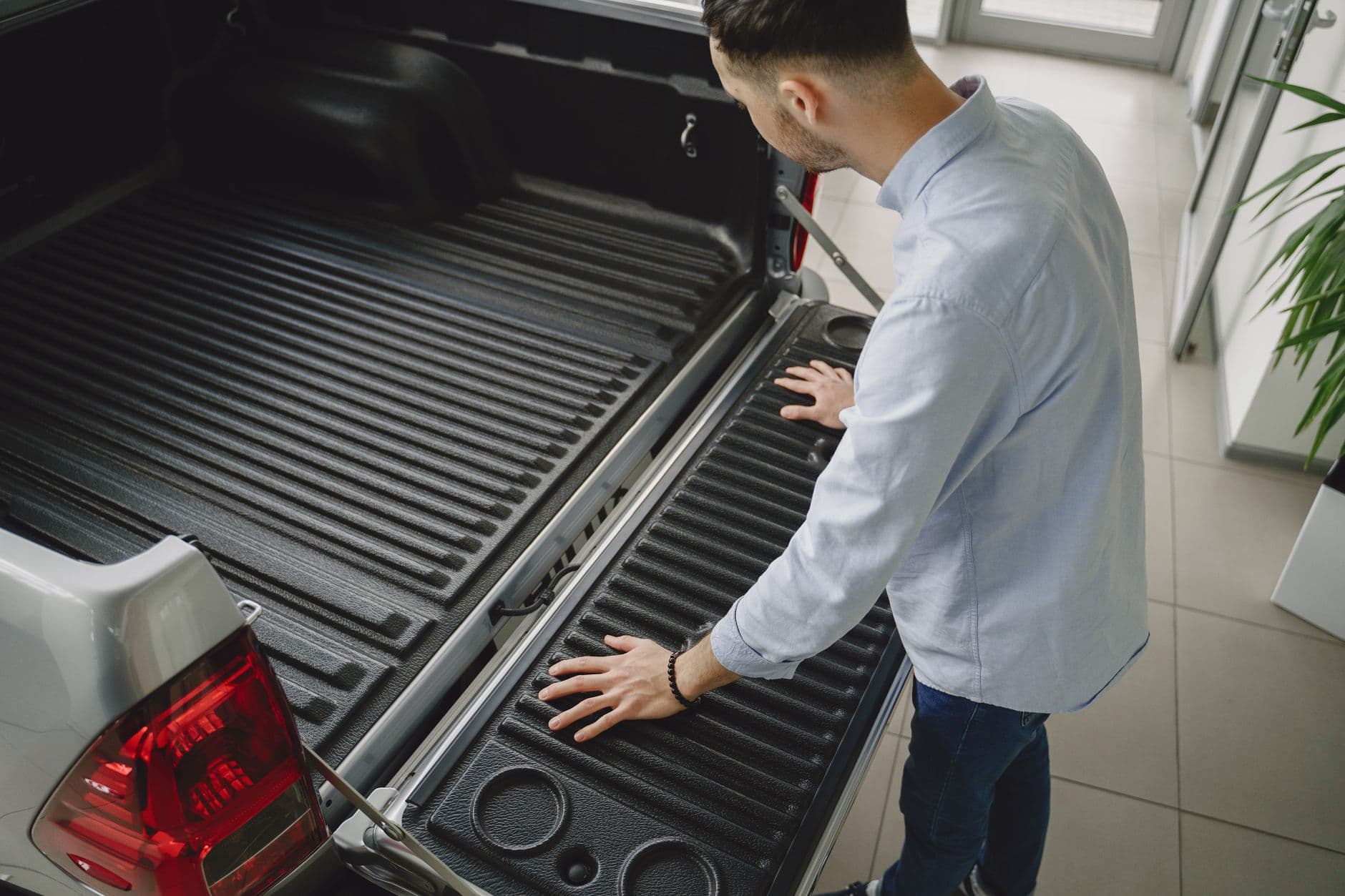
Three things that genuinely differ
Most of this site applies to a truck unchanged. A phone charger is a phone charger. But three physical facts about a pickup change what you should actually buy, and every recommendation on this page comes from one of them.
- The tires are bigger and run harder. More volume, higher pressure, and a compressor sized for a compact car will run its duty cycle out before it finishes one corner.
- The bed is open. Everything in it is exposed to weather, to the road, and to anyone walking past it in a parking lot.
- The cab is bigger. A dashboard mount that is within reach in a hatchback can be a genuine stretch across a full-size truck dash.
The compressor is the one upgrade to not economize on
This is the single most common mistake people make outfitting a truck. A small plastic 12V inflator that fills a sedan tire in three minutes will take a very long time on a light truck tire, and many of them have a duty cycle that stops them before they get there.
What to check: the duty cycle rather than the headline PSI, whether it clamps to the battery rather than running off the 12V socket, and the maximum tire size the maker publishes. The full comparison is on the tire inflator page.
An open bed is a storage problem and a security problem
| Problem | What fixes it | Where it is covered |
|---|---|---|
| Loose items sliding to the tailgate | A cargo net | Cargo nets and tie-downs |
| Groceries and small gear | A crate that folds flat | Collapsible trunk crates |
| Tools and paperwork | Cab storage, not bed storage | Storage for work vehicles |
| Anything you would miss | It does not live in the bed | Car safes and valuables storage |
The last row is the important one. An open bed has no security at all, and no accessory short of a locking cover changes that. Anything valuable belongs in the cab, and anything that has to stay in the cab belongs out of sight — console safes exist for exactly that.
Securing a load properly
- A cargo net stops things migrating, which is most of the problem most of the time. It is not a restraint for anything heavy.
- Ratchet straps are for weight. A net over a washing machine is decoration. Rated straps through anchor points are the answer.
- Check the anchor points, not the strap. The weakest part of any tie-down system is where it attaches, and bed hooks vary enormously between trucks.
- Nothing loose above the bed line. Anything that can catch air at highway speed will eventually leave. See cargo nets and tie-downs.
Recovery gear, and the one rule about it
A truck is the vehicle most likely to be asked to pull something out of something, and a recovery strap is the correct tool. The rule that matters: a recovery strap is not a tow chain and it is never attached to a ball hitch. A ball can shear off under snatch load and become a projectile with the mass of a hammer.
Use rated recovery points, use a rated strap, and keep everybody clear of the line. If the problem is traction rather than a stuck vehicle, recovery boards solve it without involving a second vehicle at all, which is usually the safer answer.
Inside the cab
A full-size truck dash puts a windshield or dash mount noticeably further from the driver’s hand than a car does, and a phone you have to lean forward to reach is a phone you look at for longer. A cup holder mount brings the phone back to where your hand already is, which is why this site rates that position highly in trucks specifically — phone mounts for trucks compares the positions.
For cameras, a three-channel unit covering forward, cabin and rear is the configuration that makes sense on a truck, because the rear channel is watching the bed as well as the road behind. There is a dedicated page for it: dash cams for trucks.
What not to bother with
Bed liners, tonneau covers, lift kits, steps and light bars are all real products with real arguments behind them, and none of them are on this site — they are installed modifications rather than accessories, they are vehicle-specific, and this site only ranks things whose makers publish specifications you can check against your own truck.
What is worth saying: if you buy nothing else on this page, buy the compressor. A truck with properly inflated tires handles better, stops shorter and wears its tires evenly, and it is the one item here that pays for itself.
Every pick, with the working
Each entry lists the specifications the maker publishes, the axis scores those specifications produce, and what you give up. Rows that read “Not published” are not omissions on our side: they are things the maker will not commit to in writing, and they cost the product points on the transparency axis. Specifications compiled September 4, 2026.
Our pickBeing pulled out of mud or snow
Rhino USA Recovery Tow Strap (3 in x 20 ft)
Skip this one. If you do not drive on unpaved surfaces, do not buy this. Recovery is a job with real injury potential done badly, and a tow truck is both safer and more likely to be the right call on a public road.
Publishes a lab-tested break strength of 31,518 lb and carries a lifetime replacement warranty. It also states what it is NOT for, which in recovery gear is the safety-critical half of the specification.
- Size
- 3 in x 20 ft
- Break strength
- 31,518 lb (lab tested)
- Material
- Poly-silk blend, 8% stretch
- Eyelets
- Reinforced and padded
- Not rated for
- Snatch recoveries requiring a running start
- Warranty
- Lifetime replacement
- List price
- Not published
What it gets right
- Publishes a lab-tested break strength figure — 31,518 lb on the 3 in x 20 ft — rather than a vague rating
- Lifetime replacement warranty published brand-wide
- Poly-silk blend with a stated 8% stretch, and reinforced padded eyelets rather than bare stitching
- States it is not for snatch recoveries requiring a running start, which is the misuse that gets people hurt
Flaws
- Break strength is not working load. The widely used rule is a safe working limit of about a third of break strength
- A strap under load stores enormous energy; if a hook or attachment point fails it becomes a projectile
- Recovery points are not tow-ball mounts or bumper brackets — using the wrong point is how bumpers come off
- For most drivers this is gear for a scenario they will never have; a tow service is the safer answer
The working behind the 9.5
- Heat headroom: not scored (weight 22%)
- The maker publishes no operating-temperature ceiling, so this axis is dropped and the other weights are re-normalized.
- Install effort: 10.0 (weight 24%)
- Drops in and sits there. No fixing of any kind, and it comes out again when you sell the car.
- Price against the ceiling: not scored (weight 24%)
- No published list price we could cite on the compile date, so this axis is dropped and the other weights are re-normalized.
- Written commitment: not scored (weight 15%)
- No warranty term published, so this axis is dropped and the other weights are re-normalized.
- Spec transparency: 8.6 (weight 15%)
- 6 of the 7 specifications we went looking for are published by the maker (86%). A blank row is never a guess here: it prints “Not published” and it costs the product points, because a figure nobody will commit to in writing is a figure you cannot check.
Axes with no published input are dropped and the remaining weights re-normalized, so a product is not punished for a category where an axis does not apply. Specifications compiled September 4, 2026 from Rhino USA recovery strap published specifications.
2A car with no vent or dash position that works
WeatherTech CupFone
Puts the phone in a cup holder instead of on the glass, which solves every adhesion and airbag-path problem at once. It publishes exact phone dimensions it accepts and carries a lifetime limited warranty, which nothing else in phone mounting does.
- Phone width accepted
- 2.37 to 3.37 in
- Phone depth accepted
- Up to 0.56 in
- Base
- Interchangeable cups plus separation tool
- Adjustment
- Full tilt and rotation
- Charging access
- Open-access design
- Origin
- Designed and manufactured in USA
- Warranty
- Lifetime limited
- List price
- Not published
What it gets right
- Lifetime limited warranty — no other mount in this ledger commits to that
- Publishes the phone dimensions it accepts: 2.37 to 3.37 in wide, up to 0.56 in deep
- Interchangeable base cups plus an included tool to match your specific cup holder
- Open-access design leaves the charging port reachable while mounted
- Designed and manufactured in the USA
Flaws
- It costs you a cup holder, permanently
- A cup holder sits low, so your eyes travel further from the road than with a vent or dash mount
- The published width range excludes some large phones in thick cases — measure first
- Nothing about it is quick to remove between cars
The working behind the 9.5
- Heat headroom: not scored (weight 22%)
- The maker publishes no operating-temperature ceiling, so this axis is dropped and the other weights are re-normalized.
- Install effort: 10.0 (weight 24%)
- Drops in and sits there. No fixing of any kind, and it comes out again when you sell the car.
- Price against the ceiling: not scored (weight 24%)
- No published list price we could cite on the compile date, so this axis is dropped and the other weights are re-normalized.
- Written commitment: not scored (weight 15%)
- No warranty term published, so this axis is dropped and the other weights are re-normalized.
- Spec transparency: 8.8 (weight 15%)
- 7 of the 8 specifications we went looking for are published by the maker (88%). A blank row is never a guess here: it prints “Not published” and it costs the product points, because a figure nobody will commit to in writing is a figure you cannot check.
Axes with no published input are dropped and the remaining weights re-normalized, so a product is not punished for a category where an axis does not apply. Specifications compiled September 4, 2026 from WeatherTech CupFone published specifications.
3Actually filling a tire from flat
VIAIR 88P Portable Compressor
Skip this one. If your job is checking four car tires on a Sunday, this is more compressor than the task needs and it makes you open the hood to do it. The socket-powered inflator is the right tool for that.
120 PSI, 1.25 CFM at 30 PSI, a 20-amp draw and a duty cycle of 25 minutes at 30 PSI. It clamps to the battery rather than plugging into the 12V socket, which is why it can draw 20 amps and why it moves real air. This is the tool for a truck tire, an off-road airing-up, or anyone who has ever waited twenty minutes for a socket-powered pump.
- Maximum pressure
- 120 PSI
- Airflow
- 1.25 CFM at 30 PSI
- Maximum amp draw
- 20 A
- Duty cycle
- 25 minutes at 30 PSI
- Power
- 12 V DC via battery clamps, 20 A inline fuse
- Dimensions
- 9.80 x 3.20 x 5.60 in
- Weight
- 4.75 lb
- Hose
- 16 ft air hose, 9 ft power cord
- List price
- Not published
- Warranty
- Not published
What it gets right
- 1.25 CFM at 30 PSI, published — an actual airflow figure rather than a headline PSI
- 25-minute duty cycle at 30 PSI, more than double the socket-powered pumps
- Battery clamps with a 20-amp inline fuse, so it is not limited by a 15-amp socket
- 16 ft air hose and 9 ft power cord reaches every corner of a full-size truck
Flaws
- 20-amp draw means clamping to the battery, which means opening the hood every time
- 4.75 lb and 9.8 inches long — this lives in the trunk, not the glovebox
- Overkill for topping up a sedan once a month
The working behind the 9.2
- Heat headroom: not scored (weight 22%)
- The maker publishes no operating-temperature ceiling, so this axis is dropped and the other weights are re-normalized.
- Install effort: 10.0 (weight 24%)
- Plugs into a 12V socket or a USB port. Nothing to mount, nothing to route, reversible in a second.
- Price against the ceiling: not scored (weight 24%)
- No published list price we could cite on the compile date, so this axis is dropped and the other weights are re-normalized.
- Written commitment: not scored (weight 15%)
- No warranty term published, so this axis is dropped and the other weights are re-normalized.
- Spec transparency: 8.0 (weight 15%)
- 8 of the 10 specifications we went looking for are published by the maker (80%). A blank row is never a guess here: it prints “Not published” and it costs the product points, because a figure nobody will commit to in writing is a figure you cannot check.
Axes with no published input are dropped and the remaining weights re-normalized, so a product is not punished for a category where an axis does not apply. Specifications compiled September 4, 2026 from VIAIR's 88P product page.
4Stopping the trunk redistributing itself
Rightline Gear Bungee Cargo Net
Five by six feet unstretched and nine by ten stretched, with twelve rigid hooks and a perimeter bungee that tightens the edges around whatever is under it. Rightline states the hooks are rigid specifically so they hold shape under load — which is the failure mode of every cheap net, where the hooks straighten and let go one at a time.
- Dimensions unstretched
- 5 ft x 6 ft
- Dimensions stretched
- 9 ft x 10 ft
- Hooks
- 12, rigid, relocatable
- Edge
- Adjustable perimeter bungee
- UV protection
- Stated, to preserve elasticity
- Load rating
- Not published
- List price
- Not published
- Warranty
- Not published
What it gets right
- Published stretched and unstretched dimensions, so you can work out whether it covers your load
- Rigid hooks stated not to bend or break, which is the whole difference between nets in this category
- Relocatable hooks and an adjustable perimeter bungee, so one net handles very different loads
- UV protected to keep elasticity, which is what stops it going brittle after two summers
Flaws
- It needs anchor points. Many hatchbacks and sedans have very few, and a net with nothing to hook to is useless
- Sized for a truck bed, so in a car trunk you will have a lot of net and not much load
- A net contains; it does not organize. For that you want a box
The working behind the 8.6
- Heat headroom: not scored (weight 22%)
- The maker publishes no operating-temperature ceiling, so this axis is dropped and the other weights are re-normalized.
- Install effort: 10.0 (weight 24%)
- Drops in and sits there. No fixing of any kind, and it comes out again when you sell the car.
- Price against the ceiling: not scored (weight 24%)
- No published list price we could cite on the compile date, so this axis is dropped and the other weights are re-normalized.
- Written commitment: not scored (weight 15%)
- No warranty term published, so this axis is dropped and the other weights are re-normalized.
- Spec transparency: 6.3 (weight 15%)
- 5 of the 8 specifications we went looking for are published by the maker (63%). A blank row is never a guess here: it prints “Not published” and it costs the product points, because a figure nobody will commit to in writing is a figure you cannot check.
Axes with no published input are dropped and the remaining weights re-normalized, so a product is not punished for a category where an axis does not apply. Specifications compiled September 4, 2026 from Rightline Gear bungee cargo net published specifications.
5Compartments rather than one open box
TrunkCratePro Collapsible Trunk Organizer
The compartmented answer to the same problem: published at 23.6 by 14.6 by 12.5 inches with internal dividers, so bottles stand up instead of rolling. It publishes dimensions but not a load rating, which is where the rigid crate beats it on paper.
- Capacity
- Not published
- Load rating
- Not published
- Open dimensions
- 23.6 x 14.6 x 12.5 in
- Collapsed height
- Not published
- Compartments
- Yes, internal dividers
- Warranty
- Not published
- List price
- Not published
What it gets right
- Published external dimensions of 23.6 x 14.6 x 12.5 in
- Internal compartments keep bottles and tall items upright rather than rolling loose
- Collapses flat when not needed, like the rigid crates
- Fabric sides with a reinforced base, so it is lighter than a plastic crate of the same size
Flaws
- No published load rating, which the rigid plastic crates do publish
- Fabric sides bow outward under weight in a way rigid walls do not
- Nothing here restrains the organizer itself — a loaded box still slides in a corner
- No warranty published
The working behind the 7.3
- Heat headroom: not scored (weight 22%)
- The maker publishes no operating-temperature ceiling, so this axis is dropped and the other weights are re-normalized.
- Install effort: 10.0 (weight 24%)
- Drops in and sits there. No fixing of any kind, and it comes out again when you sell the car.
- Price against the ceiling: not scored (weight 24%)
- No published list price we could cite on the compile date, so this axis is dropped and the other weights are re-normalized.
- Written commitment: not scored (weight 15%)
- No warranty term published, so this axis is dropped and the other weights are re-normalized.
- Spec transparency: 2.9 (weight 15%)
- 2 of the 7 specifications we went looking for are published by the maker (29%). A blank row is never a guess here: it prints “Not published” and it costs the product points, because a figure nobody will commit to in writing is a figure you cannot check.
Axes with no published input are dropped and the remaining weights re-normalized, so a product is not punished for a category where an axis does not apply. Specifications compiled September 4, 2026 from TrunkCratePro published dimensions and compartment layout.
6Three channels, including the cabin
Vantrue N4
Skip this one. Unless you drive rideshare or carry passengers you do not know, the cabin channel is a cost with no benefit. A front camera plus a rear camera does the commuter job for less.
Front, cabin and rear on one camera with infrared night vision on the interior channel and the same 70 C published ceiling as the rest of Vantrue's supercapacitor line. It is the camera for somebody who drives for a living or carries passengers they do not know. For a plain commute it is two channels more than you need and $170 more than you need to spend.
- Channels
- Three: front, interior, rear
- Resolution
- 1440p + 1080p + 1080p at 30fps, or 4K front only
- Night vision
- Sony STARVIS with infrared on the cabin channel
- Power store
- Supercapacitor
- Operating range
- -10 C to 70 C (14 F to 158 F)
- Max microSD
- 512 GB
- Parking mode
- 24-hour, motion and collision detection
- GPS
- Supported
- Published current draw
- Not published
List price $259.99 per Vantrue's own store, captured on the compile date below. Not a live price and not what you will pay — the button is where the real number is.
What it gets right
- Three channels recording at once, with IR illumination on the cabin camera
- 70 C published ceiling and a supercapacitor
- 512GB card support, which three channels genuinely need
- 24-hour parking mode with motion and collision detection
Flaws
- $259.99 list is far outside this site's usual bracket
- Three channels fill a card fast, so the running cost is a bigger card sooner
- The interior camera is pointless for most private drivers and creates a privacy question for passengers
The working behind the 6.6
- Heat headroom: 10.0 (weight 22%)
- Published operating ceiling 70 C (158 F). A car parked in summer sun runs roughly 60-70 C inside, so 65 C and up is real headroom, 60 C is living at the limit, and anything under 55 C is a summer problem waiting to happen.
- Install effort: 6.0 (weight 24%)
- Adhesive pad onto the dashboard. Permanent in practice: repositioning means a new pad, and the pad is the part that fails first.
- Price against the ceiling: 2.5 (weight 24%)
- Listed at $259.99 on the compile date. This site's buyer has a practical ceiling around $150 for a single upgrade, so the scale rewards everything under $100 and falls away sharply past $150. The live price is very often different, and that is what the button is for.
- Written commitment: 7.0 (weight 15%)
- 18-month warranty. This is the only promise in the entire listing that a court would read, which is why it is scored and the marketing copy is not.
- Spec transparency: 8.9 (weight 15%)
- 8 of the 9 specifications we went looking for are published by the maker (89%). A blank row is never a guess here: it prints “Not published” and it costs the product points, because a figure nobody will commit to in writing is a figure you cannot check.
Axes with no published input are dropped and the remaining weights re-normalized, so a product is not punished for a category where an axis does not apply. Specifications compiled September 4, 2026 from Vantrue's N4 product page.
Prices last verified September 24, 2026. They move constantly; the figure on Amazon when you click is the real one.
Questions people actually ask
Do I need a different tire inflator for a truck?
Usually yes. Light truck tires hold more air at higher pressure than car tires, and small socket-powered inflators either take a very long time or hit their duty cycle limit first. Look for a published duty cycle and maximum tire size rather than a headline PSI number.
What is the best way to stop things sliding around in a truck bed?
A cargo net for light loose items, rated ratchet straps through proper anchor points for anything heavy, and a folding crate for groceries and small gear. A net over something heavy is not a restraint — it just stops it wandering.
Can I use a recovery strap on a tow ball?
No. A snatch load can shear a ball off its mount and turn it into a projectile. Use rated recovery points, a rated strap, and keep everyone well clear of the line. If the vehicle is simply short of traction, recovery boards avoid the whole situation.
Where should a phone mount go in a pickup truck?
Usually the cup holder. A full-size truck dash sits further from the driver than a car dash, and a windshield mount you have to lean forward to reach keeps your eyes off the road longer. The trucks-specific mount page compares the positions properly.