The best recovery boards and traction mats
Printed load ratings in this category have nothing behind them. One manufacturer names a third-party test instead, and that is the only checkable claim available.
By Sawyer V. · Published · How we research
We have not tested any of this. Everything below is compiled from published manufacturer specifications, and the arithmetic is printed so you can check it. This page carries affiliate links: if you buy through one we earn a commission at no extra cost to you, and it does not change the order of the picks. Full disclosure.
The short answer
Ignore the printed load ratings — none of them states a test method. MAXTRAX publishes something that can actually be checked: reinforced nylon rather than commodity HDPE, tested at the University of Queensland to wrap completely around a 33 inch tire without breaking, at a published 3.4 kg per board. The technique matters more than the board though: spinning a wheel on any of these shears the teeth off in seconds.
| # | Pick | Install | Score | Price |
|---|---|---|---|---|
| 1 | AutoSock Textile Snow Socks A car with no wheel-well clearance for chains | Drops in | 9.0/10 | $274.95 - view on Amazon |
| 2 | MAXTRAX MKII Recovery Boards A named university test rather than a printed load number | Drops in | 8.3/10 | $279.99 - view on Amazon |
| 3 | X-BULL Recovery Traction Boards The budget board, with the trade stated | Drops in | 7.3/10 | $77.89 - view on Amazon |
Prices last verified October 26, 2026. They move constantly; the figure on Amazon when you click is the real one.
The load ratings mean nothing
Every budget recovery board prints a capacity — often a very large number in kilograms or tons. None of them publishes how it was measured.
A board under a wheel is not supporting the vehicle's weight the way a jack stand does. It is being bent, twisted and dragged across an uneven surface while a tire pushes down and forward on one end of it. A static load figure describes none of that, even if it were tested.
This is the same pattern this site has documented across car accessories: a printed number with no method behind it, on the one specification buyers compare. Cargo nets do it with load ratings. Jump starters do it with peak amps. Recovery boards do it here.
Nylon against HDPE
The material is the real difference between the tiers and it is published on one side.
| MAXTRAX MKII | Budget HDPE boards | |
|---|---|---|
| Material | UV-stabilized reinforced nylon | HDPE |
| Named third-party test | University of Queensland | None |
| Published weight | 3.4 kg (7.5 lb) per board | Not published |
| Published footprint | 35 x 13 x 3.5 in | Not published |
| Printed load rating | Not published | Stated, no method |
| Temperature rating | Not published | Not published |
Reinforced nylon is tougher and more flexible than HDPE, and it holds its properties better across a temperature range — which matters, because nobody in this category publishes a temperature rating and these get used at -20 C.
HDPE is not useless. It is what most of the market is made from and it recovers most vehicles most of the time. It flexes more, and its teeth shear more readily, which brings us to the part that decides whether any board survives.
The technique that destroys them
Recovery boards fail because of how they are used, not because of what they are made from. The failure is always the same: a spinning wheel.
The teeth on a board grip the tire. If the tire spins rather than rolls, those teeth are being machined off by rubber moving at speed — MAXTRAX publishes 66 teeth on its LITE board, and you can remove a great many of them in one bad attempt.
- Clear what you can by hand first. Snow packed under the sills is doing more to hold the car than the wheels are
- Wedge the board under the tire as far as it will go, ramped end toward the direction of travel. Kick it in rather than laying it near the wheel
- Straighten the steering. Angled front wheels climb off the side of a board
- Pull away in the highest gear that will move the car, with the gentlest throttle that produces movement. Second gear in a manual; many automatics have a winter or snow mode that does this for you
- The moment a wheel spins, stop. More throttle is the instinct and it is always wrong — it digs the hole deeper and it shreds the board
- Keep going once moving to firm ground before stopping, then walk back for the boards
Boards launch when a tire climbs them under power. Nobody should be standing behind the vehicle while you attempt this.
Boards against traction devices against a tow
Three different products for three different situations, and they are not substitutes.
- Recovery boards get a stationary vehicle out of a soft surface it has sunk into — snow, mud, sand. A one-off event
- Traction devices — socks or chains — let a moving vehicle keep going on a slippery surface. They carry a speed ceiling around 25-30 mph and a legal question, and they are the right answer for a mountain route rather than a stuck car — best snow socks and tire chains
- A recovery strap and another vehicle is what you need when the car is genuinely stuck rather than just lacking grip. Break strength is not working load — Rhino USA publishes 31,518 lb break strength on its 3-inch strap, and the widely used safe working limit is about a third of that — best tow straps and recovery gear
Who actually needs these
Being honest about it, because these are bulky, they are not cheap, and most commuters will never deploy them.
Worth carrying if you regularly park on grass or gravel that turns to mud, live somewhere that gets unplowed snow on a driveway or side street, or drive a rear-wheel-drive car in a climate that sees real winter.
Not worth carrying if you drive on maintained roads in a mild climate. The honest alternatives for occasional use are a bag of grit or cat litter in the trunk, and a shovel — both of which cost almost nothing and take less space.
And the intervention that prevents more winter stops than any of this: correct tire pressure before the temperature drops. Pressure falls roughly 1 PSI per 10 F, and an underinflated tire in snow is a worse starting point than any device fully compensates for — best tire pressure gauges.
The seasonal list is in best car accessories for winter, and what to do when you are stopped and cannot move is in what to do if your car breaks down.
Every pick, with the working
Each entry lists the specifications the maker publishes, the axis scores those specifications produce, and what you give up. Rows that read “Not published” are not omissions on our side: they are things the maker will not commit to in writing, and they cost the product points on the transparency axis. Specifications compiled September 4, 2026.
Our pickA car with no wheel-well clearance for chains
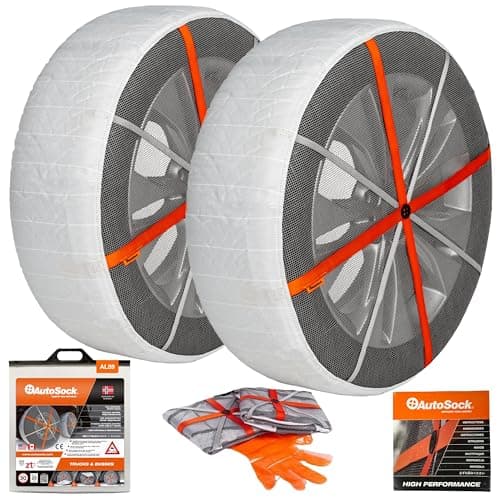
AutoSock Textile Snow Socks
A textile traction device that fits where chains physically cannot. It states a three-minute fitting time and the same 25 to 30 mph speed ceiling chains carry, and it is accepted as a chain alternative in many jurisdictions — but not all, which is the thing to check first.
- Type
- Textile traction device
- Fitting time
- Stated 3 minutes
- Speed limit
- 25-30 mph
- Clearance needed
- Minimal — fits low-clearance vehicles
- Rim damage
- Stated damage-free to alloy rims
- Legal as chain substitute
- Varies by jurisdiction — check locally
- Warranty
- Not published
- List price
- Not published
What it gets right
- Fits vehicles with limited wheel-well clearance, where chains simply do not go
- Textile rather than metal, so it does not damage alloy rims
- Stated three-minute fitting, which matters when you are doing it on a shoulder in weather
- Stated to meet the performance, safety and durability requirements of snow chain standards
Flaws
- Chain-control regulations vary: some jurisdictions accept SAE-certified socks as a chain alternative and some require actual chains. Check before you rely on it
- Same 25 to 30 mph ceiling as chains — this is a get-through device, not a way to drive normally
- Textile wears fast on bare pavement. Take them off as soon as the road clears
- No published warranty term
The working behind the 9.0
- Heat headroom: not scored (weight 22%)
- The maker publishes no operating-temperature ceiling, so this axis is dropped and the other weights are re-normalized.
- Install effort: 10.0 (weight 24%)
- Drops in and sits there. No fixing of any kind, and it comes out again when you sell the car.
- Price against the ceiling: not scored (weight 24%)
- No published list price we could cite on the compile date, so this axis is dropped and the other weights are re-normalized.
- Written commitment: not scored (weight 15%)
- No warranty term published, so this axis is dropped and the other weights are re-normalized.
- Spec transparency: 7.5 (weight 15%)
- 6 of the 8 specifications we went looking for are published by the maker (75%). A blank row is never a guess here: it prints “Not published” and it costs the product points, because a figure nobody will commit to in writing is a figure you cannot check.
Axes with no published input are dropped and the remaining weights re-normalized, so a product is not punished for a category where an axis does not apply. Specifications compiled September 4, 2026 from AutoSock published fitting time, standards and speed limit.
2A named university test rather than a printed load number
MAXTRAX MKII Recovery Boards
Made from reinforced nylon rather than the commodity HDPE most boards are molded from, and tested at the University of Queensland to wrap completely around a 33-inch tire without breaking. That is a named third-party test, which is worth far more than the load figures printed on cheaper boards.
- Material
- UV-stabilized reinforced nylon
- Third-party test
- University of Queensland, 33 in tire wrap
- Weight
- 3.4 kg (7.5 lb) per board
- Footprint
- 35 x 13 x 3.5 in
- Printed load rating
- Not published
- Warranty
- Not published
- List price
- Not published
What it gets right
- Reinforced, UV-stabilized engineering-grade nylon rather than commodity HDPE
- Named third-party test: University of Queensland, wrapped around a 33 in tire without breaking
- Published weight of 3.4 kg (7.5 lb) per board, which matters because you carry them
- Published footprint of 35 x 13 x 3.5 in, and 66 teeth on the LITE version
Flaws
- Costs several times what an HDPE board does
- Spinning a tire on any recovery board shaves the teeth off — these are not immune, they just survive it better
- Two boards is the practical minimum and doubles the cost
- Bulky to store for a device most commuters will use once
The working behind the 8.3
- Heat headroom: not scored (weight 22%)
- The maker publishes no operating-temperature ceiling, so this axis is dropped and the other weights are re-normalized.
- Install effort: 10.0 (weight 24%)
- Drops in and sits there. No fixing of any kind, and it comes out again when you sell the car.
- Price against the ceiling: not scored (weight 24%)
- No published list price we could cite on the compile date, so this axis is dropped and the other weights are re-normalized.
- Written commitment: not scored (weight 15%)
- No warranty term published, so this axis is dropped and the other weights are re-normalized.
- Spec transparency: 5.7 (weight 15%)
- 4 of the 7 specifications we went looking for are published by the maker (57%). A blank row is never a guess here: it prints “Not published” and it costs the product points, because a figure nobody will commit to in writing is a figure you cannot check.
Axes with no published input are dropped and the remaining weights re-normalized, so a product is not punished for a category where an axis does not apply. Specifications compiled September 4, 2026 from MAXTRAX published material, testing and dimensions.
3The budget board, with the trade stated
X-BULL Recovery Traction Boards
Skip this one. It works, and it is a fraction of the price, and it is the skip on this site's usual grounds. Boards in this tier print large load ratings with no stated test method and no independent verification, and they are molded from commodity HDPE rather than reinforced nylon — which matters at the teeth under a spinning wheel. Buy it knowingly as the occasional-use option, not as an equivalent.
The affordable, lighter option, and on this page because it illustrates the category's problem: boards in this tier print large load ratings with no test method or independent verification behind them. As a once-a-winter recovery aid it works; as a specification comparison it gives you nothing to check.
- Material
- HDPE
- Third-party test
- Not published
- Weight
- Not published
- Footprint
- Not published
- Printed load rating
- Stated, no test method published
- Warranty
- Not published
- List price
- Not published
What it gets right
- A fraction of the price of nylon boards, which matters for a device most drivers use rarely
- Lighter to carry and stow than the reinforced-nylon alternatives
- Functionally does the job on snow, mud and sand for occasional use
- Widely available in pairs rather than singly
Flaws
- Load ratings in this tier are printed without a stated test method or independent verification
- HDPE rather than reinforced nylon — more prone to flex, and to teeth shearing under a spinning tire
- No published material temperature range, and plastic behaves differently at -20 C
- No warranty published
The working behind the 7.3
- Heat headroom: not scored (weight 22%)
- The maker publishes no operating-temperature ceiling, so this axis is dropped and the other weights are re-normalized.
- Install effort: 10.0 (weight 24%)
- Drops in and sits there. No fixing of any kind, and it comes out again when you sell the car.
- Price against the ceiling: not scored (weight 24%)
- No published list price we could cite on the compile date, so this axis is dropped and the other weights are re-normalized.
- Written commitment: not scored (weight 15%)
- No warranty term published, so this axis is dropped and the other weights are re-normalized.
- Spec transparency: 2.9 (weight 15%)
- 2 of the 7 specifications we went looking for are published by the maker (29%). A blank row is never a guess here: it prints “Not published” and it costs the product points, because a figure nobody will commit to in writing is a figure you cannot check.
Axes with no published input are dropped and the remaining weights re-normalized, so a product is not punished for a category where an axis does not apply. Specifications compiled September 4, 2026 from Published construction and positioning against reinforced-nylon boards.
Prices last verified October 26, 2026. They move constantly; the figure on Amazon when you click is the real one.
Questions people actually ask
Are recovery board load ratings meaningful?
No. None of them publishes a test method, and a static load figure does not describe what happens to a board being bent and dragged under a wheel. MAXTRAX publishes a named University of Queensland test instead, which is checkable.
Why did my recovery board's teeth break off?
A spinning wheel. The teeth grip the tire, and if the tire spins rather than rolls they are machined off by rubber moving at speed. Stop the instant a wheel spins — more throttle is the instinct and it is always wrong.
Recovery boards or snow chains?
Different jobs. Boards get a stationary vehicle out of something it has sunk into. Traction devices let a moving vehicle keep going on a slippery road, carry a 25-30 mph ceiling and a legal question, and do nothing for a car already stuck.
Do I need recovery boards as a commuter?
Usually not. They are for people who park on ground that turns to mud, get unplowed snow at home, or drive rear-wheel drive in a real winter. A bag of grit and a shovel covers occasional use for far less money and space.