The best car gifts for drivers
The rule that makes this easy: buy the genuinely useful thing they keep not buying for themselves. That is a short and specific list, and it is not the list the gift guides sell.
By Sawyer V. · Published · How we research
We have not tested any of this. Everything below is compiled from published manufacturer specifications, and the arithmetic is printed so you can check it. This page carries affiliate links: if you buy through one we earn a commission at no extra cost to you, and it does not change the order of the picks. Full disclosure.
The short answer
Buy the jump starter. It is around $100, it is the single most valuable object in a car on the one morning it is needed, and almost nobody buys one for themselves because the purchase competes against things they want rather than things they might need. That combination — high value, low self-purchase rate — is exactly what makes a good gift. Under $30, a proper flashlight or a tire gauge follows the same logic for a fraction of the money.
| # | Pick | Install | Score | Price |
|---|---|---|---|---|
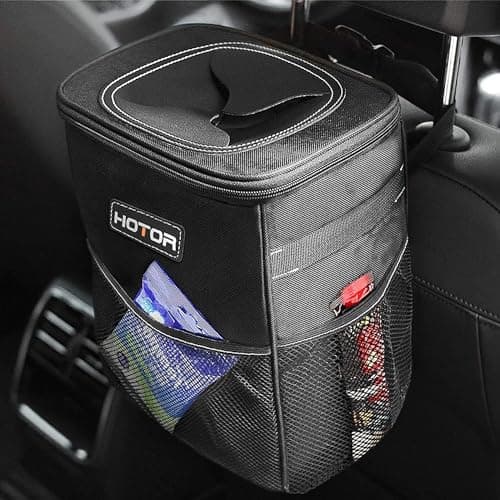
| 1 | HOTOR Car Trash Can (2 gallon) The cheapest fix for a permanently messy car | Drops in | 9.7/10 | $9.98 - view on Amazon |
| 2 | Anker Bolder LC90 Flashlight A light that is not your phone | Drops in | 8.8/10 | Check price on Amazon |
| 3 | ESR HaloLock Qi2 with CryoBoost The heat problem, solved at the mount | Clips on | 8.8/10 | Check price on Amazon |
| 4 | AstroAI Digital Tire Gauge (150 PSI) Knowing what your tires are actually at | Drops in | 8.4/10 | $6.99 - view on Amazon |
| 5 | iOttie Easy One Touch 5 Air Vent The default vent mount | Clips on | 8.3/10 | Check price on Amazon |
| 6 | NOCO Boost Plus GB40 Not needing anybody else's car | Plugs in | 8.0/10 | Check price on Amazon |
Prices last verified October 19, 2026. They move constantly; the figure on Amazon when you click is the real one.
The rule that makes this simple
The best car gift is the thing that is genuinely useful and that people reliably do not buy for themselves.
That second half is what does the work. People buy the things they want — a phone mount, a nicer cable — as soon as the annoyance crosses a threshold. What they never get around to buying is insurance: the jump starter, the real flashlight, the accurate gauge. Those sit on a list until the day they were needed.
Which is why the list below looks nothing like a typical gift guide. It is short, it is unglamorous, and every item on it is something the recipient will be quietly glad of at a specific and unpleasant future moment.
By budget
| Budget | Buy | Why it works as a gift |
|---|---|---|
| Around $15 | A tire pressure gauge | Nobody buys one; everybody should have one |
| Around $25 | A phone mount, or a real flashlight | Used daily, or valued once |
| Around $40 | A Qi2 charging mount | The upgrade they would not justify to themselves |
| Around $100 | A jump starter | The best car gift there is |
Why the jump starter is the answer
It scores perfectly against the rule. It is genuinely valuable — a flat battery is the most common way a car fails to start, and a jump starter converts that from a callout into five minutes. And almost nobody buys one, because $100 spent on something you hope never to use loses every internal argument against $100 spent on something you will.
A gift sidesteps that argument entirely, which is the whole reason this works.
NOCO publishes 1,000 peak amps, a 24 Wh pack at 2.4 lb, and — the number that actually matters — an engine-size ceiling of 6.0 liters gasoline and 3.0 diesel. Check that against their car before buying. The full page is here.
Under $30, same logic
- A real flashlight. Anker publishes 900 lumens, 6 hours and IPX5 — all three, which almost nobody in the category does. People use their phone instead, which is the wrong use of the device you call for help with. The flashlight page.
- A tire pressure gauge. Around $15, published accuracy of plus or minus 1 PSI against a named calibration standard, and genuinely nobody buys one. The gauge page.
- A phone mount. The exception to the rule — people do buy these — but a good one at $25 replaces the cheap one they settled for. The vent page.
The upgrade nobody justifies to themselves
A Qi2 charging mount at around $40 is the other kind of good gift: not insurance, but the version of a thing they already own that they would not have paid the difference for.
The ESR publishes Qi2 certification at the full 15 W plus active cooling, which is the feature that matters because a hot phone throttles its own charging. Two things to check first: their phone needs to support Qi2 to get 15 W, and the mount needs a 20 W or better USB-C source in the car, which most cars do not have from the factory. The Qi2 page covers both — consider adding a charger so the gift is complete.
Two occasions with a clear answer
- A new driver. The jump starter, and it is not close — an older car, an older battery, and someone who has not had that morning yet. The new driver list covers what else they need and in what order.
- Someone who has just bought a car. A phone mount and a charger. They are about to buy both anyway, badly, in a hurry.
Three categories to avoid
- Anything that comments on their car. A bin, a cleaning kit, an air freshener. All genuinely useful, all read as criticism however you wrap them.
- Anything that has to fit. Seat covers, floor mats, a steering wheel cover — every one needs the exact vehicle or a measurement, and a wrong-sized wheel cover is not merely useless, it rotates under the hands.
- Anything requiring installation. A dash cam is a great object and a mediocre gift, because it comes with a card to buy and a mount to position and possibly an afternoon under the dash. Unless you are fitting it for them, it is a project you have given someone.
What we cannot tell you
Whether they will like it, obviously. What this page is ranked on is the same rubric as everything else here — published specifications, install effort, price against a ceiling, warranty and transparency — with the working printed under each pick. The method is here, and nothing on this site has been tested by us.
Shopping for a gift under a gendered search term? Most of what ranks for it is decoration, and some of it works against the driver. The practical version — organized around seating distance, belt fit and where a bag goes — is in best car accessories for women.
Every pick, with the working
Each entry lists the specifications the maker publishes, the axis scores those specifications produce, and what you give up. Rows that read “Not published” are not omissions on our side: they are things the maker will not commit to in writing, and they cost the product points on the transparency axis. Specifications compiled September 4, 2026.
Our pickThe cheapest fix for a permanently messy car
HOTOR Car Trash Can (2 gallon)
Skip this one. Genuinely one of the most useful things in a car and an absolutely terrible gift. Giving somebody a bin reads as a comment on the state of their car, whatever you meant by it. Buy it for your own car and buy them something else.
Two gallons, 7.9 by 5.5 by 10.2 inches, Oxford cloth over a waterproof PEVA lining, with four magnetic snaps holding the bag open and a strap that fastens it to a headrest or the console. A car gets cluttered because there is nowhere to put rubbish, and this is thirteen dollars of nowhere-to-put-rubbish solved.
- Capacity
- 2 gallons (3-gallon version also sold)
- Dimensions
- 7.9 x 5.5 x 10.2 in
- Weight
- 1.0 lb
- Outer material
- Oxford cloth
- Lining
- Waterproof PEVA
- Bag retention
- 4 magnetic snaps, 2 spare bags included
- Pockets
- 3 mesh
- Mounting
- Adjustable strap with quick-release buckle
- Warranty
- Not published
List price $12.99 per Walmart listing, 2-gallon, captured on the compile date below. Not a live price and not what you will pay — the button is where the real number is.
What it gets right
- Published dimensions and capacity, so you can check it against the space beside your seat
- PEVA waterproof lining — the difference between a bin and a stain when someone puts a coffee cup in it
- Four magnetic snaps hold a liner bag open, which is the detail that makes it usable one-handed while driving
- Strap and quick-release buckle, so it attaches to something rather than sliding around the footwell
Flaws
- Two gallons is small if you carry passengers who eat in the car; the 3-gallon version exists for that
- Soft-sided, so it needs to be strapped to something or it tips
- It only works if you empty it, which is the same problem as every bin ever made
The working behind the 9.7
- Heat headroom: not scored (weight 22%)
- The maker publishes no operating-temperature ceiling, so this axis is dropped and the other weights are re-normalized.
- Install effort: 10.0 (weight 24%)
- Drops in and sits there. No fixing of any kind, and it comes out again when you sell the car.
- Price against the ceiling: 10.0 (weight 24%)
- Listed at $12.99 on the compile date. This site's buyer has a practical ceiling around $150 for a single upgrade, so the scale rewards everything under $100 and falls away sharply past $150. The live price is very often different, and that is what the button is for.
- Written commitment: not scored (weight 15%)
- No warranty term published, so this axis is dropped and the other weights are re-normalized.
- Spec transparency: 8.9 (weight 15%)
- 8 of the 9 specifications we went looking for are published by the maker (89%). A blank row is never a guess here: it prints “Not published” and it costs the product points, because a figure nobody will commit to in writing is a figure you cannot check.
Axes with no published input are dropped and the remaining weights re-normalized, so a product is not punished for a category where an axis does not apply. Specifications compiled September 4, 2026 from the HOTOR 2-gallon listing — HOTOR's own product page publishes none of these figures.
2A light that is not your phone
Anker Bolder LC90 Flashlight
900 lumens from a CREE LED, a published 6-hour runtime, IPX5 water resistance and five modes including strobe and SOS, on a rechargeable 18650. Using a phone as a flashlight at the roadside drains the one device you need to call for help, which is the entire argument for keeping a real one in the car.
- Output
- 900 lumens, CREE LED
- Runtime
- Up to 6 hours
- Ingress rating
- IPX5
- Modes
- High, medium, low, strobe, SOS
- Beam
- Zoomable
- Battery
- Rechargeable 18650, included
- Stated beam distance
- Over 660 ft
- Operating range
- Not published
What it gets right
- Published lumens (900), runtime (6 h) and ingress rating (IPX5) — all three, which is rare at this price
- Rechargeable 18650 included, so there is no scramble for AAs
- Zoomable from flood to spot, which covers both 'find the dropped bolt' and 'signal from the shoulder'
- SOS and strobe modes, which are exactly the modes a roadside light needs
Flaws
- IPX5 is rain resistance, not submersion. Fine for a breakdown, not for dropping in a puddle
- A lithium cell in a hot trunk self-discharges, so it needs charging on a schedule like the jump starter does
- 900 lumens on high for 6 hours is not the same as 900 lumens for 6 hours; brightness steps down between modes
The working behind the 8.8
- Heat headroom: not scored (weight 22%)
- The maker publishes no operating-temperature ceiling, so this axis is dropped and the other weights are re-normalized.
- Install effort: 10.0 (weight 24%)
- Drops in and sits there. No fixing of any kind, and it comes out again when you sell the car.
- Price against the ceiling: not scored (weight 24%)
- No published list price we could cite on the compile date, so this axis is dropped and the other weights are re-normalized.
- Written commitment: 7.0 (weight 15%)
- 18-month warranty. This is the only promise in the entire listing that a court would read, which is why it is scored and the marketing copy is not.
- Spec transparency: 8.8 (weight 15%)
- 7 of the 8 specifications we went looking for are published by the maker (88%). A blank row is never a guess here: it prints “Not published” and it costs the product points, because a figure nobody will commit to in writing is a figure you cannot check.
Axes with no published input are dropped and the remaining weights re-normalized, so a product is not punished for a category where an axis does not apply. Specifications compiled September 4, 2026 from Anker Bolder LC90 published specifications.
3The heat problem, solved at the mount
ESR HaloLock Qi2 with CryoBoost
Qi2 certified 15W with an actual cooling fan built into the mount. That sounds like a gimmick until you have watched a phone throttle its own charging to a crawl on a summer afternoon while running navigation. Wireless charging in a hot car is a thermal problem before it is a power problem, and this is the only mount here that addresses it directly.
- Wireless standard
- Qi2 certified
- Wireless output
- 15 W
- Cooling
- CryoBoost active fan plus heat-dissipating components
- Required input
- USB-C PD source of 20 W or more
- Attachment
- Vent mount
- Magnet
- MagSafe compatible alignment
- Warranty
- Not published
- Operating range
- Not published
List price $39.99 per ESR's own store, sale price (regular $59.99), captured on the compile date below. Not a live price and not what you will pay — the button is where the real number is.
What it gets right
- Qi2 certified at the full 15W, not a 7.5W mount described as fast
- Active cooling fan, which is the difference between 15W sustained and 15W for four minutes
- Magnetic alignment does the aiming for you, one-handed, without looking
- $39.99 sale against a $59.99 list
Flaws
- Needs a USB-C source of 20W or more, which most cars do not have from the factory — budget for a car charger too
- There is a fan in your car, and you can hear it when the stereo is off
- Vent mounting means a blocked vent, on the mount whose selling point is cooling
The working behind the 8.8
- Heat headroom: not scored (weight 22%)
- The maker publishes no operating-temperature ceiling, so this axis is dropped and the other weights are re-normalized.
- Install effort: 9.0 (weight 24%)
- Clips onto a vent blade or a headrest post. Two minutes, no tools, no adhesive, no residue.
- Price against the ceiling: 9.5 (weight 24%)
- Listed at $39.99 on the compile date. This site's buyer has a practical ceiling around $150 for a single upgrade, so the scale rewards everything under $100 and falls away sharply past $150. The live price is very often different, and that is what the button is for.
- Written commitment: not scored (weight 15%)
- No warranty term published, so this axis is dropped and the other weights are re-normalized.
- Spec transparency: 7.5 (weight 15%)
- 6 of the 8 specifications we went looking for are published by the maker (75%). A blank row is never a guess here: it prints “Not published” and it costs the product points, because a figure nobody will commit to in writing is a figure you cannot check.
Axes with no published input are dropped and the remaining weights re-normalized, so a product is not punished for a category where an axis does not apply. Specifications compiled September 4, 2026 from ESR's Qi2 CryoBoost car charger page.
4Knowing what your tires are actually at
AstroAI Digital Tire Gauge (150 PSI)
0 to 150 PSI, factory calibrated to plus or minus 1 PSI, reading in 0.1 increments across four units with a backlit screen. The gas-station gauge you have been trusting is almost certainly worse than this, and this costs about the same as one tank of fuel.
- Range
- 0-150 PSI / 0-10 Bar / 0-10 Kgf/cm2 / 0-1000 kPa
- Accuracy
- Plus or minus 1 PSI
- Calibration standard
- ANSI B40.7, AstroAI UK listing only
- Resolution
- 0.1 PSI
- Display
- Backlit LCD, 4 selectable units
- Auto shut-off
- 30 seconds
- List price
- Not published
- Warranty
- 1 year, stated
What it gets right
- Published accuracy of plus or minus 1 PSI, stated in the listing title — almost nothing else in this category states an accuracy figure at all
- Reads to 0.1 PSI, which matters because a 3 PSI error is the difference between correct and noticeably underinflated
- Backlit screen, because tire pressures get checked in the dark more often than not
- Auto shut-off after 30 seconds, so the battery lasts
Flaws
- 150 PSI range is far beyond a passenger car, so the useful part of the scale is the bottom fifth
- A digital gauge has a battery, and a battery in a glovebox is a battery you will find dead
- It measures. It does not inflate — that is a separate tool
The working behind the 8.4
- Heat headroom: not scored (weight 22%)
- The maker publishes no operating-temperature ceiling, so this axis is dropped and the other weights are re-normalized.
- Install effort: 10.0 (weight 24%)
- Drops in and sits there. No fixing of any kind, and it comes out again when you sell the car.
- Price against the ceiling: not scored (weight 24%)
- No published list price we could cite on the compile date, so this axis is dropped and the other weights are re-normalized.
- Written commitment: 5.5 (weight 15%)
- 12-month warranty. This is the only promise in the entire listing that a court would read, which is why it is scored and the marketing copy is not.
- Spec transparency: 8.8 (weight 15%)
- 7 of the 8 specifications we went looking for are published by the maker (88%). A blank row is never a guess here: it prints “Not published” and it costs the product points, because a figure nobody will commit to in writing is a figure you cannot check.
Axes with no published input are dropped and the remaining weights re-normalized, so a product is not punished for a category where an axis does not apply. Specifications compiled September 4, 2026 from AstroAI 150 PSI gauge published specifications.
5The default vent mount
iOttie Easy One Touch 5 Air Vent
A twist-lock vent clamp and the one-handed cradle iOttie has been refining for a decade, at $24.95. It grips the phone mechanically rather than magnetically, which means it does not care what case you have, and it costs a quarter of what the Qi2 chargers cost because it does not charge anything.
- Attachment
- Twist-lock air vent
- Hold
- Mechanical cradle, one-touch lock and release
- Orientation
- Portrait or landscape
- Cable management
- Magnetic cord organizer
- SKU
- HLCRIO172
- Weight capacity
- Not published
- Operating range
- Not published
List price $24.95 per iOttie's own store, captured on the compile date below. Not a live price and not what you will pay — the button is where the real number is.
What it gets right
- Twist-lock vent attachment rather than a spring clip, which is the difference between staying put and rattling loose
- Mechanical cradle works with any case, any thickness, and any phone that fits
- One-handed lock and release, which is the entire point of the product line
- $24.95 list, the cheapest way to solve the problem properly
Flaws
- Blocks a vent, and in summer that vent is the one you wanted
- No charging, so the cable still has to come from somewhere
- A heavy phone on a thin vent blade will still droop over time on some cars
The working behind the 8.3
- Heat headroom: not scored (weight 22%)
- The maker publishes no operating-temperature ceiling, so this axis is dropped and the other weights are re-normalized.
- Install effort: 9.0 (weight 24%)
- Clips onto a vent blade or a headrest post. Two minutes, no tools, no adhesive, no residue.
- Price against the ceiling: 10.0 (weight 24%)
- Listed at $24.95 on the compile date. This site's buyer has a practical ceiling around $150 for a single upgrade, so the scale rewards everything under $100 and falls away sharply past $150. The live price is very often different, and that is what the button is for.
- Written commitment: 5.5 (weight 15%)
- 12-month warranty. This is the only promise in the entire listing that a court would read, which is why it is scored and the marketing copy is not.
- Spec transparency: 7.1 (weight 15%)
- 5 of the 7 specifications we went looking for are published by the maker (71%). A blank row is never a guess here: it prints “Not published” and it costs the product points, because a figure nobody will commit to in writing is a figure you cannot check.
Axes with no published input are dropped and the remaining weights re-normalized, so a product is not punished for a category where an axis does not apply. Specifications compiled September 4, 2026 from iOttie's Easy One Touch 5 Air Vent page.
6Not needing anybody else's car
NOCO Boost Plus GB40
1,000 peak amps out of a 24 watt-hour lithium pack that weighs 2.4 pounds, rated for gasoline engines to 6.0 liters and diesel to 3.0, with spark-proof clamps and reverse-polarity protection. It is the single accessory here that changes what happens on the worst morning of your year, and it fits in a glovebox.
- Peak amps
- 1,000 A
- Battery
- 24 Wh lithium-ion
- Engine ceiling
- Gasoline to 6.0 L, diesel to 3.0 L
- Starts per charge
- Up to 20
- Dimensions
- 7.7 x 3.2 x 1.7 in
- Weight
- 2.4 lb with clamps
- Light
- 100 lumens
- Safety
- Spark proof, reverse polarity protected
- Operating range
- Not published
List price $99.95 per NOCO's listed price, captured on the compile date below. Not a live price and not what you will pay — the button is where the real number is.
What it gets right
- 1,000 peak amps and up to 20 starts on one charge, both published
- Spark-proof and reverse-polarity protected, which matters when you are doing this in the dark
- 2.4 lb and 7.7 inches long — it genuinely lives in the car rather than the garage
- USB port and a 100-lumen light, so it is also the thing you reach for in a power cut
Flaws
- Lithium, so it self-discharges and needs topping up every few months or it is a brick when you need it
- 6.0 L gasoline and 3.0 L diesel is the published ceiling — a big diesel needs the bigger model
- $99.95 for something you hope never to use
The working behind the 8.0
- Heat headroom: not scored (weight 22%)
- The maker publishes no operating-temperature ceiling, so this axis is dropped and the other weights are re-normalized.
- Install effort: 10.0 (weight 24%)
- Plugs into a 12V socket or a USB port. Nothing to mount, nothing to route, reversible in a second.
- Price against the ceiling: 7.0 (weight 24%)
- Listed at $99.95 on the compile date. This site's buyer has a practical ceiling around $150 for a single upgrade, so the scale rewards everything under $100 and falls away sharply past $150. The live price is very often different, and that is what the button is for.
- Written commitment: 5.5 (weight 15%)
- 12-month warranty. This is the only promise in the entire listing that a court would read, which is why it is scored and the marketing copy is not.
- Spec transparency: 8.9 (weight 15%)
- 8 of the 9 specifications we went looking for are published by the maker (89%). A blank row is never a guess here: it prints “Not published” and it costs the product points, because a figure nobody will commit to in writing is a figure you cannot check.
Axes with no published input are dropped and the remaining weights re-normalized, so a product is not punished for a category where an axis does not apply. Specifications compiled September 4, 2026 from NOCO Boost Plus GB40 published specifications.
Prices last verified October 19, 2026. They move constantly; the figure on Amazon when you click is the real one.
Questions people actually ask
What is the best car gift under $100?
A jump starter, at around $100. High value on the one morning it matters, and almost nobody buys one for themselves because it loses the internal argument against something they actively want.
What is a good cheap car gift?
A tire pressure gauge with published accuracy at around $15, or a proper flashlight at around $25. Both follow the same rule: genuinely useful, and reliably not self-purchased.
What should I not buy?
Anything that comments on the state of their car — a bin, a cleaning kit. Anything that has to fit, like seat covers or a wheel cover. And anything needing installation, unless you are doing the installing.
Is a dash cam a good gift?
A great object and a mediocre gift. It arrives needing an endurance card, a mounting decision and possibly an afternoon of wiring — so unless you are fitting it for them, you have given someone a project.
Sources
- NOCO Boost Plus GB40 published peak amps, capacity and engine ceiling
- Anker Bolder LC90 published lumens, runtime and IPX rating
- AstroAI 150 PSI gauge published accuracy and calibration standard
- ESR Qi2 CryoBoost published output, cooling and input requirement
- iOttie Easy One Touch 5 Air Vent published specifications and price