The best car fire extinguishers
This is one of the few products here with real third-party certification. It is also one whose published temperature ceiling is below what a parked car reaches in summer.
By Sawyer V. · Published · How we research
We have not tested any of this. Everything below is compiled from published manufacturer specifications, and the arithmetic is printed so you can check it. This page carries affiliate links: if you buy through one we earn a commission at no extra cost to you, and it does not change the order of the picks. Full disclosure.
The short answer
Buy the First Alert AUTO5, mount it where you can reach it seated, and check the gauge often. It publishes a UL 5-B:C rating against four named standards, DOT approval for vehicle use, and a mounting bracket in the box. It also publishes an operating range topping out at 120 F (49 C) — and a parked car reaches roughly 60-70 C inside, which is above that. Getting everyone out comes before fighting anything.
| # | Pick | Install | Score | Price |
|---|---|---|---|---|
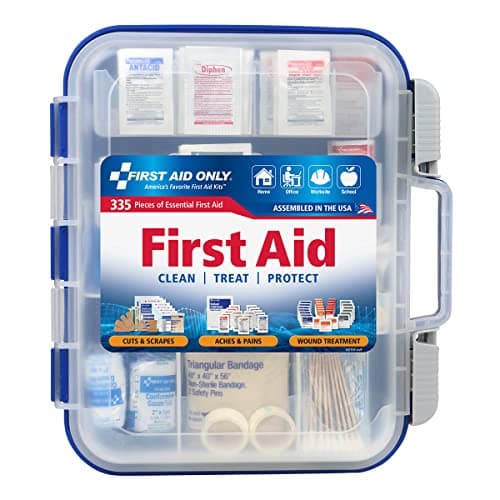
| 1 | First Aid Only 335-Piece OSHA Kit A kit whose contents are defined by a standard | Drops in | 9.5/10 | $37.44 - view on Amazon |
| 2 | resqme Car Escape Tool Keeping an escape tool actually within reach | Drops in | 9.2/10 | $17.15 - view on Amazon |
| 3 | First Alert AUTO5 Car Fire Extinguisher The one emergency where seconds decide everything | Adhesive | 5.1/10 | $23.69 - view on Amazon |
Prices last verified October 22, 2026. They move constantly; the figure on Amazon when you click is the real one.
What 5-B:C actually means
Fire extinguisher ratings are one of the genuinely standardized things in this whole market, and they are worth understanding because they tell you exactly what a unit will and will not do.
- Class A — ordinary combustibles: paper, fabric, wood, upholstery
- Class B — flammable liquids: fuel, oil, grease
- Class C — energized electrical equipment
- The number before the B is a relative measure of capability on that class. A 5-B unit handles a larger liquid fire than a 2-B unit
The AUTO5 is rated 5-B:C. That covers the two most likely vehicle fire types — a fuel or oil fire, and an electrical fire — and notably excludes Class A. Upholstery and carpet are Class A materials, so a seat fire is outside what this unit is rated for.
Units rated A:B:C exist and cover all three. The trade is size and weight for something that has to live in a car, and 5-B:C is the common vehicle specification for that reason.
The certifications, which are real
This is one of very few products on this site with meaningful third-party certification, and First Alert publishes the list.
| Specification | Published |
|---|---|
| UL rating | 5-B:C |
| Standards listed to | UL711, ULC-S508, UL299, ULC-S504 |
| DOT | Approved for vehicle use |
| Agent | Sodium bicarbonate |
| Operating temperature | -40 F to 120 F (-40 C to 49 C) |
| Charge pressure | 100 psi (689 kPa) |
| Dimensions | 2.9 in dia x 10.3 in H |
| Weight | 2.7 lb |
| Mounting | Bracket and strap included |
DOT approval matters more than it sounds. An extinguisher in a vehicle is a pressurized vessel subject to vibration and temperature cycling, and DOT approval means it has been assessed for exactly that. A household extinguisher has not.
The published ceiling, and the problem with it
First Alert publishes an operating range of -40 F to 120 F, which is -40 C to 49 C. That is more than most roadside products publish and it is genuinely useful.
It is also below what a parked car reaches. A cabin in summer sun runs roughly 60-70 C, comfortably past the stated 49 C ceiling. This is the same heat arithmetic that governs dash cams on this site, and it applies here too.
We are not going to overstate what that means — the unit is not going to fail catastrophically at 50 C. But the manufacturer has stated a range and a parked car exceeds it, so two things follow.
- Mount it in the coolest place available. Low, out of direct sun, under a seat rather than on a parcel shelf or in a rear window
- Check the pressure gauge regularly. Monthly is reasonable. The needle should sit in the green band, and a unit that has lost pressure is an empty cylinder that looks full
Shading the car helps here as much as it helps everything else in the cabin — how to keep your car cool when parked.
Mounting is not optional
An extinguisher loose in a trunk fails twice over: it is unreachable when needed, and it is a 2.7 lb unrestrained object in a collision. First Alert ships a bracket and strap precisely because neither is acceptable.
Mount it where a seated, belted person can reach it. Under the driver's seat, on a seat rail, or on a footwell side panel. In a car where nothing suits, the passenger footwell side is usually the compromise.
Fit the bracket properly rather than relying on the strap alone, and check what is behind the panel before drilling anything — the same caution that applies to any interior fixing on a car with airbags. The full placement framework is in where to store emergency gear in your car.
What sodium bicarbonate leaves behind
Worth knowing before you use it. Sodium bicarbonate is the agent, it works by interrupting the chemical chain reaction of the fire, and it leaves a fine powder residue over everything.
That residue is mildly corrosive, particularly on electrical connections and bare metal, and it should be cleaned up promptly rather than left. Which is a reason not to discharge one casually — but not a reason to hesitate on an actual fire.
Cleaning it is a vacuum-and-wipe job, and a small vacuum with a crevice tool is the practical approach — best car vacuums and how to clean your car interior.
What goes with it
An extinguisher is one item in a small set that only matters at the worst moment, and it is arguably the least important of them.
The escape tool comes first — a jammed belt or a window that will not open is the problem an extinguisher cannot solve, and it must be on your keys or a door bracket rather than in a compartment. Check your glass type too, since these work on tempered and not laminated: best car escape tools.
Then a first aid kit built to a published contents standard — best car first aid kits — triangles to make yourself visible, and a flashlight. The pre-packed option is best emergency car kits, and what to do at the moment it happens is what to do if your car breaks down.
Every pick, with the working
Each entry lists the specifications the maker publishes, the axis scores those specifications produce, and what you give up. Rows that read “Not published” are not omissions on our side: they are things the maker will not commit to in writing, and they cost the product points on the transparency axis. Specifications compiled September 4, 2026.
Our pickA kit whose contents are defined by a standard
First Aid Only 335-Piece OSHA Kit
335 pieces built to an OSHA-compliant contents list rather than to a number on the box. That is the only meaningful way to judge a first aid kit: the piece count tells you nothing, the standard the contents are drawn from tells you everything. First Aid Only states supplies adequate for up to 100 people, which is generous for one car.
- Piece count
- 335
- Rated for
- Up to 100 people
- Standard
- OSHA-compliant contents
- Reference standard
- ANSI/ISEA Z308.1 minimum workplace requirements
- Intended use
- Home, car, travel and office
- Case
- Wall-mountable plastic, clear cover, compartments
- Warranty
- Not published
List price $37.44 per Amazon listing, September 27, 2026, captured on the compile date below. Not a live price and not what you will pay — the button is where the real number is.
What it gets right
- Contents built against an OSHA-compliant list, which traces to ANSI/ISEA Z308.1 minimum requirements
- Stated adequate for up to 100 people, so the quantities are generous for one car
- Published piece count of 335 alongside the standard, not instead of it
- Clear cover and individual compartments, so you can find one item under pressure
Flaws
- Workplace kits are weighted toward cuts and abrasions, not roadside trauma
- The case is wall-mountable and built for a shelf, not for a trunk that gets wet
- No published warranty, and consumables have expiry dates you have to track yourself
The working behind the 9.5
- Heat headroom: not scored (weight 22%)
- The maker publishes no operating-temperature ceiling, so this axis is dropped and the other weights are re-normalized.
- Install effort: 10.0 (weight 24%)
- Drops in and sits there. No fixing of any kind, and it comes out again when you sell the car.
- Price against the ceiling: 9.5 (weight 24%)
- Listed at $37.44 on the compile date. This site's buyer has a practical ceiling around $150 for a single upgrade, so the scale rewards everything under $100 and falls away sharply past $150. The live price is very often different, and that is what the button is for.
- Written commitment: not scored (weight 15%)
- No warranty term published, so this axis is dropped and the other weights are re-normalized.
- Spec transparency: 8.6 (weight 15%)
- 6 of the 7 specifications we went looking for are published by the maker (86%). A blank row is never a guess here: it prints “Not published” and it costs the product points, because a figure nobody will commit to in writing is a figure you cannot check.
Axes with no published input are dropped and the remaining weights re-normalized, so a product is not punished for a category where an axis does not apply. Specifications compiled September 4, 2026 from the First Aid Only 335-piece OSHA kit listing.
2Keeping an escape tool actually within reach
resqme Car Escape Tool
Skip this one. Not an extinguisher, and deliberately on this page. In a vehicle fire the correct sequence is get everyone out first, and the tool that achieves that is the escape tool — not the extinguisher. If you buy one item for a fire scenario, buy the thing that gets you out.
The one escape tool small enough to live on your keyring, which is the only place an escape tool is any use — a hammer in the glovebox is a hammer you cannot reach with a jammed belt across your chest. Spring-loaded, so it needs no swing.
- Height
- 2.93 in
- Materials
- ABS plastic and stainless steel
- Window breaker
- Spring-loaded stainless spike, resets after each use
- Belt cutter
- Stainless blade, rated for up to 100 seat belts
- Cut time
- Under 2 seconds (manufacturer figure)
- Certification
- TUV tested and certified
- Origin
- Made in USA
- Works on laminated glass
- No — tempered side glass only
- List price
- Not published
- Warranty
- Not published
What it gets right
- 2.93 inches tall and keyring-mounted, so it is on you rather than in a compartment you cannot reach
- Spring-loaded spike needs no room to swing, which matters when you are belted in
- Publishes a service life: one unit cuts up to 100 seat belts, and the spike resets after each use
- TUV tested and certified, and made in the USA
Flaws
- Breaks tempered side glass only. It will not touch a laminated side window, which is increasingly common on newer cars
- Small enough to lose, and a lost escape tool is no escape tool
- No published warranty term
The working behind the 9.2
- Heat headroom: not scored (weight 22%)
- The maker publishes no operating-temperature ceiling, so this axis is dropped and the other weights are re-normalized.
- Install effort: 10.0 (weight 24%)
- Drops in and sits there. No fixing of any kind, and it comes out again when you sell the car.
- Price against the ceiling: not scored (weight 24%)
- No published list price we could cite on the compile date, so this axis is dropped and the other weights are re-normalized.
- Written commitment: not scored (weight 15%)
- No warranty term published, so this axis is dropped and the other weights are re-normalized.
- Spec transparency: 8.0 (weight 15%)
- 8 of the 10 specifications we went looking for are published by the maker (80%). A blank row is never a guess here: it prints “Not published” and it costs the product points, because a figure nobody will commit to in writing is a figure you cannot check.
Axes with no published input are dropped and the remaining weights re-normalized, so a product is not punished for a category where an axis does not apply. Specifications compiled September 4, 2026 from resqme published specifications and certification.
3The one emergency where seconds decide everything
First Alert AUTO5 Car Fire Extinguisher
UL rated 5-B:C against four named standards, DOT approved for vehicle use, with a mounting bracket in the box. It also publishes an operating range topping out at 49 C — which is below what a parked car reaches, and that is worth knowing.
- UL rating
- 5-B:C
- Agent
- Sodium bicarbonate
- Standards
- UL711, ULC-S508, UL299, ULC-S504
- DOT
- Approved for vehicle use
- Operating temperature
- -40 F to 120 F (-40 C to 49 C)
- Charge pressure
- 100 psi (689 kPa)
- Dimensions
- 2.9 in dia x 10.3 in H
- Weight
- 2.7 lb
- Mounting
- Vehicle bracket and strap included
- Warranty
- Not published
- List price
- Not published
What it gets right
- UL rated 5-B:C and listed to UL711, ULC-S508, UL299 and ULC-S504 — four named standards, published
- Approved by the US Department of Transportation for vehicle use
- Ships with a vehicle mount, bracket and strap, so it is secured rather than rolling loose
- Metal head and metal pull pin with a safety seal, rather than the plastic head on cheaper units
- Publishes an operating temperature range and a charge pressure, which is unusual
Flaws
- Published operating range tops out at 120 F (49 C), and a car parked in summer sun runs 60-70 C inside — mount it where it is coolest and check the gauge often
- 5-B:C covers flammable liquid and electrical fires. It is not rated for Class A materials like upholstery
- Sodium bicarbonate leaves a residue that is corrosive to clean up after
- 2.7 lb is a real object that must be mounted, not left in a footwell
The working behind the 5.1
- Heat headroom: 2.0 (weight 22%)
- Published operating ceiling 49 C (120 F). A car parked in summer sun runs roughly 60-70 C inside, so 65 C and up is real headroom, 60 C is living at the limit, and anything under 55 C is a summer problem waiting to happen.
- Install effort: 6.0 (weight 24%)
- Adhesive pad onto the dashboard. Permanent in practice: repositioning means a new pad, and the pad is the part that fails first.
- Price against the ceiling: not scored (weight 24%)
- No published list price we could cite on the compile date, so this axis is dropped and the other weights are re-normalized.
- Written commitment: not scored (weight 15%)
- No warranty term published, so this axis is dropped and the other weights are re-normalized.
- Spec transparency: 8.2 (weight 15%)
- 9 of the 11 specifications we went looking for are published by the maker (82%). A blank row is never a guess here: it prints “Not published” and it costs the product points, because a figure nobody will commit to in writing is a figure you cannot check.
Axes with no published input are dropped and the remaining weights re-normalized, so a product is not punished for a category where an axis does not apply. Specifications compiled September 4, 2026 from First Alert AUTO5 published specifications.
Prices last verified October 22, 2026. They move constantly; the figure on Amazon when you click is the real one.
Questions people actually ask
What size fire extinguisher do I need for a car?
A 5-B:C rated unit is the common vehicle specification, balancing capability against something that has to be mounted in a car. The AUTO5 is 2.9 in diameter by 10.3 in and weighs 2.7 lb.
Does a car extinguisher work on a seat fire?
A 5-B:C unit is rated for flammable liquid and electrical fires, not Class A materials like upholstery. An A:B:C unit covers all three but is larger. Either way, get everyone out first.
Will the heat in my car ruin the extinguisher?
First Alert publishes a ceiling of 120 F (49 C) and a parked car exceeds that in summer. Mount it low and out of direct sun, and check the pressure gauge monthly — a unit that has lost pressure looks identical to one that has not.
Should I try to put out a car fire myself?
Get everyone out and clear, then call emergency services. An extinguisher is for a small contained fire only. Vehicle fires can develop very fast, and distance is the correct answer far more often than the extinguisher is.