Where to store emergency gear in your car
An escape tool in the trunk is not an escape tool. Where each item lives is a decision with consequences, and most people never make it deliberately.
By Sawyer V. · Published · How we research
We have not tested any of this. Everything below is compiled from published manufacturer specifications, and the arithmetic is printed so you can check it. This page carries affiliate links: if you buy through one we earn a commission at no extra cost to you, and it does not change the order of the picks. Full disclosure.
The short version
Sort everything by how fast you need to reach it. An escape tool must be on your keys or a door bracket, because the scenario that needs it is one where you cannot reach across the cabin. A fire extinguisher needs a mounted bracket within reach of a seat. First aid, triangles and a jump starter can live in the trunk, restrained. Then account for heat: a parked car reaches roughly 60-70 C, and several of these items publish ceilings below that.
| # | Pick | Install | Score | Price |
|---|---|---|---|---|
| 1 | First Aid Only 335-Piece OSHA Kit A kit whose contents are defined by a standard | Drops in | 9.5/10 | $37.44 - view on Amazon |
| 2 | resqme Car Escape Tool Keeping an escape tool actually within reach | Drops in | 9.2/10 | $17.15 - view on Amazon |
| 3 | CARTMAN Warning Triangle Kit (3 pack) Being seen before someone hits you | Drops in | 8.9/10 | $27.99 - view on Amazon |
| 4 | NOCO Boost Plus GB40 Not needing anybody else's car | Plugs in | 8.0/10 | Check price on Amazon |
| 5 | First Alert AUTO5 Car Fire Extinguisher The one emergency where seconds decide everything | Adhesive | 5.1/10 | $23.69 - view on Amazon |
Prices last verified October 22, 2026. They move constantly; the figure on Amazon when you click is the real one.
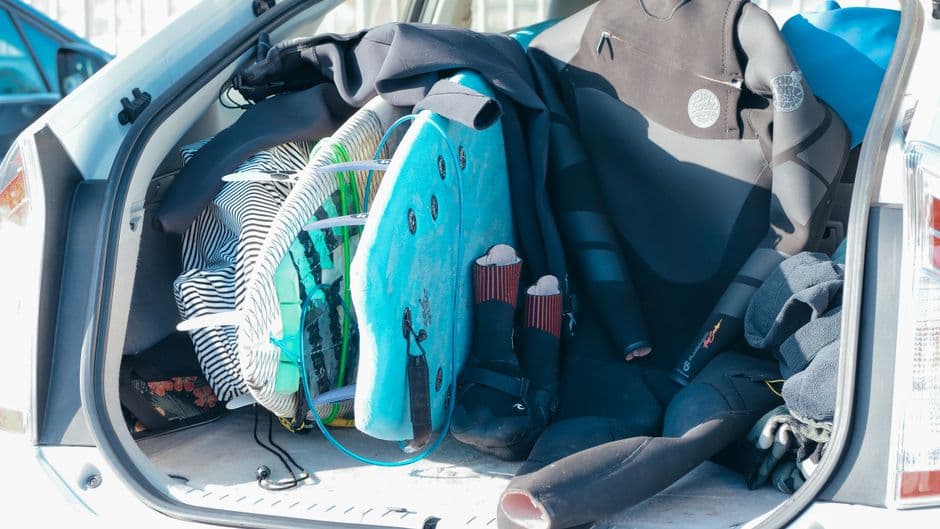
Reachability is the whole framework
Emergency equipment fails in a specific and predictable way: it is in the car, and it is somewhere you cannot get to in the situation it was bought for.
The question to ask of each item is not “where does this fit?” but “in the scenario this exists for, where will I be and what can I reach?” That produces three tiers, and they are not negotiable in the way storage decisions usually are.
| Tier | Reachable from | Items |
|---|---|---|
| On your person | Belted in, one hand, no reaching | Escape tool |
| Within the cabin | Seated, may need to lean | Fire extinguisher, flashlight |
| Trunk, restrained | Out of the car, on your feet | First aid, triangles, jump starter, tools |
Tier one: the escape tool
This is the only item where the storage decision is genuinely safety-critical, and it is the one most people get wrong.
Picture the scenario: belted in, possibly after an impact, possibly with the car on its side or filling with water. You need one hand, from a seated restrained position. A glovebox fails that test. So does a center console on the far side, a door pocket you are lying against, and the trunk.
The resqme is 2.93 in and lives on a keyring, which puts it in the ignition, a cup holder or your pocket. The Lifehammer is the better tool with a door bracket — and only if you actually fit the bracket. An unmounted full-size hammer is worse than a small one on your keys, because you will not find it.
Also check your glass before relying on either: these break tempered side glass and do nothing to laminated, which more new cars use on the front doors — best car escape tools.
Tier two: the fire extinguisher
An extinguisher rolling loose in a trunk is two problems at once: it is unreachable when needed, and it is a 2.7 lb unrestrained object in a collision.
First Alert ships the AUTO5 with a vehicle mount, bracket and strap for exactly this reason. Mount it — under a seat, on a seat rail, or in a footwell side panel where a seated person can reach it.
A flashlight belongs in this tier too, because the reason to need one is often that it is dark and you are still in the car. Anker publishes 900 lumens, up to 6 hours and IPX5 for the Bolder LC90 — best flashlights for a car.
Tier three: the trunk, restrained
Everything else can live in the trunk, on one condition: it has to be restrained. Loose equipment in a trunk migrates, gets buried, and becomes an unrestrained mass in a collision.
- First aid kit. Surviveware's hook-and-loop panel attaches to trunk lining, which is a genuinely practical answer — best car first aid kits
- Warning triangles. Near the top and near the opening, because you need them within seconds of stopping — best warning triangles and road flares
- Jump starter. Trunk is fine, and it needs charging every few months regardless of where it lives — best portable jump starters
- Tire repair kit and inflator. Near the spare, since they are used together — best tire repair kits
A cargo net or tie-downs anchored to the vehicle's own points is what restrains all of it — best cargo nets and tie-downs. A rigid organizer with securing straps does the same with structure.
The packing mistake that undoes all of it
A trunk packed for a road trip buries the emergency gear at the bottom, which is exactly when you are most likely to need it — long distances, unfamiliar roads, a loaded car.
Pack so the emergency items stay accessible: triangles near the opening, the spare wheel not under everything you own, and the first aid kit not at the bottom of a stack. The full loading order is in how to pack a car for a road trip.
Heat, which quietly degrades half of this
A trunk goes through a full temperature cycle every day, and several categories of emergency equipment do not tolerate that well.
- First aid consumables. Adhesive dries out, wipes evaporate through their packaging, medications degrade. Check annually — neither maker publishes a replacement interval, so it needs a calendar reminder
- Tire sealant. Slime publishes a working range of -35 F to 182 F and a shelf life of four years, which is more than most of this category states. It still expires
- Lithium jump starters and power banks. Heat permanently degrades lithium cells, and no maker publishes an operating range for these. A pack that lived through a hot summer holds less
- The fire extinguisher. Published ceiling of 49 C, below what a parked car reaches
The practical response is a review once a year: check dates, check the extinguisher gauge, charge the jump starter, and replace whatever has expired. Put it in the calendar, because nothing in a trunk will remind you.
Every pick, with the working
Each entry lists the specifications the maker publishes, the axis scores those specifications produce, and what you give up. Rows that read “Not published” are not omissions on our side: they are things the maker will not commit to in writing, and they cost the product points on the transparency axis. Specifications compiled September 4, 2026.
Our pickA kit whose contents are defined by a standard
First Aid Only 335-Piece OSHA Kit
Skip this one. The kit itself is the best contents-standard option we cover, and its case is built for a wall or a shelf rather than a wet trunk. If you buy it, plan to put it in something else — this is a storage page, and that case is the weakest storage in the list.
335 pieces built to an OSHA-compliant contents list rather than to a number on the box. That is the only meaningful way to judge a first aid kit: the piece count tells you nothing, the standard the contents are drawn from tells you everything. First Aid Only states supplies adequate for up to 100 people, which is generous for one car.
- Piece count
- 335
- Rated for
- Up to 100 people
- Standard
- OSHA-compliant contents
- Reference standard
- ANSI/ISEA Z308.1 minimum workplace requirements
- Intended use
- Home, car, travel and office
- Case
- Wall-mountable plastic, clear cover, compartments
- Warranty
- Not published
List price $37.44 per Amazon listing, September 27, 2026, captured on the compile date below. Not a live price and not what you will pay — the button is where the real number is.
What it gets right
- Contents built against an OSHA-compliant list, which traces to ANSI/ISEA Z308.1 minimum requirements
- Stated adequate for up to 100 people, so the quantities are generous for one car
- Published piece count of 335 alongside the standard, not instead of it
- Clear cover and individual compartments, so you can find one item under pressure
Flaws
- Workplace kits are weighted toward cuts and abrasions, not roadside trauma
- The case is wall-mountable and built for a shelf, not for a trunk that gets wet
- No published warranty, and consumables have expiry dates you have to track yourself
The working behind the 9.5
- Heat headroom: not scored (weight 22%)
- The maker publishes no operating-temperature ceiling, so this axis is dropped and the other weights are re-normalized.
- Install effort: 10.0 (weight 24%)
- Drops in and sits there. No fixing of any kind, and it comes out again when you sell the car.
- Price against the ceiling: 9.5 (weight 24%)
- Listed at $37.44 on the compile date. This site's buyer has a practical ceiling around $150 for a single upgrade, so the scale rewards everything under $100 and falls away sharply past $150. The live price is very often different, and that is what the button is for.
- Written commitment: not scored (weight 15%)
- No warranty term published, so this axis is dropped and the other weights are re-normalized.
- Spec transparency: 8.6 (weight 15%)
- 6 of the 7 specifications we went looking for are published by the maker (86%). A blank row is never a guess here: it prints “Not published” and it costs the product points, because a figure nobody will commit to in writing is a figure you cannot check.
Axes with no published input are dropped and the remaining weights re-normalized, so a product is not punished for a category where an axis does not apply. Specifications compiled September 4, 2026 from the First Aid Only 335-piece OSHA kit listing.
2Keeping an escape tool actually within reach
resqme Car Escape Tool
The one escape tool small enough to live on your keyring, which is the only place an escape tool is any use — a hammer in the glovebox is a hammer you cannot reach with a jammed belt across your chest. Spring-loaded, so it needs no swing.
- Height
- 2.93 in
- Materials
- ABS plastic and stainless steel
- Window breaker
- Spring-loaded stainless spike, resets after each use
- Belt cutter
- Stainless blade, rated for up to 100 seat belts
- Cut time
- Under 2 seconds (manufacturer figure)
- Certification
- TUV tested and certified
- Origin
- Made in USA
- Works on laminated glass
- No — tempered side glass only
- List price
- Not published
- Warranty
- Not published
What it gets right
- 2.93 inches tall and keyring-mounted, so it is on you rather than in a compartment you cannot reach
- Spring-loaded spike needs no room to swing, which matters when you are belted in
- Publishes a service life: one unit cuts up to 100 seat belts, and the spike resets after each use
- TUV tested and certified, and made in the USA
Flaws
- Breaks tempered side glass only. It will not touch a laminated side window, which is increasingly common on newer cars
- Small enough to lose, and a lost escape tool is no escape tool
- No published warranty term
The working behind the 9.2
- Heat headroom: not scored (weight 22%)
- The maker publishes no operating-temperature ceiling, so this axis is dropped and the other weights are re-normalized.
- Install effort: 10.0 (weight 24%)
- Drops in and sits there. No fixing of any kind, and it comes out again when you sell the car.
- Price against the ceiling: not scored (weight 24%)
- No published list price we could cite on the compile date, so this axis is dropped and the other weights are re-normalized.
- Written commitment: not scored (weight 15%)
- No warranty term published, so this axis is dropped and the other weights are re-normalized.
- Spec transparency: 8.0 (weight 15%)
- 8 of the 10 specifications we went looking for are published by the maker (80%). A blank row is never a guess here: it prints “Not published” and it costs the product points, because a figure nobody will commit to in writing is a figure you cannot check.
Axes with no published input are dropped and the remaining weights re-normalized, so a product is not punished for a category where an axis does not apply. Specifications compiled September 4, 2026 from resqme published specifications and certification.
3Being seen before someone hits you
CARTMAN Warning Triangle Kit (3 pack)
Built to FMVSS 571.125, which is a real federal standard with defined shape, size and performance requirements for roadside warning devices. In a category full of vague safety language, a named standard is the whole specification.
- Standard
- FMVSS 571.125 / 49 CFR Part 571.125
- Pack
- 3 triangles with case
- Visibility
- Reflective panels plus fluorescent plates
- Base
- Weighted non-skid
- Power
- None required
- Warranty
- Not published
- List price
- Not published
What it gets right
- Identical to the United States FMVSS 571.125 standard (49 CFR Part 571.125), which sets shape, size and performance requirements
- Reflective panels plus fluorescent plates, so they work in daylight and at night
- Weighted, non-skid bases that stay put in wind rather than blowing into traffic
- Sold as three, which is what the standard scenario actually calls for
- No battery, so it cannot be flat when you need it
Flaws
- Bulky compared with an LED flare, and they only fold so far
- Setting them out means walking back along a live carriageway, which is itself the dangerous part
- No published warranty term
The working behind the 8.9
- Heat headroom: not scored (weight 22%)
- The maker publishes no operating-temperature ceiling, so this axis is dropped and the other weights are re-normalized.
- Install effort: 10.0 (weight 24%)
- Drops in and sits there. No fixing of any kind, and it comes out again when you sell the car.
- Price against the ceiling: not scored (weight 24%)
- No published list price we could cite on the compile date, so this axis is dropped and the other weights are re-normalized.
- Written commitment: not scored (weight 15%)
- No warranty term published, so this axis is dropped and the other weights are re-normalized.
- Spec transparency: 7.1 (weight 15%)
- 5 of the 7 specifications we went looking for are published by the maker (71%). A blank row is never a guess here: it prints “Not published” and it costs the product points, because a figure nobody will commit to in writing is a figure you cannot check.
Axes with no published input are dropped and the remaining weights re-normalized, so a product is not punished for a category where an axis does not apply. Specifications compiled September 4, 2026 from CARTMAN warning triangle published standard compliance.
4Not needing anybody else's car
NOCO Boost Plus GB40
1,000 peak amps out of a 24 watt-hour lithium pack that weighs 2.4 pounds, rated for gasoline engines to 6.0 liters and diesel to 3.0, with spark-proof clamps and reverse-polarity protection. It is the single accessory here that changes what happens on the worst morning of your year, and it fits in a glovebox.
- Peak amps
- 1,000 A
- Battery
- 24 Wh lithium-ion
- Engine ceiling
- Gasoline to 6.0 L, diesel to 3.0 L
- Starts per charge
- Up to 20
- Dimensions
- 7.7 x 3.2 x 1.7 in
- Weight
- 2.4 lb with clamps
- Light
- 100 lumens
- Safety
- Spark proof, reverse polarity protected
- Operating range
- Not published
List price $99.95 per NOCO's listed price, captured on the compile date below. Not a live price and not what you will pay — the button is where the real number is.
What it gets right
- 1,000 peak amps and up to 20 starts on one charge, both published
- Spark-proof and reverse-polarity protected, which matters when you are doing this in the dark
- 2.4 lb and 7.7 inches long — it genuinely lives in the car rather than the garage
- USB port and a 100-lumen light, so it is also the thing you reach for in a power cut
Flaws
- Lithium, so it self-discharges and needs topping up every few months or it is a brick when you need it
- 6.0 L gasoline and 3.0 L diesel is the published ceiling — a big diesel needs the bigger model
- $99.95 for something you hope never to use
The working behind the 8.0
- Heat headroom: not scored (weight 22%)
- The maker publishes no operating-temperature ceiling, so this axis is dropped and the other weights are re-normalized.
- Install effort: 10.0 (weight 24%)
- Plugs into a 12V socket or a USB port. Nothing to mount, nothing to route, reversible in a second.
- Price against the ceiling: 7.0 (weight 24%)
- Listed at $99.95 on the compile date. This site's buyer has a practical ceiling around $150 for a single upgrade, so the scale rewards everything under $100 and falls away sharply past $150. The live price is very often different, and that is what the button is for.
- Written commitment: 5.5 (weight 15%)
- 12-month warranty. This is the only promise in the entire listing that a court would read, which is why it is scored and the marketing copy is not.
- Spec transparency: 8.9 (weight 15%)
- 8 of the 9 specifications we went looking for are published by the maker (89%). A blank row is never a guess here: it prints “Not published” and it costs the product points, because a figure nobody will commit to in writing is a figure you cannot check.
Axes with no published input are dropped and the remaining weights re-normalized, so a product is not punished for a category where an axis does not apply. Specifications compiled September 4, 2026 from NOCO Boost Plus GB40 published specifications.
5The one emergency where seconds decide everything
First Alert AUTO5 Car Fire Extinguisher
UL rated 5-B:C against four named standards, DOT approved for vehicle use, with a mounting bracket in the box. It also publishes an operating range topping out at 49 C — which is below what a parked car reaches, and that is worth knowing.
- UL rating
- 5-B:C
- Agent
- Sodium bicarbonate
- Standards
- UL711, ULC-S508, UL299, ULC-S504
- DOT
- Approved for vehicle use
- Operating temperature
- -40 F to 120 F (-40 C to 49 C)
- Charge pressure
- 100 psi (689 kPa)
- Dimensions
- 2.9 in dia x 10.3 in H
- Weight
- 2.7 lb
- Mounting
- Vehicle bracket and strap included
- Warranty
- Not published
- List price
- Not published
What it gets right
- UL rated 5-B:C and listed to UL711, ULC-S508, UL299 and ULC-S504 — four named standards, published
- Approved by the US Department of Transportation for vehicle use
- Ships with a vehicle mount, bracket and strap, so it is secured rather than rolling loose
- Metal head and metal pull pin with a safety seal, rather than the plastic head on cheaper units
- Publishes an operating temperature range and a charge pressure, which is unusual
Flaws
- Published operating range tops out at 120 F (49 C), and a car parked in summer sun runs 60-70 C inside — mount it where it is coolest and check the gauge often
- 5-B:C covers flammable liquid and electrical fires. It is not rated for Class A materials like upholstery
- Sodium bicarbonate leaves a residue that is corrosive to clean up after
- 2.7 lb is a real object that must be mounted, not left in a footwell
The working behind the 5.1
- Heat headroom: 2.0 (weight 22%)
- Published operating ceiling 49 C (120 F). A car parked in summer sun runs roughly 60-70 C inside, so 65 C and up is real headroom, 60 C is living at the limit, and anything under 55 C is a summer problem waiting to happen.
- Install effort: 6.0 (weight 24%)
- Adhesive pad onto the dashboard. Permanent in practice: repositioning means a new pad, and the pad is the part that fails first.
- Price against the ceiling: not scored (weight 24%)
- No published list price we could cite on the compile date, so this axis is dropped and the other weights are re-normalized.
- Written commitment: not scored (weight 15%)
- No warranty term published, so this axis is dropped and the other weights are re-normalized.
- Spec transparency: 8.2 (weight 15%)
- 9 of the 11 specifications we went looking for are published by the maker (82%). A blank row is never a guess here: it prints “Not published” and it costs the product points, because a figure nobody will commit to in writing is a figure you cannot check.
Axes with no published input are dropped and the remaining weights re-normalized, so a product is not punished for a category where an axis does not apply. Specifications compiled September 4, 2026 from First Alert AUTO5 published specifications.
Prices last verified October 22, 2026. They move constantly; the figure on Amazon when you click is the real one.
Questions people actually ask
Where should a fire extinguisher go in a car?
Mounted on its bracket within reach of a seated occupant — under a seat or on a seat rail. Not loose in the trunk, where it is both unreachable and a 2.7 lb unrestrained object.
Is it fine to keep an escape tool in the glovebox?
No. The scenario needing it is frequently one where you cannot reach across the cabin. Keyring or a fitted door bracket are the only two placements that work.
Does heat ruin emergency supplies in the trunk?
It degrades several categories: first aid adhesives and medications, lithium cells in jump starters, and the fire extinguisher which publishes a 49 C ceiling below what a parked car reaches. An annual check is the answer.
How do I stop emergency gear rolling around the trunk?
A cargo net or tie-downs anchored to the vehicle's own points, or a rigid organizer with securing straps. A skid-resistant liner stops creep but is not restraint.