The best snow socks and tire chains
Two things decide this and neither is performance: whether your car has the wheel-well clearance for chains, and whether the road you are on accepts a textile alternative.
By Sawyer V. · Published · How we research
We have not tested any of this. Everything below is compiled from published manufacturer specifications, and the arithmetic is printed so you can check it. This page carries affiliate links: if you buy through one we earn a commission at no extra cost to you, and it does not change the order of the picks. Full disclosure.
The short answer
Check your local chain-control rules first, then your wheel-well clearance. Some jurisdictions accept SAE-certified textile socks as a chain alternative and some require actual chains, so the legal question comes before the product question. AutoSock states a three-minute fitting time and fits vehicles where chains physically will not go. Both carry the same 25 to 30 mph ceiling — these are get-through devices, not a way to drive normally.
| # | Pick | Install | Score | Price |
|---|---|---|---|---|
| 1 | AutoSock Textile Snow Socks A car with no wheel-well clearance for chains | Drops in | 9.0/10 | $274.95 - view on Amazon |
| 2 | CARTMAN Warning Triangle Kit (3 pack) Being seen before someone hits you | Drops in | 8.9/10 | $27.99 - view on Amazon |
| 3 | AstroAI Digital Tire Gauge (150 PSI) Knowing what your tires are actually at | Drops in | 8.4/10 | $6.99 - view on Amazon |
Prices last verified October 24, 2026. They move constantly; the figure on Amazon when you click is the real one.
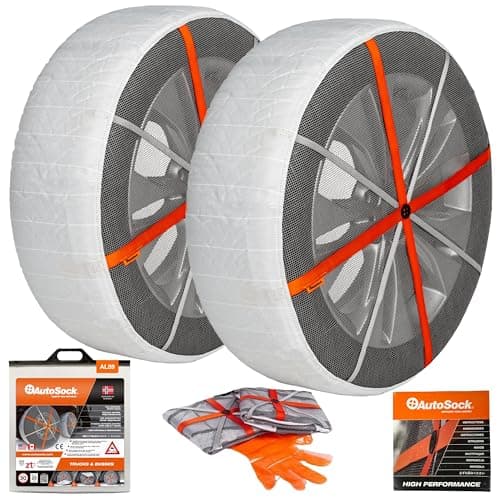
Clearance, which decides it for a lot of cars
The second question is physical and it rules chains out of many modern vehicles entirely.
A chain adds real thickness around the tire, and it moves — it flexes and it can flail slightly under load. So it needs meaningful clearance between the tire and the strut, the wheel arch liner and the suspension components. Plenty of cars with wide tires in tight arches simply do not have it, and manufacturers frequently state chains are not permitted at all.
A textile sock is a fabric cover a few millimeters thick. It fits where chains cannot, which is the entire reason the product exists and the reason it is our pick for most drivers.
Check your owner's manual before buying either. If it says no chains, that is a manufacturer's clearance statement, not a suggestion — and it is exactly the case socks were made for.
Socks against chains
| Textile socks | Metal chains | |
|---|---|---|
| Clearance needed | Minimal | Significant |
| Fitting time | Stated 3 minutes | Longer, and harder in the cold |
| Speed ceiling | 25-30 mph | 25-30 mph |
| On ice | Stated effective | Effective |
| In deep snow | Good | Generally better |
| Alloy rim damage | Stated damage-free | Possible if fitted loose |
| Wear on bare pavement | Fast | Slower, but damages the road |
| Universally accepted in chain control | No — varies | Yes |
The honest summary: chains are better in deep snow and universally accepted; socks fit more cars, go on far faster, and are accepted in many but not all places. For most drivers facing occasional winter conditions in a modern car, socks are the practical answer. For someone regularly crossing a mountain pass with mandatory chain control, chains.
Three minutes matters more than it sounds
AutoSock states a three-minute fitting time. That figure is worth taking seriously because of where you will be doing it.
Fitting traction devices happens at the roadside, in falling snow, in the cold, usually at the point where you have already decided the road is worse than you expected. Kneeling beside a live traffic lane is the genuinely dangerous part of the whole exercise, and halving the time you spend there is a real safety gain.
- Pull well off the road first. Further than feels necessary, hazards on
- Fit to the driven wheels. Front on a front-wheel-drive car, rear on rear-drive. On all-wheel drive, check the manual — it usually specifies which axle
- Pull the sock over the top of the tire, then drive forward a foot to expose the contact patch and pull the remainder over
- Drive a short distance and re-check. They settle, and a loose device is the one that comes off
Practice once in a dry driveway before winter. Reading instructions for the first time in the dark with cold hands is how a three-minute job becomes twenty.
The speed ceiling is not advisory
Both socks and chains carry a maximum around 25 to 30 mph. That is a structural limit rather than a comfort recommendation.
Above it, centrifugal force and heat build faster than the device can shed them. A chain that lets go at speed can wrap into a wheel arch and damage brake lines and bodywork. A sock that fails simply stops working, which is less dramatic and leaves you with no traction at the moment you assumed you had some.
The related rule: take them off as soon as the road clears. Textile socks wear very quickly on bare pavement, and chains damage the road surface and themselves. Neither is designed to run on tarmac.
The thing that beats both
Proper winter tires outperform any traction device fitted to summer tires, and they do it for the whole season without you kneeling in the snow.
Winter compounds stay flexible below about 7 C, where summer rubber hardens and loses grip long before there is any snow on the road. That is a change in every cold-weather journey, not just the snowy ones.
Traction devices are the answer for someone who meets snow occasionally — a few days a year, or one mountain route — rather than someone driving all winter in it. If you are in the second group, tires first, and carry socks for the exceptional day.
And check pressures cold before winter. Tire pressure falls roughly 1 PSI per 10 F temperature drop, so a tire set in September is measurably low by December. AstroAI publishes plus or minus 1 PSI — best tire pressure gauges.
The rest of the winter kit
Traction devices are one item. If you are carrying them, you are anticipating conditions in which several other things matter more often.
Warning triangles, because a stopped car in falling snow is very hard to see — best warning triangles and road flares. A flashlight, because this happens in the dark — best flashlights for a car. Washer fluid rated for the temperature, since summer fluid freezes in the lines — best windshield wipers.
The full seasonal list is in what to keep in your car in winter, and what to do when it goes wrong anyway is in what to do if your car breaks down.
Traction devices keep a moving car moving. For a car already stuck in snow or mud, recovery boards are the different product — and one maker publishes a named university test rather than a printed load rating — best recovery boards and traction mats.
Every pick, with the working
Each entry lists the specifications the maker publishes, the axis scores those specifications produce, and what you give up. Rows that read “Not published” are not omissions on our side: they are things the maker will not commit to in writing, and they cost the product points on the transparency axis. Specifications compiled September 4, 2026.
Our pickA car with no wheel-well clearance for chains
AutoSock Textile Snow Socks
A textile traction device that fits where chains physically cannot. It states a three-minute fitting time and the same 25 to 30 mph speed ceiling chains carry, and it is accepted as a chain alternative in many jurisdictions — but not all, which is the thing to check first.
- Type
- Textile traction device
- Fitting time
- Stated 3 minutes
- Speed limit
- 25-30 mph
- Clearance needed
- Minimal — fits low-clearance vehicles
- Rim damage
- Stated damage-free to alloy rims
- Legal as chain substitute
- Varies by jurisdiction — check locally
- Warranty
- Not published
- List price
- Not published
What it gets right
- Fits vehicles with limited wheel-well clearance, where chains simply do not go
- Textile rather than metal, so it does not damage alloy rims
- Stated three-minute fitting, which matters when you are doing it on a shoulder in weather
- Stated to meet the performance, safety and durability requirements of snow chain standards
Flaws
- Chain-control regulations vary: some jurisdictions accept SAE-certified socks as a chain alternative and some require actual chains. Check before you rely on it
- Same 25 to 30 mph ceiling as chains — this is a get-through device, not a way to drive normally
- Textile wears fast on bare pavement. Take them off as soon as the road clears
- No published warranty term
The working behind the 9.0
- Heat headroom: not scored (weight 22%)
- The maker publishes no operating-temperature ceiling, so this axis is dropped and the other weights are re-normalized.
- Install effort: 10.0 (weight 24%)
- Drops in and sits there. No fixing of any kind, and it comes out again when you sell the car.
- Price against the ceiling: not scored (weight 24%)
- No published list price we could cite on the compile date, so this axis is dropped and the other weights are re-normalized.
- Written commitment: not scored (weight 15%)
- No warranty term published, so this axis is dropped and the other weights are re-normalized.
- Spec transparency: 7.5 (weight 15%)
- 6 of the 8 specifications we went looking for are published by the maker (75%). A blank row is never a guess here: it prints “Not published” and it costs the product points, because a figure nobody will commit to in writing is a figure you cannot check.
Axes with no published input are dropped and the remaining weights re-normalized, so a product is not punished for a category where an axis does not apply. Specifications compiled September 4, 2026 from AutoSock published fitting time, standards and speed limit.
2Being seen before someone hits you
CARTMAN Warning Triangle Kit (3 pack)
Built to FMVSS 571.125, which is a real federal standard with defined shape, size and performance requirements for roadside warning devices. In a category full of vague safety language, a named standard is the whole specification.
- Standard
- FMVSS 571.125 / 49 CFR Part 571.125
- Pack
- 3 triangles with case
- Visibility
- Reflective panels plus fluorescent plates
- Base
- Weighted non-skid
- Power
- None required
- Warranty
- Not published
- List price
- Not published
What it gets right
- Identical to the United States FMVSS 571.125 standard (49 CFR Part 571.125), which sets shape, size and performance requirements
- Reflective panels plus fluorescent plates, so they work in daylight and at night
- Weighted, non-skid bases that stay put in wind rather than blowing into traffic
- Sold as three, which is what the standard scenario actually calls for
- No battery, so it cannot be flat when you need it
Flaws
- Bulky compared with an LED flare, and they only fold so far
- Setting them out means walking back along a live carriageway, which is itself the dangerous part
- No published warranty term
The working behind the 8.9
- Heat headroom: not scored (weight 22%)
- The maker publishes no operating-temperature ceiling, so this axis is dropped and the other weights are re-normalized.
- Install effort: 10.0 (weight 24%)
- Drops in and sits there. No fixing of any kind, and it comes out again when you sell the car.
- Price against the ceiling: not scored (weight 24%)
- No published list price we could cite on the compile date, so this axis is dropped and the other weights are re-normalized.
- Written commitment: not scored (weight 15%)
- No warranty term published, so this axis is dropped and the other weights are re-normalized.
- Spec transparency: 7.1 (weight 15%)
- 5 of the 7 specifications we went looking for are published by the maker (71%). A blank row is never a guess here: it prints “Not published” and it costs the product points, because a figure nobody will commit to in writing is a figure you cannot check.
Axes with no published input are dropped and the remaining weights re-normalized, so a product is not punished for a category where an axis does not apply. Specifications compiled September 4, 2026 from CARTMAN warning triangle published standard compliance.
3Knowing what your tires are actually at
AstroAI Digital Tire Gauge (150 PSI)
Skip this one. Not a traction device, and on this page because cold is the reason most people find their tires underinflated. Pressure falls roughly 1 PSI per 10 F drop, and an underinflated tire in snow is a worse starting point than any device will fully compensate for. Check pressures before you reach for traction aids.
0 to 150 PSI, factory calibrated to plus or minus 1 PSI, reading in 0.1 increments across four units with a backlit screen. The gas-station gauge you have been trusting is almost certainly worse than this, and this costs about the same as one tank of fuel.
- Range
- 0-150 PSI / 0-10 Bar / 0-10 Kgf/cm2 / 0-1000 kPa
- Accuracy
- Plus or minus 1 PSI
- Calibration standard
- ANSI B40.7, AstroAI UK listing only
- Resolution
- 0.1 PSI
- Display
- Backlit LCD, 4 selectable units
- Auto shut-off
- 30 seconds
- List price
- Not published
- Warranty
- 1 year, stated
What it gets right
- Published accuracy of plus or minus 1 PSI, stated in the listing title — almost nothing else in this category states an accuracy figure at all
- Reads to 0.1 PSI, which matters because a 3 PSI error is the difference between correct and noticeably underinflated
- Backlit screen, because tire pressures get checked in the dark more often than not
- Auto shut-off after 30 seconds, so the battery lasts
Flaws
- 150 PSI range is far beyond a passenger car, so the useful part of the scale is the bottom fifth
- A digital gauge has a battery, and a battery in a glovebox is a battery you will find dead
- It measures. It does not inflate — that is a separate tool
The working behind the 8.4
- Heat headroom: not scored (weight 22%)
- The maker publishes no operating-temperature ceiling, so this axis is dropped and the other weights are re-normalized.
- Install effort: 10.0 (weight 24%)
- Drops in and sits there. No fixing of any kind, and it comes out again when you sell the car.
- Price against the ceiling: not scored (weight 24%)
- No published list price we could cite on the compile date, so this axis is dropped and the other weights are re-normalized.
- Written commitment: 5.5 (weight 15%)
- 12-month warranty. This is the only promise in the entire listing that a court would read, which is why it is scored and the marketing copy is not.
- Spec transparency: 8.8 (weight 15%)
- 7 of the 8 specifications we went looking for are published by the maker (88%). A blank row is never a guess here: it prints “Not published” and it costs the product points, because a figure nobody will commit to in writing is a figure you cannot check.
Axes with no published input are dropped and the remaining weights re-normalized, so a product is not punished for a category where an axis does not apply. Specifications compiled September 4, 2026 from AstroAI 150 PSI gauge published specifications.
Prices last verified October 24, 2026. They move constantly; the figure on Amazon when you click is the real one.
Questions people actually ask
Are snow socks legal instead of chains?
It varies. Many jurisdictions accept SAE-certified textile devices as a chain alternative and some specifically require metal chains. Check the rules for the roads you drive before buying — this is general information, not legal advice.
How fast can I drive with snow socks or chains?
Both carry a ceiling around 25 to 30 mph. It is a structural limit, not a comfort figure — above it, heat and centrifugal force build faster than the device can handle.
Which wheels do traction devices go on?
The driven wheels — front on front-wheel drive, rear on rear-wheel drive. On all-wheel drive, check the owner's manual, which usually specifies an axle.
Are winter tires better than chains?
For a whole season, yes — winter compounds stay flexible below about 7 C, which improves every cold journey rather than only snowy ones. Traction devices are for occasional conditions or a mandatory chain-control route.