The best tow straps and recovery gear
A loaded strap stores an enormous amount of energy. Understanding what happens when something in the chain fails is more important than which strap you buy.
By Sawyer V. · Published · How we research
We have not tested any of this. Everything below is compiled from published manufacturer specifications, and the arithmetic is printed so you can check it. This page carries affiliate links: if you buy through one we earn a commission at no extra cost to you, and it does not change the order of the picks. Full disclosure.
The short answer
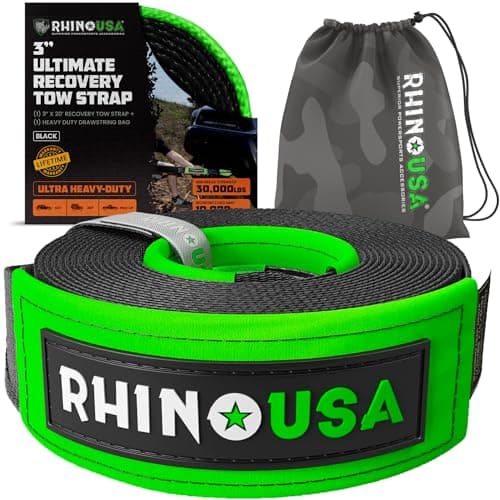
Most drivers should call a tow service instead. If you do drive unpaved surfaces, the Rhino USA publishes a lab-tested break strength of 31,518 lb on the 3-inch by 20-foot, carries a lifetime replacement warranty, and — usefully — states what it is not for. Two things to internalize: break strength is not working load (the widely used rule is about a third), and a loaded strap that lets go turns whatever it is attached to into a projectile.
| # | Pick | Install | Score | Price |
|---|---|---|---|---|
| 1 | Rhino USA Recovery Tow Strap (3 in x 20 ft) Being pulled out of mud or snow | Drops in | 9.5/10 | $39.90 - view on Amazon |
| 2 | CARTMAN Warning Triangle Kit (3 pack) Being seen before someone hits you | Drops in | 8.9/10 | $27.99 - view on Amazon |
| 3 | Anker Bolder LC90 Flashlight A light that is not your phone | Drops in | 8.8/10 | Check price on Amazon |
Prices last verified October 22, 2026. They move constantly; the figure on Amazon when you click is the real one.
Break strength is not working load
This is the number that gets misread, and the misreading is the dangerous one. Rhino USA publishes 31,518 lb break strength on the 3-inch strap, and break strength is the load at which the strap fails — not the load at which it is safe to operate.
The widely applied convention is a safe working limit of roughly a third of break strength. On this strap that is around 10,000 lb, which is a very different number from the one on the packaging.
The reason for the margin is that recovery loads are not steady. A vehicle stuck in mud breaks free suddenly, the strap goes from taut to slack to taut again, and shock loading can momentarily far exceed the steady pull. The margin absorbs that.
| Width | Published break strength | Rough safe working limit |
|---|---|---|
| 2 in | About 20,000 lb | About 6,600 lb |
| 3 in | 31,518 lb (lab tested) | About 10,000 lb |
| 4 in | About 40,000 lb | About 13,000 lb |
What actually goes wrong
A recovery strap under load is storing energy — Rhino USA publishes an 8% stretch on its poly-silk blend, and that stretch is elastic energy being held.
If the strap breaks, or more commonly if an attachment point fails, that energy is released instantly. Whatever was attached — a hook, a shackle, a torn-off bumper bracket — travels back toward one of the vehicles at speed. This is the mechanism behind the serious injuries in vehicle recovery, and it is why the attachment points matter more than the strap.
- Use designated recovery points only. Many vehicles have them, marked in the owner's manual. They are structural
- Never a tow ball. A tow ball is designed for a downward and forward load, not a sudden horizontal jerk, and balls have failed and become projectiles
- Never a bumper, a bumper bracket, a suspension arm or an axle unless the manual specifically identifies it
- Never through a hole not designed for it. A slot in a bumper cover is not a recovery point
- Keep everyone well clear, well outside the length of the strap, on both sides
Recovery strap versus tow strap
These are different products sold under overlapping names, and using the wrong one is a real error.
A recovery strap is designed to stretch — the 8% figure Rhino USA publishes. That elasticity is deliberate: it smooths the load and helps pull a stuck vehicle free with a gentler build-up rather than a jerk.
A tow strap is designed not to stretch. Its job is towing a rolling vehicle a distance, where stretch would make the towed vehicle surge and snatch unpredictably.
Using a non-stretch tow strap for a recovery transmits shock loads straight into the attachment points. Using a stretchy recovery strap for towing gives you a vehicle behind you oscillating on a rubber band. Rhino USA states plainly that its strap is not for snatch recoveries requiring a running start, which is exactly the kind of limit worth publishing.
The hooks question
Straps come with or without metal hooks sewn into the ends, and the safer arrangement is without.
A metal hook is a dense, hard object at the end of a strap storing elastic energy — the worst possible thing to have there if something fails. Soft loop ends attached to a properly rated soft shackle or a screw-pin shackle at a designated recovery point put far less mass in flight if the worst happens.
Rhino USA's reinforced, padded eyelets are the loop design rather than a hook design. The padding is there because the eyelet is the wear point, chafing against whatever it passes around.
When not to use one at all
On a public road. A vehicle being towed on a strap has no brake assistance, possibly no power steering, and a long flexible connection to the vehicle in front. Traffic, junctions and other drivers make that a much worse proposition than it is on a track. Call a tow service.
When you cannot identify a recovery point on both vehicles. If it is not in the manual, the answer is not to guess.
When the stuck vehicle is genuinely buried. If the wheels are down to the axles, the load required can exceed what any of this is rated for, and that is when things break.
When the assisting vehicle is much lighter. A small car pulling a large stuck one is a small car being dragged backward, or a strap loaded well beyond what the situation implies.
What most people should carry instead
If you are assembling roadside equipment and were considering a recovery strap, these earn their place first, for the far more likely scenarios:
- A jump starter — a flat battery is orders of magnitude more common than being stuck — best portable jump starters
- Tire repair and an inflator — best tire repair kits
- Warning triangles, because being seen is the actual safety issue — best warning triangles and road flares
- A flashlight and a first aid kit — best flashlights for a car and best car first aid kits
- The number of a tow service in your phone, which is free
The full pre-packed option is best emergency car kits, and what to do in the first minute is what to do if your car breaks down.
Every pick, with the working
Each entry lists the specifications the maker publishes, the axis scores those specifications produce, and what you give up. Rows that read “Not published” are not omissions on our side: they are things the maker will not commit to in writing, and they cost the product points on the transparency axis. Specifications compiled September 4, 2026.
Our pickBeing pulled out of mud or snow
Rhino USA Recovery Tow Strap (3 in x 20 ft)
Skip this one. We are naming the category winner as the skip, because for most drivers the honest recommendation is not to own one. Recovery is a job with real injury potential done badly, on a public road a tow service is both safer and more likely to be the correct call, and a strap you have never used is a strap you will use wrong. Buy it if you drive unpaved surfaces regularly; otherwise do not.
Publishes a lab-tested break strength of 31,518 lb and carries a lifetime replacement warranty. It also states what it is NOT for, which in recovery gear is the safety-critical half of the specification.
- Size
- 3 in x 20 ft
- Break strength
- 31,518 lb (lab tested)
- Material
- Poly-silk blend, 8% stretch
- Eyelets
- Reinforced and padded
- Not rated for
- Snatch recoveries requiring a running start
- Warranty
- Lifetime replacement
- List price
- Not published
What it gets right
- Publishes a lab-tested break strength figure — 31,518 lb on the 3 in x 20 ft — rather than a vague rating
- Lifetime replacement warranty published brand-wide
- Poly-silk blend with a stated 8% stretch, and reinforced padded eyelets rather than bare stitching
- States it is not for snatch recoveries requiring a running start, which is the misuse that gets people hurt
Flaws
- Break strength is not working load. The widely used rule is a safe working limit of about a third of break strength
- A strap under load stores enormous energy; if a hook or attachment point fails it becomes a projectile
- Recovery points are not tow-ball mounts or bumper brackets — using the wrong point is how bumpers come off
- For most drivers this is gear for a scenario they will never have; a tow service is the safer answer
The working behind the 9.5
- Heat headroom: not scored (weight 22%)
- The maker publishes no operating-temperature ceiling, so this axis is dropped and the other weights are re-normalized.
- Install effort: 10.0 (weight 24%)
- Drops in and sits there. No fixing of any kind, and it comes out again when you sell the car.
- Price against the ceiling: not scored (weight 24%)
- No published list price we could cite on the compile date, so this axis is dropped and the other weights are re-normalized.
- Written commitment: not scored (weight 15%)
- No warranty term published, so this axis is dropped and the other weights are re-normalized.
- Spec transparency: 8.6 (weight 15%)
- 6 of the 7 specifications we went looking for are published by the maker (86%). A blank row is never a guess here: it prints “Not published” and it costs the product points, because a figure nobody will commit to in writing is a figure you cannot check.
Axes with no published input are dropped and the remaining weights re-normalized, so a product is not punished for a category where an axis does not apply. Specifications compiled September 4, 2026 from Rhino USA recovery strap published specifications.
2Being seen before someone hits you
CARTMAN Warning Triangle Kit (3 pack)
Built to FMVSS 571.125, which is a real federal standard with defined shape, size and performance requirements for roadside warning devices. In a category full of vague safety language, a named standard is the whole specification.
- Standard
- FMVSS 571.125 / 49 CFR Part 571.125
- Pack
- 3 triangles with case
- Visibility
- Reflective panels plus fluorescent plates
- Base
- Weighted non-skid
- Power
- None required
- Warranty
- Not published
- List price
- Not published
What it gets right
- Identical to the United States FMVSS 571.125 standard (49 CFR Part 571.125), which sets shape, size and performance requirements
- Reflective panels plus fluorescent plates, so they work in daylight and at night
- Weighted, non-skid bases that stay put in wind rather than blowing into traffic
- Sold as three, which is what the standard scenario actually calls for
- No battery, so it cannot be flat when you need it
Flaws
- Bulky compared with an LED flare, and they only fold so far
- Setting them out means walking back along a live carriageway, which is itself the dangerous part
- No published warranty term
The working behind the 8.9
- Heat headroom: not scored (weight 22%)
- The maker publishes no operating-temperature ceiling, so this axis is dropped and the other weights are re-normalized.
- Install effort: 10.0 (weight 24%)
- Drops in and sits there. No fixing of any kind, and it comes out again when you sell the car.
- Price against the ceiling: not scored (weight 24%)
- No published list price we could cite on the compile date, so this axis is dropped and the other weights are re-normalized.
- Written commitment: not scored (weight 15%)
- No warranty term published, so this axis is dropped and the other weights are re-normalized.
- Spec transparency: 7.1 (weight 15%)
- 5 of the 7 specifications we went looking for are published by the maker (71%). A blank row is never a guess here: it prints “Not published” and it costs the product points, because a figure nobody will commit to in writing is a figure you cannot check.
Axes with no published input are dropped and the remaining weights re-normalized, so a product is not punished for a category where an axis does not apply. Specifications compiled September 4, 2026 from CARTMAN warning triangle published standard compliance.
3A light that is not your phone
Anker Bolder LC90 Flashlight
900 lumens from a CREE LED, a published 6-hour runtime, IPX5 water resistance and five modes including strobe and SOS, on a rechargeable 18650. Using a phone as a flashlight at the roadside drains the one device you need to call for help, which is the entire argument for keeping a real one in the car.
- Output
- 900 lumens, CREE LED
- Runtime
- Up to 6 hours
- Ingress rating
- IPX5
- Modes
- High, medium, low, strobe, SOS
- Beam
- Zoomable
- Battery
- Rechargeable 18650, included
- Stated beam distance
- Over 660 ft
- Operating range
- Not published
What it gets right
- Published lumens (900), runtime (6 h) and ingress rating (IPX5) — all three, which is rare at this price
- Rechargeable 18650 included, so there is no scramble for AAs
- Zoomable from flood to spot, which covers both 'find the dropped bolt' and 'signal from the shoulder'
- SOS and strobe modes, which are exactly the modes a roadside light needs
Flaws
- IPX5 is rain resistance, not submersion. Fine for a breakdown, not for dropping in a puddle
- A lithium cell in a hot trunk self-discharges, so it needs charging on a schedule like the jump starter does
- 900 lumens on high for 6 hours is not the same as 900 lumens for 6 hours; brightness steps down between modes
The working behind the 8.8
- Heat headroom: not scored (weight 22%)
- The maker publishes no operating-temperature ceiling, so this axis is dropped and the other weights are re-normalized.
- Install effort: 10.0 (weight 24%)
- Drops in and sits there. No fixing of any kind, and it comes out again when you sell the car.
- Price against the ceiling: not scored (weight 24%)
- No published list price we could cite on the compile date, so this axis is dropped and the other weights are re-normalized.
- Written commitment: 7.0 (weight 15%)
- 18-month warranty. This is the only promise in the entire listing that a court would read, which is why it is scored and the marketing copy is not.
- Spec transparency: 8.8 (weight 15%)
- 7 of the 8 specifications we went looking for are published by the maker (88%). A blank row is never a guess here: it prints “Not published” and it costs the product points, because a figure nobody will commit to in writing is a figure you cannot check.
Axes with no published input are dropped and the remaining weights re-normalized, so a product is not punished for a category where an axis does not apply. Specifications compiled September 4, 2026 from Anker Bolder LC90 published specifications.
Prices last verified October 22, 2026. They move constantly; the figure on Amazon when you click is the real one.
Questions people actually ask
What break strength tow strap do I need?
Break strength is not the working figure — the widely used rule is a safe working limit of about a third. Match it to vehicle weight with that margin in mind, and remember the weakest link is usually the attachment point rather than the strap.
Can I use a tow ball as a recovery point?
No. A tow ball is designed for a downward and forward load, not a sudden horizontal jerk. Balls have failed under recovery loads and become projectiles. Use only points identified in the owner's manual.
What is the difference between a tow strap and a recovery strap?
A recovery strap stretches — Rhino USA publishes 8% — which smooths the load when pulling a stuck vehicle free. A tow strap does not stretch, because a towed rolling vehicle on an elastic connection surges unpredictably.
Should I tow a broken-down car myself?
On a public road, generally no. A towed vehicle has reduced braking and steering assistance and a long flexible connection to the vehicle ahead. A tow service is safer and usually the right call.