The best tire inflators under $50
Cold air is lower-pressure air, so November is when the tire light comes on. Five pumps under fifty dollars, ranked on published inflation time against a named tire size rather than the 150 PSI on the front of every box.
By Sawyer V. · Published · How we research
We have not tested any of this. Everything below is compiled from published manufacturer specifications, and the arithmetic is printed so you can check it. This page carries affiliate links: if you buy through one we earn a commission at no extra cost to you, and it does not change the order of the picks. Full disclosure.
The verdict
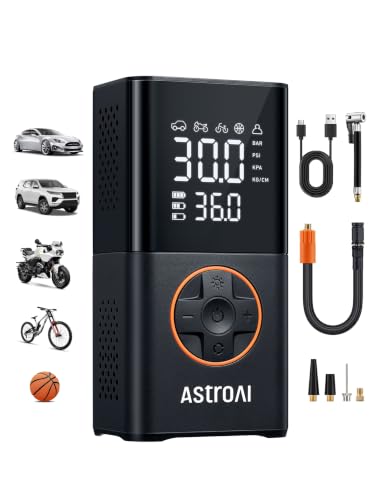
Buy the AstroAI L7, about $22. It is the only inflator here that publishes both halves of the question: a named tire at a named pressure change in a named time - 195/65R15 from 30 to 36 PSI in 1.5 minutes - and how many of those it does per charge, which is eight. It weighs under a pound, carries a published 2-year warranty and doubles as a USB power bank. Prices as of November 21, 2026.
If you want a gauge you can trust, buy the AVID POWER 20V at about $42. It is the only pump on this page that publishes an accuracy figure for its gauge - plus or minus 2 PSI - and the only one with two power paths, so a flat battery falls back to the car's 12V socket rather than ending the job.
| # | Pick | Install | Score | Price |
|---|---|---|---|---|
| 1 | AstroAI L7 Cordless Tire Inflator A published minutes-per-tire figure with no cord | Drops in | 9.4/10 | $21.83 - view on Amazon |
| 2 | AVID POWER 20V Cordless Tire Inflator The only one that publishes a gauge accuracy figure | Drops in | 9.7/10 | $41.79 - view on Amazon |
| 3 | AstroAI Portable Tire Inflator (150 PSI) Topping up four tires in a driveway | Plugs in | 9.1/10 | $24.69 - view on Amazon |
| 4 | AstroAI Dual-Power Tire Inflator (CZK-3666) A pump that works in the garage and at the roadside | Plugs in | 9.7/10 | $37.99 - view on Amazon |
| 5 | Slime 40050 12V Tire Inflator A 10 ft cord and a sensor-safe claim | Plugs in | 8.5/10 | $26.88 - view on Amazon |
Prices last verified November 21, 2026. They move constantly; the figure on Amazon when you click is the real one.
Why the light comes on in November
Nothing is leaking. Air pressure falls with temperature, and the arithmetic is small enough to do here. A tire at 35 PSI on the gauge is at about 50 PSI absolute. Drop the temperature from 70 F to 40 F and you have removed roughly 30 degrees from an absolute temperature of about 530 Rankine - about 5.7% - so the absolute pressure falls by about 2.8 PSI and the gauge reads about 32 PSI. That is the rule of thumb everyone quotes as a pound per ten degrees, and it is why the first cold snap of the season lights up a dashboard that was fine in October.
It is also why a $22 pump solves the problem completely. You are not inflating a flat tire; you are putting three or four pounds back into four tires. Every product on this page does that in under ten minutes. What separates them is whether the maker will tell you how long, how accurately and how often.
150 PSI is not a specification
Four of the five pumps here publish a maximum pressure of 150 PSI. No passenger car tire runs above about 44 PSI cold, and AVID POWER is the only maker here honest enough to publish the real ceiling for car use: 50 PSI. The 150 on the box describes what the pump can do against a closed valve, not what it will do to your tire, and it is identical across pumps that take between 1.5 and 8 minutes to do the actual job.
| Inflator | Published inflation time | Power | Duty cycle | Noise | Price checked Nov 21 |
|---|---|---|---|---|---|
| AstroAI L7 cordless | 195/65R15, 30 to 36 PSI, 1.5 min | Internal battery, USB-C charge | 15 min on / 10 min rest | 80 dB | $21.83 |
| AVID POWER 20V cordless | 195/60 R14 to 38 PSI, 3.5 min | 20V pack or 12V DC lead | Not published | 85 dB | $41.79 |
| AstroAI 150 PSI 12V | 195/65/R15, 30 to 36 PSI, under 1 min | 12V socket | 15 min on / 10 min rest | Not published | $24.69 |
| AstroAI dual-power | 195/65/R15, 0 to 36 PSI, 5 min | 12V socket or 110V wall | 15 min on / 10 min rest | 80 dB | $37.99 |
| Slime 40050 | Flat to full, standard tire, about 8 min | 12V socket, 10 ft cord | Not published | 87 dB | $26.88 |
Read the first and third rows together. AstroAI publishes 1.5 minutes for the cordless L7 and under a minute for its own corded 12V pump on the same tire and the same pressure change. That gap is the cost of going cordless, stated by the one maker here that gives you the figures to see it.
The duty cycle decides whether it finishes
Three of the five publish the same limit: 15 minutes of running, then 10 minutes of cooling. That is plenty for four top-ups and it is not plenty for one genuinely flat tire, which is the situation people buy these for. If the tire is on the rim at zero pressure, the from-flat figures are the ones that apply - 5 minutes on the AstroAI dual-power, about 8 on the Slime - and you are inside the cooling window either way, but only just.
The other figure worth checking before you buy is current. AstroAI’s dual-power unit publishes a maximum of 15 A and its own manual says to connect it to a 15 A socket. A great many cars fuse their accessory socket at 10 A or 15 A exactly, so that pump will blow a fuse in some cars and not others. The two cordless units sidestep the question entirely, which is a real advantage and the main argument for them.
Who each one is for
- AstroAI L7 - for almost everybody. 1.5 minutes a tire, 8 tires a charge, under a pound, a published 2-year warranty, a 3-mode torch and a USB output that will restart a dead phone. Skip it if you want to inflate a truck tire - AstroAI states it is not for tires over 25 in - and note AstroAI publishes two different battery capacities for it
- AVID POWER 20V - for a gauge with a number on it. Plus or minus 2 PSI published, 28 L/min, a self-locking trigger so it cannot switch on in the trunk, and a 9.8 ft 12V lead as a backup when the pack is flat. Skip it if your tires are wider than 245 mm, which AVID POWER excludes, and check the model number: the brand publishes 28, 30 and 35 L/min on three versions of this tool
- AstroAI 150 PSI 12V - for the fastest top-up and the lowest price. Under a minute for a 30-to-36 PSI top-up on a named tire, a digital gauge with automatic shut-off, and the published 15/10 duty cycle. Skip it if the cord will not reach your rear tires, because a 12V pump is only as useful as its lead
- AstroAI dual-power - for a driveway in December. The only pump here that runs from a wall socket, so you can check four tires in a cold garage without the engine running, at a published 120 W on either supply. Skip it if your car’s socket is fused below 15 A, and skip it if trunk space is tight at 2.2 lb
- Slime 40050 - careful. See the skip note above. The 10 ft cord and the sensor-safe statement are both genuinely useful, and an analog gauge with no shut-off is the wrong tool for cold hands
What a pump does not fix
An inflator puts air in. It does not find out why the air left, and in winter that distinction matters because a slow leak and a cold snap look identical on the dashboard. Check the pressures with the car cold, write them down, and check again in two days. If one tire has fallen and three have not, that is a leak, and a tire repair kit is the product that addresses it.
A pump is also not a gauge. The cheapest pencil gauge you can buy is more accurate than most built-in digital displays, and only one pump on this page publishes an accuracy figure at all - the tire pressure gauges page is where that argument lives. If the dashboard light itself is the problem rather than the pressures, TPMS sensors is the page, and if you want one box that both jump-starts and inflates, the combo units are ranked separately.
For the pumps above fifty dollars, including the heavy-duty compressors that will air up a truck tire from flat, the main tire inflators page is the wider ranking.
Every pick, with the working
Each entry lists the specifications the maker publishes, the axis scores those specifications produce, and what you give up. Rows that read “Not published” are not omissions on our side: they are things the maker will not commit to in writing, and they cost the product points on the transparency axis. Specifications compiled September 4, 2026.
Our pickA published minutes-per-tire figure with no cord
AstroAI L7 Cordless Tire Inflator
AstroAI publishes the figure that actually answers the question: a 195/65R15 tire from 30 to 36 PSI in 1.5 minutes, and eight of those tires on one charge of the built-in pack. It weighs under a pound, it carries a published two-year manufacturer warranty, and it doubles as a USB power bank and a three-mode flashlight. The one thing to know is that AstroAI publishes two different battery capacities for it.
- Maximum pressure
- 150 PSI
- Published inflation time
- 195/65R15 from 30 to 36 PSI in 1.5 minutes
- Published runtime
- Eight 195/65R15 top-ups (30 to 36 PSI) per charge
- Inflation speed
- 17 L/min per the manual
- Battery
- 4,000 mAh per the product page; 2,000 mAh x 2 per the manual
- Duty cycle
- 15 minutes continuous, then 10 minutes rest
- Noise
- 80 dB
- Weight
- 15.36 oz per the listing; 1.17 lb and 528 g elsewhere on AstroAI's channels
- Modes
- Car, motorcycle, bicycle, ball and custom (3-150 PSI)
- Extras
- USB-C input, USB output, 3-mode LED torch
- Warranty
- 2 years, manufacturer
- Tire size limit
- Stated not suitable for tires over 25 in
What it gets right
- Publishes an inflation time against a named tire size and pressure change: 195/65R15, 30 to 36 PSI, 1.5 minutes
- Publishes a runtime in tires rather than minutes: eight 195/65R15 top-ups per charge
- Published 2-year manufacturer warranty, the longest here
- Under a pound and cordless, so it reaches a rear tire without unspooling 10 ft of cable
- USB-C in and USB out, so it is also a small power bank, with a 3-mode LED including SOS
Flaws
- AstroAI publishes 4,000 mAh on the product page and 2,000 mAh x 2 in the manual, and three different weights across its own channels
- Published duty cycle is the category norm and still a limit: 15 minutes on, 10 minutes off
- Stated as not suitable for tires over 25 in, which rules out heavy-duty truck tires
- A dead battery is a dead inflator - a 12V unit always has the car
The working behind the 9.4
- Heat headroom: not scored (weight 22%)
- The maker publishes no operating-temperature ceiling, so this axis is dropped and the other weights are re-normalized.
- Install effort: 10.0 (weight 24%)
- Drops in and sits there. No fixing of any kind, and it comes out again when you sell the car.
- Price against the ceiling: not scored (weight 24%)
- No published list price we could cite on the compile date, so this axis is dropped and the other weights are re-normalized.
- Written commitment: 8.0 (weight 15%)
- 24-month warranty. This is the only promise in the entire listing that a court would read, which is why it is scored and the marketing copy is not.
- Spec transparency: 10.0 (weight 15%)
- 12 of the 12 specifications we went looking for are published by the maker (100%). A blank row is never a guess here: it prints “Not published” and it costs the product points, because a figure nobody will commit to in writing is a figure you cannot check.
Axes with no published input are dropped and the remaining weights re-normalized, so a product is not punished for a category where an axis does not apply. Specifications compiled September 4, 2026 from AstroAI's L7 tire inflator page.
2The only one that publishes a gauge accuracy figure
AVID POWER 20V Cordless Tire Inflator
AVID POWER publishes two numbers nobody else here does: a gauge accuracy of plus or minus 2 PSI, and a maximum working pressure for car tires of 50 PSI - which is the honest version of the 150 PSI on the front of every box in this category. It runs from its own 20 V battery or from the car on a 9.8 ft 12 V lead, so it is the one unit here with a genuine backup power path.
- Power
- 20 V Li-ion battery, or 12 V DC on a 9.8 ft lead
- Maximum pressure
- 150 PSI (10.35 bar)
- Car tire working ceiling
- 50 PSI, stated
- Gauge accuracy
- +/- 2 PSI
- Airflow
- 28 L/min on this model
- Published inflation times
- 195/60 R14 to 38 PSI in 3.5 min; 215/60 R16 in 6 min
- Air hose
- 20 in (500 mm)
- Weight
- 1.15 kg (2.5 lb)
- Noise
- 85 dB
- Tire width limit
- Stated not for tires over 245 mm
- Safety
- Self-locking switch below the trigger
- Warranty
- Not published
What it gets right
- Published gauge accuracy of +/- 2 PSI. Nothing else in this ledger publishes one at all
- Published 28 L/min airflow and two named inflation times: 195/60 R14 to 38 PSI in 3.5 min, 215/60 R16 in 6 min
- Two power paths in one tool: a 20 V Li-ion pack, or a 9.8 ft 12 V DC car lead when the pack is flat
- Self-locking trigger so it cannot be switched on by accident in a trunk
- Published 1.15 kg and a 20 in air hose, with a digital gauge and an LED work light
Flaws
- AVID POWER publishes 28 L/min on this model, 30 L/min on another and 35 L/min on the blue version - check the model number against the figure
- Published 50 PSI maximum working pressure for car tires, well under the 150 PSI headline
- Stated as not for tires wider than 245 mm, and not for commercial vehicles or trucks
- 85 dB published, and the heaviest cordless unit here at 2.5 lb
The working behind the 9.7
- Heat headroom: not scored (weight 22%)
- The maker publishes no operating-temperature ceiling, so this axis is dropped and the other weights are re-normalized.
- Install effort: 10.0 (weight 24%)
- Drops in and sits there. No fixing of any kind, and it comes out again when you sell the car.
- Price against the ceiling: not scored (weight 24%)
- No published list price we could cite on the compile date, so this axis is dropped and the other weights are re-normalized.
- Written commitment: not scored (weight 15%)
- No warranty term published, so this axis is dropped and the other weights are re-normalized.
- Spec transparency: 9.2 (weight 15%)
- 11 of the 12 specifications we went looking for are published by the maker (92%). A blank row is never a guess here: it prints “Not published” and it costs the product points, because a figure nobody will commit to in writing is a figure you cannot check.
Axes with no published input are dropped and the remaining weights re-normalized, so a product is not punished for a category where an axis does not apply. Specifications compiled September 4, 2026 from AVID POWER's 20V cordless inflator page.
3Topping up four tires in a driveway
AstroAI Portable Tire Inflator (150 PSI)
150 PSI maximum, a digital gauge, and AstroAI's own published figure of a 195/65/R15 tire going 30 to 36 PSI in under a minute. It also publishes the duty cycle honestly: fifteen minutes of continuous use and then ten minutes of cooling. That duty cycle is the specification that separates a topping-up tool from a tire-filling one.
- Maximum pressure
- 150 PSI
- Power
- 12 V DC
- Duty cycle
- 15 minutes continuous, then 10 minutes cooling
- Published inflation rate
- 195/65/R15 from 30 to 36 PSI in under 1 minute
- Gauge
- Digital, automatic shutoff
- Warranty
- Not published
- Operating range
- Not published
List price $37.99 per AstroAI's own store, captured on the compile date below. Not a live price and not what you will pay — the button is where the real number is.
What it gets right
- Published inflation rate on a named tire size, which is the only useful way to state this figure
- Published duty cycle: 15 minutes on, 10 minutes cooling
- Digital gauge with automatic shutoff at the set pressure
- Around $32 to $38 depending on the model
Flaws
- 15 minutes of continuous running is four tires topped up, not one tire filled from flat
- 150 PSI is a headline number a passenger car will never approach
- 12V socket powered, so a car with the ignition off will run its battery down doing this
The working behind the 9.1
- Heat headroom: not scored (weight 22%)
- The maker publishes no operating-temperature ceiling, so this axis is dropped and the other weights are re-normalized.
- Install effort: 10.0 (weight 24%)
- Plugs into a 12V socket or a USB port. Nothing to mount, nothing to route, reversible in a second.
- Price against the ceiling: 9.5 (weight 24%)
- Listed at $37.99 on the compile date. This site's buyer has a practical ceiling around $150 for a single upgrade, so the scale rewards everything under $100 and falls away sharply past $150. The live price is very often different, and that is what the button is for.
- Written commitment: not scored (weight 15%)
- No warranty term published, so this axis is dropped and the other weights are re-normalized.
- Spec transparency: 7.1 (weight 15%)
- 5 of the 7 specifications we went looking for are published by the maker (71%). A blank row is never a guess here: it prints “Not published” and it costs the product points, because a figure nobody will commit to in writing is a figure you cannot check.
Axes with no published input are dropped and the remaining weights re-normalized, so a product is not punished for a category where an axis does not apply. Specifications compiled September 4, 2026 from AstroAI's 150 PSI tire inflator page.
4A pump that works in the garage and at the roadside
AstroAI Dual-Power Tire Inflator (CZK-3666)
The only inflator here that runs from a wall socket as well as the car: AstroAI publishes 120 W rated power on both 12 V DC and 120 V AC at 60 Hz. For somebody who checks tires on a driveway in December and does not want the engine running, that is the whole argument. The published 15 A draw is the thing to check first, because it is right at the limit of many 12V sockets.
- Power
- 12 V DC and 110/120 V AC at 60 Hz
- Rated power
- 120 W
- Maximum current
- 15 A
- Maximum pressure
- 150 PSI
- Maximum inflation speed
- 25 L/min
- Published inflation time
- 195/65/R15 from 0 to 36 PSI in 5 minutes
- Duty cycle
- 15 minutes continuous, then 10 minutes rest
- Noise
- 80 dB
- DC cord
- About 3 m
- Weight
- 2.2 lb
- Voltage warning
- Stated not for use on 24 V vehicle power
- Warranty
- Not published
What it gets right
- Dual power: a 12V car socket or a 110/120 V wall outlet, both published at 120 W rated
- Twin metal cylinders and a published 25 L/min maximum inflation speed
- Published inflation time against a named tire: 195/65/R15 from 0 to 36 PSI in 5 minutes
- 80 dB published, the quietest corded unit here, with a backlit LCD and automatic shut-off
- Memory function keeps your preset pressure for next time; cords and nozzles store inside the body
Flaws
- Published 15 A maximum current. AstroAI's own manual says to connect it to a 12 V DC 15 A socket, and plenty of cars fuse theirs at 10 A or 15 A exactly
- Published 15-minute continuous limit, then 10 minutes rest, like everything else in the category
- 2.2 lb and a hard body, so it takes real trunk space next to a cordless unit
- AstroAI states it must not be used on 24 V vehicle power
The working behind the 9.7
- Heat headroom: not scored (weight 22%)
- The maker publishes no operating-temperature ceiling, so this axis is dropped and the other weights are re-normalized.
- Install effort: 10.0 (weight 24%)
- Plugs into a 12V socket or a USB port. Nothing to mount, nothing to route, reversible in a second.
- Price against the ceiling: not scored (weight 24%)
- No published list price we could cite on the compile date, so this axis is dropped and the other weights are re-normalized.
- Written commitment: not scored (weight 15%)
- No warranty term published, so this axis is dropped and the other weights are re-normalized.
- Spec transparency: 9.2 (weight 15%)
- 11 of the 12 specifications we went looking for are published by the maker (92%). A blank row is never a guess here: it prints “Not published” and it costs the product points, because a figure nobody will commit to in writing is a figure you cannot check.
Axes with no published input are dropped and the remaining weights re-normalized, so a product is not punished for a category where an axis does not apply. Specifications compiled September 4, 2026 from AstroAI's dual-power air compressor page.
5A 10 ft cord and a sensor-safe claim
Slime 40050 12V Tire Inflator
Skip this one. It has the best cord in the group - 10 ft, long enough to reach the far rear tire without moving the car - and it is still the one to skip, because it has no automatic shut-off. An analog dial means standing over it watching a needle in the cold, and the one thing you are most likely to do wrong when your hands are freezing is overfill. Slime's own listing also says 100 psi in the title and 0 to 60 psi in the description, which is not a confidence-building disagreement on a gauge.
An analog 12V pump with a 10 ft power cord - long enough to reach all four tires from one socket, which the short-cord units are not - plus an air-cooled motor and a published statement that it is tire-sensor safe. Slime publishes about 8 minutes from flat to full on a standard tire, which is the slowest figure here and the most honest one, because it is measured from flat rather than from a top-up.
- Power
- 12 V DC, car accessory socket
- Gauge
- Analog dial, 0 to 60 psi per Slime's description
- Published inflation time
- About 8 minutes, flat to full, standard mid-size car tire
- Power cord
- 10 ft
- Noise
- 87 dB
- Sensor safety
- Stated tire-sensor safe
- Motor
- Air cooled
- Warranty
- 1 year from date of purchase
- Automatic shut-off
- None on this model
- Maximum current
- Not published
What it gets right
- 10 ft power cord, published, which is what decides whether you move the car to reach the fourth tire
- Published 8-minute inflation time from flat to full on a standard car tire - a from-flat figure, not a top-up figure
- Stated as tire-sensor safe, which matters on any car with factory TPMS
- Air-cooled motor and a built-in LED, and ball and raft adapters in the box
- Published 1-year warranty from date of purchase
Flaws
- Analog dial, so there is no preset and no automatic shut-off - you watch it
- Slime's own listing title says a 100 psi dial while the description says the built-in gauge reads 0 to 60 psi
- 87 dB published, the loudest unit on this page
- 8 minutes from flat is slow if the tire is genuinely flat at the roadside in February
The working behind the 8.5
- Heat headroom: not scored (weight 22%)
- The maker publishes no operating-temperature ceiling, so this axis is dropped and the other weights are re-normalized.
- Install effort: 10.0 (weight 24%)
- Plugs into a 12V socket or a USB port. Nothing to mount, nothing to route, reversible in a second.
- Price against the ceiling: not scored (weight 24%)
- No published list price we could cite on the compile date, so this axis is dropped and the other weights are re-normalized.
- Written commitment: 5.5 (weight 15%)
- 12-month warranty. This is the only promise in the entire listing that a court would read, which is why it is scored and the marketing copy is not.
- Spec transparency: 9.0 (weight 15%)
- 9 of the 10 specifications we went looking for are published by the maker (90%). A blank row is never a guess here: it prints “Not published” and it costs the product points, because a figure nobody will commit to in writing is a figure you cannot check.
Axes with no published input are dropped and the remaining weights re-normalized, so a product is not punished for a category where an axis does not apply. Specifications compiled September 4, 2026 from Slime's 12V analog tire inflator page.
Prices last verified November 21, 2026. They move constantly; the figure on Amazon when you click is the real one.
Questions people actually ask
Is a $50 tire inflator good enough for a car?
For topping up four tires, yes, and comfortably. The published figures on this page run from 1.5 to about 8 minutes a tire, and the job most people need - putting three or four pounds back after a cold snap - is the easy end of that. What you do not get under fifty dollars is the duty cycle to air up a truck tire from flat, or a pump that can run for half an hour without a cooling break.
Why does my tire pressure light come on when it gets cold?
Because cold air exerts less pressure. A tire at 35 PSI gauge is about 50 PSI absolute; cooling it from 70 F to 40 F removes roughly 5.7 percent of its absolute temperature and therefore about 2.8 PSI, so the gauge reads about 32. That is the familiar rule of one pound per ten degrees. Nothing has leaked - but the car is genuinely underinflated and it should be corrected, because low pressure costs fuel and wears the shoulders of the tire.
Is a cordless tire inflator better than a 12V one?
Cordless is more convenient and slower. AstroAI publishes both figures for its own tools: under a minute for a 30-to-36 PSI top-up on the corded 12V pump against 1.5 minutes for the cordless L7, same tire, same pressure change. Cordless also avoids the current question entirely, which matters because one pump here publishes a 15 A draw that some cars' accessory sockets will not supply.
Does 150 PSI matter on a tire inflator?
Not for a car. No passenger tire runs above about 44 PSI cold, and AVID POWER is the one maker on this page that publishes the real working ceiling for car tires: 50 PSI. The 150 PSI figure describes the pump against a closed valve. Four of these five publish exactly the same 150 PSI and they take between 1.5 and 8 minutes to do the same job, which is the clearest proof that the number does not separate them.
How long can you run a portable tire inflator?
Fifteen minutes, then ten minutes off. Three of the five makers here publish exactly that duty cycle and the other two publish none. Fifteen minutes covers four top-ups comfortably. It does not cover filling a fully flat tire and then a second one, so if you are reinflating after a repair, expect to wait.
Sources
- Published inflation time, runtime, duty cycle and warranty for the AstroAI L7
- Published gauge accuracy, airflow, inflation times and hose length for the AVID POWER 20V
- Published inflation rate and duty cycle for the AstroAI 150 PSI 12V inflator
- Published rated power, maximum current and inflation speed for the AstroAI dual-power compressor
- Published inflation time, cord length, gauge range and sensor-safe statement for the Slime 40050