The best tire repair kits
Sealant is the most specification-transparent product in roadside gear. It publishes exactly what it seals, how far you can drive on it, and when it expires.
By Sawyer V. · Published · How we research
We have not tested any of this. Everything below is compiled from published manufacturer specifications, and the arithmetic is printed so you can check it. This page carries affiliate links: if you buy through one we earn a commission at no extra cost to you, and it does not change the order of the picks. Full disclosure.
The short answer
Carry sealant for getting home, and a plug kit if you will actually use one. Slime publishes what almost nothing in roadside gear does: the puncture size it seals (1/4 in, tread only), the limit before removal (3 days or 100 miles), a working range of -35 F to 182 F, TPMS compatibility, and a four-year shelf life. Neither product touches a sidewall puncture — that tire is scrap, and no kit changes it.
| # | Pick | Install | Score | Price |
|---|---|---|---|---|
| 1 | Slime Emergency Tire Sealant Getting off the hard shoulder without changing a wheel | Plugs in | 9.7/10 | $10.98 - view on Amazon |
| 2 | AstroAI Portable Tire Inflator (150 PSI) Topping up four tires in a driveway | Plugs in | 9.1/10 | $26.99 - view on Amazon |
| 3 | Astro Pneumatic 45-Piece Tire Repair Kit Actually repairing the puncture rather than postponing it | Drops in | 8.9/10 | $32.19 - view on Amazon |
| 4 | AstroAI Digital Tire Gauge (150 PSI) Knowing what your tires are actually at | Drops in | 8.4/10 | $6.99 - view on Amazon |
Prices last verified October 22, 2026. They move constantly; the figure on Amazon when you click is the real one.
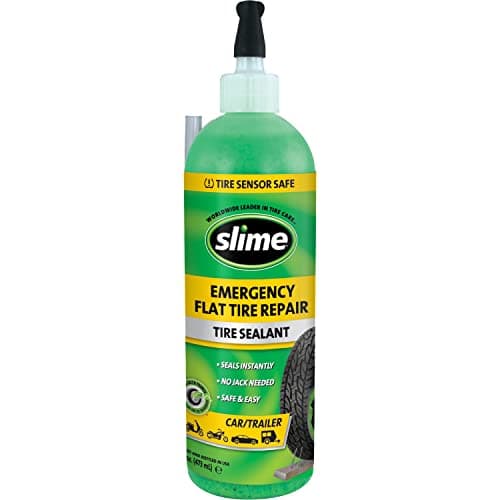
Sealant publishes more than anything else in this category
This is genuinely unusual and it is why sealant leads the page. Roadside products are typically sold on adjectives. Slime publishes a specification sheet you can act on.
| Specification | Published figure | Why it matters |
|---|---|---|
| Maximum puncture sealed | 1/4 in (6 mm), tread only | Tells you when not to bother |
| Temporary limit | 3 days or 100 miles | It is honest that this is not a repair |
| Working temperature | -35 F to 182 F | Brackets what a trunk actually sees |
| TPMS compatibility | Stated safe | The question everyone asks |
| Shelf life | 4 years (2 for Thru-Core) | It expires, and nothing tells you |
| Hazard | Non-toxic, non-flammable, non-corrosive | Relevant to storing it in a car |
The temperature range is the figure that matters most for a product living in a trunk. A car interior reaches roughly 60-70 C in summer, and Slime's stated ceiling of 182 F — about 83 C — brackets that comfortably. Very little roadside gear publishes a range at all, and one that does not is an unknown.
"Temporary" is a real limit, not a disclaimer
Slime states removal within 3 days or 100 miles. That is a genuine engineering limit rather than legal boilerplate, and it is worth respecting for two reasons.
The sealant plug is a mechanical bung of suspended particles forced into the hole by escaping air. It holds because pressure is holding it there. It is not bonded to the rubber and it is not a structural repair, so continued flexing works against it.
The second reason is what sealant does inside the tire over time: it stays liquid, it can pool and unbalance the wheel at speed, and it coats the TPMS sensor. Slime states its formula is TPMS-safe, which addresses the sensor concern specifically — but leaving any sealant in for months is outside what it is specified for.
Tell the tire shop you used sealant. Some charge for the extra cleanup, and a technician who opens a tire unexpectedly full of liquid is entitled to be annoyed.
The plug kit case
A plug is a sticky rubber string forced into the puncture with a T-handle tool. It is a proper mechanical repair that holds far longer than sealant, does not need cleaning out, and does not expire.
Astro Pneumatic publishes its exact contents rather than a piece count — 40 four-inch repair strings, a steel T-handle insert tool, a steel spiral probe, lubricant and a spare Allen wrench. Steel handles are the specification that matters: the plastic-handled kits snap on first insertion, which is precisely when you need them not to.
Two honest limitations. Using one requires finding the object, pulling it out, reaming the hole and forcing a plug in — real effort, often kneeling in weather beside a road. And a plug is generally regarded as a temporary repair too; the proper fix is a patch-plug applied from inside the tire, which needs the tire off the wheel.
A plug kit is also useless without a way to reinflate, since the tire is flat by the time you are using it.
The tool both approaches need
Sealant needs the tire brought back to pressure after it is injected. A plug repair needs the tire inflated from flat. Either way an inflator is not optional.
The specification that decides an inflator is duty cycle — how long it can run before it has to stop and cool. It is the first thing cut to hit a low price, and a unit that overheats partway through one tire has failed at the only job it had. AstroAI publishes a duty cycle, which is the reason it is the one we cover: best tire inflators.
You also need to know the target pressure, which is on the door jamb placard rather than the tire sidewall — the sidewall number is a maximum, not a recommendation. And a gauge is worth more than the inflator's own display: AstroAI publishes plus or minus 1 PSI, which almost nothing in that category states — best tire pressure gauges.
What about the spare
Many cars no longer come with one — a sealant kit and an inflator is increasingly the factory provision, which is exactly why understanding sealant's limits matters.
If you do have a spare, check its pressure occasionally. A spare that has sat for five years is often well below usable pressure, and discovering that at the roadside is a bad moment. Space-saver spares also carry their own speed and distance limits, printed on the wheel.
Changing it is a separate skill worth having — how to change a tire.
What to actually carry
- Sealant and an inflator as the baseline. Between them they cover the common case in a few minutes with no physical effort
- A gauge, because the inflator's own display is usually the least accurate thing involved
- A plug kit as well if you drive somewhere remote, tow, or are comfortable doing the work
- A flashlight. Punctures happen at night — best flashlights for a car
- Warning triangles, because standing beside a stopped car on a road is the genuinely dangerous part of all this — best warning triangles and road flares
And check the sealant date once a year. It expires, it looks identical either way, and a can three years past its shelf life is not something you want to discover on a hard shoulder — the whole storage question is in where to store emergency gear in your car.
Every pick, with the working
Each entry lists the specifications the maker publishes, the axis scores those specifications produce, and what you give up. Rows that read “Not published” are not omissions on our side: they are things the maker will not commit to in writing, and they cost the product points on the transparency axis. Specifications compiled September 4, 2026.
Our pickGetting off the hard shoulder without changing a wheel
Slime Emergency Tire Sealant
Publishes more checkable numbers than anything else in roadside: the puncture size it seals, the distance and time limit before it must come out, its shelf life, and its working temperature range. That last one is why it belongs in a car.
- Maximum puncture sealed
- 1/4 in (6 mm), tread area only
- Temporary limit
- Remove within 3 days or 100 miles
- Working temperature
- -35 F to 182 F (-37 C to 83 C)
- TPMS
- Stated safe for tire pressure monitoring systems
- Shelf life
- 4 years standard, 2 years Thru-Core
- Hazard
- Non-toxic, non-flammable, non-corrosive
- Size
- 16 oz
- List price
- Not published
What it gets right
- Publishes the maximum puncture it seals — 1/4 in (6 mm) — in the tread area
- States plainly that it is temporary: remove within 3 days or 100 miles
- Publishes a working range of -35 F to 182 F, which brackets what a trunk actually sees
- Stated safe for TPMS sensors, which is the question everyone asks and nobody answers
- Published shelf life: 4 years for the standard formula, 2 years for Thru-Core
Flaws
- Tread area only. A sidewall puncture is not repairable by any sealant and the tire is scrap
- It is a get-home measure, not a repair — the tire still has to go to a shop
- Sealant inside a tire makes the eventual proper repair messier and some shops charge for it
- It expires, and a can that expired three years ago looks exactly like one that did not
The working behind the 9.7
- Heat headroom: 10.0 (weight 22%)
- Published operating ceiling 83 C (181 F). A car parked in summer sun runs roughly 60-70 C inside, so 65 C and up is real headroom, 60 C is living at the limit, and anything under 55 C is a summer problem waiting to happen.
- Install effort: 10.0 (weight 24%)
- Plugs into a 12V socket or a USB port. Nothing to mount, nothing to route, reversible in a second.
- Price against the ceiling: not scored (weight 24%)
- No published list price we could cite on the compile date, so this axis is dropped and the other weights are re-normalized.
- Written commitment: not scored (weight 15%)
- No warranty term published, so this axis is dropped and the other weights are re-normalized.
- Spec transparency: 8.8 (weight 15%)
- 7 of the 8 specifications we went looking for are published by the maker (88%). A blank row is never a guess here: it prints “Not published” and it costs the product points, because a figure nobody will commit to in writing is a figure you cannot check.
Axes with no published input are dropped and the remaining weights re-normalized, so a product is not punished for a category where an axis does not apply. Specifications compiled September 4, 2026 from Slime Emergency Tire Sealant published specifications.
2Topping up four tires in a driveway
AstroAI Portable Tire Inflator (150 PSI)
150 PSI maximum, a digital gauge, and AstroAI's own published figure of a 195/65/R15 tire going 30 to 36 PSI in under a minute. It also publishes the duty cycle honestly: fifteen minutes of continuous use and then ten minutes of cooling. That duty cycle is the specification that separates a topping-up tool from a tire-filling one.
- Maximum pressure
- 150 PSI
- Power
- 12 V DC
- Duty cycle
- 15 minutes continuous, then 10 minutes cooling
- Published inflation rate
- 195/65/R15 from 30 to 36 PSI in under 1 minute
- Gauge
- Digital, automatic shutoff
- Warranty
- Not published
- Operating range
- Not published
List price $37.99 per AstroAI's own store, captured on the compile date below. Not a live price and not what you will pay — the button is where the real number is.
What it gets right
- Published inflation rate on a named tire size, which is the only useful way to state this figure
- Published duty cycle: 15 minutes on, 10 minutes cooling
- Digital gauge with automatic shutoff at the set pressure
- Around $32 to $38 depending on the model
Flaws
- 15 minutes of continuous running is four tires topped up, not one tire filled from flat
- 150 PSI is a headline number a passenger car will never approach
- 12V socket powered, so a car with the ignition off will run its battery down doing this
The working behind the 9.1
- Heat headroom: not scored (weight 22%)
- The maker publishes no operating-temperature ceiling, so this axis is dropped and the other weights are re-normalized.
- Install effort: 10.0 (weight 24%)
- Plugs into a 12V socket or a USB port. Nothing to mount, nothing to route, reversible in a second.
- Price against the ceiling: 9.5 (weight 24%)
- Listed at $37.99 on the compile date. This site's buyer has a practical ceiling around $150 for a single upgrade, so the scale rewards everything under $100 and falls away sharply past $150. The live price is very often different, and that is what the button is for.
- Written commitment: not scored (weight 15%)
- No warranty term published, so this axis is dropped and the other weights are re-normalized.
- Spec transparency: 7.1 (weight 15%)
- 5 of the 7 specifications we went looking for are published by the maker (71%). A blank row is never a guess here: it prints “Not published” and it costs the product points, because a figure nobody will commit to in writing is a figure you cannot check.
Axes with no published input are dropped and the remaining weights re-normalized, so a product is not punished for a category where an axis does not apply. Specifications compiled September 4, 2026 from AstroAI's 150 PSI tire inflator page.
3Actually repairing the puncture rather than postponing it
Astro Pneumatic 45-Piece Tire Repair Kit
Skip this one. Steel T-handles and 40 strings make it the better long-term repair, and it is the wrong thing to carry if you will not use it. Plugging a tire at the roadside means reaming a hole and forcing a plug in with real physical effort, often in weather. Sealant takes thirty seconds. Be honest about which you will actually do.
Steel T-handle tools and 40 repair strings, which is the difference between a plug kit that works and the plastic-handled ones that snap on the first insertion. It publishes its exact contents, which is rare at this end of the market.
- Piece count
- 45
- Insert tool
- Heavy-duty steel T-handle
- Probe
- Heavy-duty steel T-handle spiral probe
- Repair strings
- 40 x 4 in
- Also included
- Lubricant, 3 mm Allen wrench, replacement tools
- Warranty
- Not published
- List price
- Not published
What it gets right
- Heavy-duty steel T-handles on both the insert tool and the spiral probe — the failure point on cheap kits
- Publishes the exact contents rather than a piece count: 40 x 4 in repair strings, 2 tools, lubricant, spare Allen wrench
- A plug repair holds far longer than sealant and does not have to be cleaned out
- No expiry date on steel tools and rubber strings, unlike a sealant can
Flaws
- It requires you to remove the object, ream the hole and force a plug in — real physical effort at the roadside
- Tread punctures only, same as sealant. A sidewall is scrap either way
- A plug is widely regarded as a temporary repair; a proper fix is a patch-plug from inside the tire
- Useless without a way to reinflate, which is a separate tool
The working behind the 8.9
- Heat headroom: not scored (weight 22%)
- The maker publishes no operating-temperature ceiling, so this axis is dropped and the other weights are re-normalized.
- Install effort: 10.0 (weight 24%)
- Drops in and sits there. No fixing of any kind, and it comes out again when you sell the car.
- Price against the ceiling: not scored (weight 24%)
- No published list price we could cite on the compile date, so this axis is dropped and the other weights are re-normalized.
- Written commitment: not scored (weight 15%)
- No warranty term published, so this axis is dropped and the other weights are re-normalized.
- Spec transparency: 7.1 (weight 15%)
- 5 of the 7 specifications we went looking for are published by the maker (71%). A blank row is never a guess here: it prints “Not published” and it costs the product points, because a figure nobody will commit to in writing is a figure you cannot check.
Axes with no published input are dropped and the remaining weights re-normalized, so a product is not punished for a category where an axis does not apply. Specifications compiled September 4, 2026 from Astro Pneumatic 7445 published contents.
4Knowing what your tires are actually at
AstroAI Digital Tire Gauge (150 PSI)
0 to 150 PSI, factory calibrated to plus or minus 1 PSI, reading in 0.1 increments across four units with a backlit screen. The gas-station gauge you have been trusting is almost certainly worse than this, and this costs about the same as one tank of fuel.
- Range
- 0-150 PSI / 0-10 Bar / 0-10 Kgf/cm2 / 0-1000 kPa
- Accuracy
- Plus or minus 1 PSI
- Calibration standard
- ANSI B40.7, AstroAI UK listing only
- Resolution
- 0.1 PSI
- Display
- Backlit LCD, 4 selectable units
- Auto shut-off
- 30 seconds
- List price
- Not published
- Warranty
- 1 year, stated
What it gets right
- Published accuracy of plus or minus 1 PSI, stated in the listing title — almost nothing else in this category states an accuracy figure at all
- Reads to 0.1 PSI, which matters because a 3 PSI error is the difference between correct and noticeably underinflated
- Backlit screen, because tire pressures get checked in the dark more often than not
- Auto shut-off after 30 seconds, so the battery lasts
Flaws
- 150 PSI range is far beyond a passenger car, so the useful part of the scale is the bottom fifth
- A digital gauge has a battery, and a battery in a glovebox is a battery you will find dead
- It measures. It does not inflate — that is a separate tool
The working behind the 8.4
- Heat headroom: not scored (weight 22%)
- The maker publishes no operating-temperature ceiling, so this axis is dropped and the other weights are re-normalized.
- Install effort: 10.0 (weight 24%)
- Drops in and sits there. No fixing of any kind, and it comes out again when you sell the car.
- Price against the ceiling: not scored (weight 24%)
- No published list price we could cite on the compile date, so this axis is dropped and the other weights are re-normalized.
- Written commitment: 5.5 (weight 15%)
- 12-month warranty. This is the only promise in the entire listing that a court would read, which is why it is scored and the marketing copy is not.
- Spec transparency: 8.8 (weight 15%)
- 7 of the 8 specifications we went looking for are published by the maker (88%). A blank row is never a guess here: it prints “Not published” and it costs the product points, because a figure nobody will commit to in writing is a figure you cannot check.
Axes with no published input are dropped and the remaining weights re-normalized, so a product is not punished for a category where an axis does not apply. Specifications compiled September 4, 2026 from AstroAI 150 PSI gauge published specifications.
Prices last verified October 22, 2026. They move constantly; the figure on Amazon when you click is the real one.
Questions people actually ask
Can I repair a sidewall puncture?
No. Not with sealant, not with a plug, and not at a tire shop. The sidewall flexes constantly and carries structural load, and a repair there can fail at speed. That tire is scrap.
Is tire sealant safe for TPMS sensors?
Slime states its formula is safe for tire pressure monitoring systems. Still tell the tire shop you used it — they need to clean the sensor, and some charge for it.
How long can I drive on sealant?
Slime publishes 3 days or 100 miles, and that is an engineering limit rather than boilerplate. The plug is held in place by pressure, not bonded, and continued flexing works against it.
Does tire sealant expire?
Yes — Slime publishes four years for the standard formula and two for Thru-Core. An expired can looks identical to a fresh one, so check the date annually.