The best warning triangles and road flares
A named federal standard governs this category, which makes it one of the few where the specification is checkable. The harder question is placement.
By Sawyer V. · Published · How we research
We have not tested any of this. Everything below is compiled from published manufacturer specifications, and the arithmetic is printed so you can check it. This page carries affiliate links: if you buy through one we earn a commission at no extra cost to you, and it does not change the order of the picks. Full disclosure.
The short answer
Buy triangles built to FMVSS 571.125, and set them out properly. That is a real federal standard — 49 CFR Part 571.125 — defining shape, size and performance for roadside warning devices, which makes this one of the few car accessory categories with a checkable specification. Triangles beat LED flares on one decisive point: they need no battery, so they cannot be flat when you need them. The dangerous part is walking back along a live carriageway to place them.
| # | Pick | Install | Score | Price |
|---|---|---|---|---|
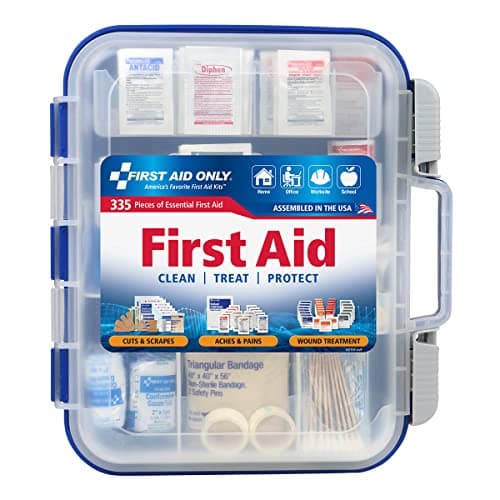
| 1 | First Aid Only 335-Piece OSHA Kit A kit whose contents are defined by a standard | Drops in | 9.5/10 | $37.44 - view on Amazon |
| 2 | CARTMAN Warning Triangle Kit (3 pack) Being seen before someone hits you | Drops in | 8.9/10 | $27.99 - view on Amazon |
| 3 | Anker Bolder LC90 Flashlight A light that is not your phone | Drops in | 8.8/10 | Check price on Amazon |
Prices last verified October 22, 2026. They move constantly; the figure on Amazon when you click is the real one.
A category with a real standard
FMVSS 571.125 — Federal Motor Vehicle Safety Standard 125, at 49 CFR Part 571.125 — establishes shape, size and performance requirements for non-powered day and night warning devices erected near a roadway to warn traffic of a stopped vehicle.
That matters because it means "DOT approved" on a triangle is a claim about compliance with a defined standard rather than marketing. Compliant triangles are typically built around 17-inch reflective panels with fluorescent plates, so they work by reflecting headlights at night and by fluorescing in daylight.
The weighted, non-skid base is part of the design rather than a nicety. A triangle that blows over in the draft of a passing truck has stopped warning anyone, and a triangle that blowsinto the carriageway is worse than none.
| Triangles (FMVSS 571.125) | LED flares, typical | |
|---|---|---|
| Named standard | Yes | Rarely |
| Needs power | No | Yes — batteries |
| Daylight visibility | Fluorescent plates | Poor in bright sun |
| Night visibility | Reflects headlights | Self-illuminating |
| Packed size | Bulky | Compact |
| Fails when | Blown over | Battery flat |
Triangles versus LED flares
LED flares are genuinely appealing: compact, magnetic, self-illuminating, often with flashing patterns. They have one structural weakness that decides this for us.
They need working batteries. A device that sits in a trunk for two years through full temperature cycling, and then has to work on the one night it matters, is a device that is often flat. Batteries self-discharge, and heat accelerates it.
A reflective triangle has no failure mode of that kind. It reflects headlights because of its physical surface, and that surface works after five years in a trunk exactly as it did on day one.
The other advantage is daylight. A reflective triangle with fluorescent plates is highly visible in daylight; an LED flare in bright sun is much less so, and daytime breakdowns are at least as common as night ones.
LED flares make a reasonable supplement — the flashing pattern draws attention differently. As the primary device, the battery dependency is the wrong trade.
Placement, which is the hard part
Owning triangles achieves nothing; placing them achieves everything. The principle is to give approaching traffic enough distance to see, react and change lanes — and that distance scales with speed.
- Hazard lights on before anything else, immediately on stopping
- Get everyone out on the side away from traffic and behind a barrier if there is one. People do not belong in a car stopped on a live carriageway
- Put on something high visibility before walking anywhere
- Walk back facing traffic, on the shoulder or behind the barrier, never on the carriageway
- Place the first triangle well back — considerably further on a highway than on a suburban road. The faster the traffic, the further back
- Place the others between it and the vehicle, giving a progressive warning
- On a curve or a crest, place beyond it so drivers see the warning before they see the obstruction
Requirements for how far back differ by state and by vehicle type — commercial vehicles have specific rules that private cars do not. Check your own state's requirements; this is general guidance rather than a legal specification.
The honest caveat about walking back
Setting out triangles requires walking along the side of a road with traffic passing, which is itself the most dangerous thing in this entire scenario.
On a fast highway with a narrow shoulder and no barrier, that risk can genuinely exceed the benefit. The judgment — get behind the barrier and stay there, or walk back to place triangles — depends on the road, the traffic, the visibility and the weather.
We are not going to tell you which to choose. What we will say is that hazard lights are instant and free, getting out of the vehicle on the safe side is instant and free, and neither requires walking anywhere. Do those first, always, and then decide about the triangles.
The rest of being seen
- A high-visibility vest. Cheap, packs flat, and it is the difference between a person and a shape at the roadside at night. Keep it in the cabin, not the trunk — you want it on before you get out
- A flashlight. Anker publishes 900 lumens, up to 6 hours and IPX5 for the Bolder LC90 — all three figures, which is rare. It makes you visible and lets you see what you are doing — best flashlights for a car
- Interior light on if you are staying in the vehicle, so it reads as occupied
Where they live
Near the trunk opening, not underneath the luggage. Triangles buried under a packed trunk are triangles you will not deploy, because getting them out means unloading a car on a hard shoulder.
This is the recurring failure with road trip packing specifically, when the trunk is fullest and the driving is longest — the loading order that avoids it is in how to pack a car for a road trip, and the full placement framework in where to store emergency gear in your car.
What to do in the first minute is in what to do if your car breaks down, and the wider kit in best emergency car kits.
Every pick, with the working
Each entry lists the specifications the maker publishes, the axis scores those specifications produce, and what you give up. Rows that read “Not published” are not omissions on our side: they are things the maker will not commit to in writing, and they cost the product points on the transparency axis. Specifications compiled September 4, 2026.
Our pickA kit whose contents are defined by a standard
First Aid Only 335-Piece OSHA Kit
Skip this one. Not a warning device, and here to make an ordering point. The most likely serious injury at a roadside breakdown is being struck by another vehicle, which means visibility equipment prevents the injury the first aid kit would treat. Buy the triangles first.
335 pieces built to an OSHA-compliant contents list rather than to a number on the box. That is the only meaningful way to judge a first aid kit: the piece count tells you nothing, the standard the contents are drawn from tells you everything. First Aid Only states supplies adequate for up to 100 people, which is generous for one car.
- Piece count
- 335
- Rated for
- Up to 100 people
- Standard
- OSHA-compliant contents
- Reference standard
- ANSI/ISEA Z308.1 minimum workplace requirements
- Intended use
- Home, car, travel and office
- Case
- Wall-mountable plastic, clear cover, compartments
- Warranty
- Not published
List price $37.44 per Amazon listing, September 27, 2026, captured on the compile date below. Not a live price and not what you will pay — the button is where the real number is.
What it gets right
- Contents built against an OSHA-compliant list, which traces to ANSI/ISEA Z308.1 minimum requirements
- Stated adequate for up to 100 people, so the quantities are generous for one car
- Published piece count of 335 alongside the standard, not instead of it
- Clear cover and individual compartments, so you can find one item under pressure
Flaws
- Workplace kits are weighted toward cuts and abrasions, not roadside trauma
- The case is wall-mountable and built for a shelf, not for a trunk that gets wet
- No published warranty, and consumables have expiry dates you have to track yourself
The working behind the 9.5
- Heat headroom: not scored (weight 22%)
- The maker publishes no operating-temperature ceiling, so this axis is dropped and the other weights are re-normalized.
- Install effort: 10.0 (weight 24%)
- Drops in and sits there. No fixing of any kind, and it comes out again when you sell the car.
- Price against the ceiling: 9.5 (weight 24%)
- Listed at $37.44 on the compile date. This site's buyer has a practical ceiling around $150 for a single upgrade, so the scale rewards everything under $100 and falls away sharply past $150. The live price is very often different, and that is what the button is for.
- Written commitment: not scored (weight 15%)
- No warranty term published, so this axis is dropped and the other weights are re-normalized.
- Spec transparency: 8.6 (weight 15%)
- 6 of the 7 specifications we went looking for are published by the maker (86%). A blank row is never a guess here: it prints “Not published” and it costs the product points, because a figure nobody will commit to in writing is a figure you cannot check.
Axes with no published input are dropped and the remaining weights re-normalized, so a product is not punished for a category where an axis does not apply. Specifications compiled September 4, 2026 from the First Aid Only 335-piece OSHA kit listing.
2Being seen before someone hits you
CARTMAN Warning Triangle Kit (3 pack)
Built to FMVSS 571.125, which is a real federal standard with defined shape, size and performance requirements for roadside warning devices. In a category full of vague safety language, a named standard is the whole specification.
- Standard
- FMVSS 571.125 / 49 CFR Part 571.125
- Pack
- 3 triangles with case
- Visibility
- Reflective panels plus fluorescent plates
- Base
- Weighted non-skid
- Power
- None required
- Warranty
- Not published
- List price
- Not published
What it gets right
- Identical to the United States FMVSS 571.125 standard (49 CFR Part 571.125), which sets shape, size and performance requirements
- Reflective panels plus fluorescent plates, so they work in daylight and at night
- Weighted, non-skid bases that stay put in wind rather than blowing into traffic
- Sold as three, which is what the standard scenario actually calls for
- No battery, so it cannot be flat when you need it
Flaws
- Bulky compared with an LED flare, and they only fold so far
- Setting them out means walking back along a live carriageway, which is itself the dangerous part
- No published warranty term
The working behind the 8.9
- Heat headroom: not scored (weight 22%)
- The maker publishes no operating-temperature ceiling, so this axis is dropped and the other weights are re-normalized.
- Install effort: 10.0 (weight 24%)
- Drops in and sits there. No fixing of any kind, and it comes out again when you sell the car.
- Price against the ceiling: not scored (weight 24%)
- No published list price we could cite on the compile date, so this axis is dropped and the other weights are re-normalized.
- Written commitment: not scored (weight 15%)
- No warranty term published, so this axis is dropped and the other weights are re-normalized.
- Spec transparency: 7.1 (weight 15%)
- 5 of the 7 specifications we went looking for are published by the maker (71%). A blank row is never a guess here: it prints “Not published” and it costs the product points, because a figure nobody will commit to in writing is a figure you cannot check.
Axes with no published input are dropped and the remaining weights re-normalized, so a product is not punished for a category where an axis does not apply. Specifications compiled September 4, 2026 from CARTMAN warning triangle published standard compliance.
3A light that is not your phone
Anker Bolder LC90 Flashlight
900 lumens from a CREE LED, a published 6-hour runtime, IPX5 water resistance and five modes including strobe and SOS, on a rechargeable 18650. Using a phone as a flashlight at the roadside drains the one device you need to call for help, which is the entire argument for keeping a real one in the car.
- Output
- 900 lumens, CREE LED
- Runtime
- Up to 6 hours
- Ingress rating
- IPX5
- Modes
- High, medium, low, strobe, SOS
- Beam
- Zoomable
- Battery
- Rechargeable 18650, included
- Stated beam distance
- Over 660 ft
- Operating range
- Not published
What it gets right
- Published lumens (900), runtime (6 h) and ingress rating (IPX5) — all three, which is rare at this price
- Rechargeable 18650 included, so there is no scramble for AAs
- Zoomable from flood to spot, which covers both 'find the dropped bolt' and 'signal from the shoulder'
- SOS and strobe modes, which are exactly the modes a roadside light needs
Flaws
- IPX5 is rain resistance, not submersion. Fine for a breakdown, not for dropping in a puddle
- A lithium cell in a hot trunk self-discharges, so it needs charging on a schedule like the jump starter does
- 900 lumens on high for 6 hours is not the same as 900 lumens for 6 hours; brightness steps down between modes
The working behind the 8.8
- Heat headroom: not scored (weight 22%)
- The maker publishes no operating-temperature ceiling, so this axis is dropped and the other weights are re-normalized.
- Install effort: 10.0 (weight 24%)
- Drops in and sits there. No fixing of any kind, and it comes out again when you sell the car.
- Price against the ceiling: not scored (weight 24%)
- No published list price we could cite on the compile date, so this axis is dropped and the other weights are re-normalized.
- Written commitment: 7.0 (weight 15%)
- 18-month warranty. This is the only promise in the entire listing that a court would read, which is why it is scored and the marketing copy is not.
- Spec transparency: 8.8 (weight 15%)
- 7 of the 8 specifications we went looking for are published by the maker (88%). A blank row is never a guess here: it prints “Not published” and it costs the product points, because a figure nobody will commit to in writing is a figure you cannot check.
Axes with no published input are dropped and the remaining weights re-normalized, so a product is not punished for a category where an axis does not apply. Specifications compiled September 4, 2026 from Anker Bolder LC90 published specifications.
Prices last verified October 22, 2026. They move constantly; the figure on Amazon when you click is the real one.
Questions people actually ask
Are LED road flares better than reflective triangles?
As a supplement, they are useful. As the primary device, no — they depend on batteries that self-discharge in a hot trunk, and they are much less visible in bright daylight than a fluorescent reflective triangle.
How far back should I place a warning triangle?
Far enough that approaching traffic can see, react and change lanes, which means much further on a highway than a suburban road. Requirements vary by state and by vehicle type — check your own rules.
What does FMVSS 571.125 actually cover?
It sets shape, size and performance requirements for non-powered day and night warning devices placed near a roadway to warn traffic of a stopped vehicle. It is why "DOT approved" means something specific on a triangle.
Should I get out of the car to place triangles?
It depends on the road. Walking along a fast highway shoulder carries real risk that can exceed the benefit. Hazard lights and getting out on the safe side are instant and free — do those first, then judge the rest.