The best car accessories for older cars
Almost everything people miss about a new car retrofits for very little. One thing does not, and it is the most commonly bought item on this list.
By Sawyer V. · Published · How we research
We have not tested any of this. Everything below is compiled from published manufacturer specifications, and the arithmetic is printed so you can check it. This page carries affiliate links: if you buy through one we earn a commission at no extra cost to you, and it does not change the order of the picks. Full disclosure.
The short answer
Bluetooth, charging and a dash cam retrofit for very little. If your car has a 3.5 mm aux socket, an adapter turns it into a Bluetooth car — and the Besign BK01 gives you two USB ports back at the same time. Add a modern 12V charger, which beats most factory USB ports comfortably. A wireless CarPlay adapter will not work — those convert existing wired CarPlay to wireless and cannot create it.
| # | Pick | Install | Score | Price |
|---|---|---|---|---|
| 1 | Nulaxy KM18 Bluetooth FM Transmitter A car with a radio and nothing else | Plugs in | 9.2/10 | $21.99 - view on Amazon |
| 2 | Anker 335 Car Charger (67W) Three devices, no arguments | Plugs in | 9.0/10 | $42.99 - view on Amazon |
| 3 | Besign BK01 Bluetooth Car Kit An aux socket plus an alternator whine | Plugs in | 9.0/10 | $19.99 - view on Amazon |
| 4 | CarlinKit 5.0 (CPC200-2air) Making factory wired CarPlay wireless | Plugs in | 8.2/10 | $54.99 - view on Amazon |
| 5 | Jabra Drive Bluetooth Visor Speakerphone Calls in a car with no hands-free at all | Clips on | 8.2/10 | $29.99 - view on Amazon |
| 6 | Vantrue E1 Lite The cheapest camera here worth owning | Adhesive | 7.6/10 | $99.99 - view on Amazon |
Prices last verified October 22, 2026. They move constantly; the figure on Amazon when you click is the real one.
The irony about old cars
A car old enough to have no USB ports at all frequently charges better than a newer one, once you plug a decent charger into the 12V socket.
The reason is that many factory USB-A ports were specified as data ports — their job was letting the head unit read music from a flash drive, and charging was secondary. Some supply well under an amp.
A 12V accessory socket has no such history. It was designed to run a cigarette lighter, which is a high-current device, so the circuit behind it is properly rated — typically fused at 10 to 15 A, which is 120 to 180W of headroom. Put a modern charger there and you are ahead of the newer car. How to add USB ports to an older car.
Audio, decided by one socket
Look for a 3.5 mm socket on the head unit face, in the console, or inside the armrest. That single check decides which product you need.
| Your car has | Buy | Signal path |
|---|---|---|
| A 3.5 mm aux socket | Bluetooth aux receiver | Line-level straight to the amplifier |
| No aux socket | FM transmitter | Radio broadcast and reception hop |
| Calls matter most | Visor speakerphone | Mic near your mouth, own speaker |
With an aux socket, the Besign BK01 is the pick for an older car specifically, for two reasons. It runs from the 12V socket so there is nothing to charge, and it includes a ground loop noise isolator — the fix for the alternator whine that ruins aux audio in older cars, which is a real fix rather than a filter.
The battery-powered Anker Soundsync is the alternative, and it publishes an operating range of -10 C to 55 C. That 55 C ceiling is the lowest of anything on this site, and a parked car reaches 60-70 C — so it wants taking indoors in summer. Best Bluetooth adapters for older cars and Bluetooth vs aux vs FM transmitter.
Calls are a separate purchase
An aux adapter or FM transmitter puts the microphone in the console — low, behind you, next to the blower and surrounded by road noise. Your voice arrives quiet and the noise arrives at full strength.
A visor speakerphone puts the microphone near your mouth, which is the entire product. Jabra publishes up to 20 hours talk time and up to 20 dB of noise reduction with DSP — figures rather than adjectives.
It sounds worse to you, because it drives a small speaker rather than your car's system. Running both is entirely reasonable, with the phone routing calls and media separately — best visor speakerphones.
A dash cam does not care how old the car is
This is the item where an older car is at no disadvantage whatsoever. A dash cam is a self-contained device that needs power from a 12V socket, and that socket has existed since long before anything else on this list.
The specification that matters is the same as for any car: a published operating-temperature ceiling, because a parked cabin reaches 60-70 C. Vantrue publishes 70 C for the E1 line, which is real headroom stated in writing, and a supercapacitor rather than a lithium battery is the right choice in anything that parks outside. Best dash cams under $100 and dash cam features you actually need.
One older-car advantage: no lane departure warnings, no forward collision alerts, no driver-monitoring camera in the mirror housing to work around. The windshield is empty.
Reversing, which is the real gap
The feature genuinely missing from older cars that people miss most is a backup camera, and a conventional dash cam's rear channel does not provide it — it records, with no live feed.
A mirror dash cam does. It replaces the rear view mirror with a screen and its rear camera doubles as a live backup display, which is the one thing that format does that nothing else here does.
The trade is real: AUTO-VOX states card support up to 64 GB, which across two channels is a short footage window, and putting your mirror and camera in one device means a single failure takes both. Best mirror dash cams.
The parts that are just old
Some of what makes an older car feel old is not missing features. It is accumulated wear, and that is cheaper to address than any electronics.
- Clean the inside of the windshield. Years of off-gassing plastics leave a film that scatters light and turns headlights into starbursts. It is free and the difference surprises people — how to clean car windows without streaks
- Deal with smells at source. Every persistent smell has a physical cause, most often a clogged cabin filter or damp carpet — how to get smells out of your car
- Seat covers over worn upholstery, with airbag-compatible stitching — FH Group states its stitching is officially tested — best car seat covers
- A steering wheel cover over a worn or shiny rim, which is the surface you touch most — best steering wheel covers
- New floor mats. Nothing dates an interior like the originals — best all-weather floor mats
An older car also gives you warning lights with no context attached. Every car built for the US market from 1996 has an OBD2 port under the dash, and a basic reader turns check engine into a specific code before anyone quotes you for the work best OBD2 scanners.
Headlights are the other failure that arrives purely with age, and the fix is almost always the lens rather than the bulb. The reasoning, including why drop-in LED conversions are not the answer, is in best headlight restoration kits and LED headlight bulbs.
One thing worth carrying in an older car specifically
An older car is statistically more likely to have an older battery, and a flat battery is by a wide margin the most common roadside failure.
A jump pack turns that from a tow into a two-minute delay, and it does not need a second vehicle or a willing stranger. Charge it every few months, since a pack that has sat in a glovebox for two years is a brick — and lithium cells degrade in heat, which a car supplies plenty of. Best portable jump starters and how to jump start a car.
Every pick, with the working
Each entry lists the specifications the maker publishes, the axis scores those specifications produce, and what you give up. Rows that read “Not published” are not omissions on our side: they are things the maker will not commit to in writing, and they cost the product points on the transparency axis. Specifications compiled September 4, 2026.
Our pickA car with a radio and nothing else
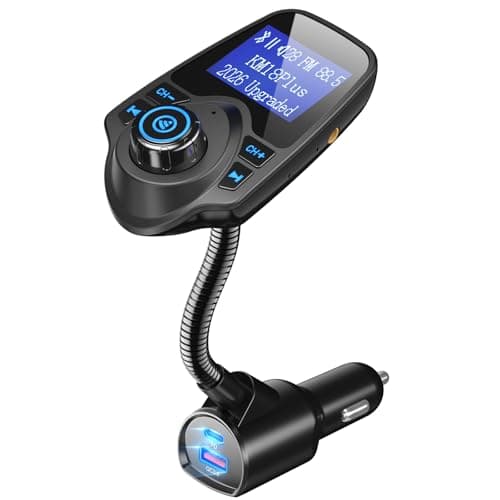
Nulaxy KM18 Bluetooth FM Transmitter
Bluetooth 5.0 into the 87.5 to 108.0 MHz FM band, on a gooseneck with a 1.44-inch screen, running from 12 V or 24 V. It is the answer for a car too old for CarPlay, Android Auto or even an aux socket — and it is a genuinely different product from the CarPlay adapters, which need a car that already has CarPlay.
- Frequency range
- 87.5 - 108.0 MHz
- Bluetooth
- 5.0
- Display
- 1.44 in LCD
- Input voltage
- 12 V - 24 V
- Extra inputs
- TF card, aux
- Calls
- Hands-free supported
- Mounting
- Rotatable gooseneck in the 12V socket
- List price
- Not published
- Warranty
- Not published
What it gets right
- Works in literally any car with an FM radio, which no other connectivity product on this site can claim
- Published frequency range and Bluetooth version, and 12-24 V input so it works in a truck
- Screen shows battery voltage as well as the station, which is a genuinely useful extra on an old car
- Handles calls, plus TF card and aux input for when Bluetooth is not the answer
Flaws
- FM transmission is a lossy analog hop. It will never sound as good as a cable or a proper head unit
- You have to find a genuinely empty frequency, and in a city there may not be one
- Gooseneck mounted in the 12V socket means it occupies the socket and sticks out into the console
The working behind the 9.2
- Heat headroom: not scored (weight 22%)
- The maker publishes no operating-temperature ceiling, so this axis is dropped and the other weights are re-normalized.
- Install effort: 10.0 (weight 24%)
- Plugs into a 12V socket or a USB port. Nothing to mount, nothing to route, reversible in a second.
- Price against the ceiling: not scored (weight 24%)
- No published list price we could cite on the compile date, so this axis is dropped and the other weights are re-normalized.
- Written commitment: not scored (weight 15%)
- No warranty term published, so this axis is dropped and the other weights are re-normalized.
- Spec transparency: 7.8 (weight 15%)
- 7 of the 9 specifications we went looking for are published by the maker (78%). A blank row is never a guess here: it prints “Not published” and it costs the product points, because a figure nobody will commit to in writing is a figure you cannot check.
Axes with no published input are dropped and the remaining weights re-normalized, so a product is not punished for a category where an axis does not apply. Specifications compiled September 4, 2026 from Nulaxy's KM18 product page.
2Three devices, no arguments
Anker 335 Car Charger (67W)
Two USB-C and one USB-A totaling 67W, with a per-port ceiling of 35W. That per-port number is the whole difference between this and the 535: 35W charges any phone at full speed and charges a laptop slowly. For a car with two phones and a tablet in it, this is the right one and it is the cheaper one.
- Ports
- 2 x USB-C, 1 x USB-A
- Total output
- 67 W
- Maximum per port
- 35 W
- Protocols
- USB Power Delivery and PPS
- Safety
- ActiveShield 2.0
- Model
- A2736H11-1
- Warranty
- 18 months
- Operating range
- Not published
List price $29.99 per Best Buy listing for A2736H11-1, captured on the compile date below. Not a live price and not what you will pay — the button is where the real number is.
What it gets right
- Three ports, so the passenger argument ends
- PD and PPS support, which is what Samsung phones need for their fastest charging
- 35W per port is more than any phone can take, so nothing is bottlenecked
- ActiveShield 2.0 thermal management, and an 18-month warranty
Flaws
- 35W per-port ceiling means a laptop charges slowly even though the unit says 67W
- Three ports in one 12V socket is a physically chunky thing in a tight console
- Anker does not publish an operating-temperature range
The working behind the 9.0
- Heat headroom: not scored (weight 22%)
- The maker publishes no operating-temperature ceiling, so this axis is dropped and the other weights are re-normalized.
- Install effort: 10.0 (weight 24%)
- Plugs into a 12V socket or a USB port. Nothing to mount, nothing to route, reversible in a second.
- Price against the ceiling: 9.5 (weight 24%)
- Listed at $29.99 on the compile date. This site's buyer has a practical ceiling around $150 for a single upgrade, so the scale rewards everything under $100 and falls away sharply past $150. The live price is very often different, and that is what the button is for.
- Written commitment: 7.0 (weight 15%)
- 18-month warranty. This is the only promise in the entire listing that a court would read, which is why it is scored and the marketing copy is not.
- Spec transparency: 8.8 (weight 15%)
- 7 of the 8 specifications we went looking for are published by the maker (88%). A blank row is never a guess here: it prints “Not published” and it costs the product points, because a figure nobody will commit to in writing is a figure you cannot check.
Axes with no published input are dropped and the remaining weights re-normalized, so a product is not punished for a category where an axis does not apply. Specifications compiled September 4, 2026 from Anker's 335 Car Charger product page.
3An aux socket plus an alternator whine
Besign BK01 Bluetooth Car Kit
Socket-powered rather than battery-powered, so it wakes with the ignition and there is nothing to charge. The reason to pick it over the Anker is the included ground loop noise isolator, which is the fix for the whine that ruins aux audio in older cars.
- Bluetooth version
- 4.1 + EDR
- Power
- 12V socket, dual-port 2.1 A / 10 W charger included
- Multipoint
- Two devices simultaneously
- Noise handling
- Ground loop noise isolator included
- Behavior on start
- Auto power-on and auto reconnect to last device
- Included
- Kit, magnetic mounting plate, ground loop isolator, guide
- Operating temperature
- Not published
- Warranty
- Not published
What it gets right
- Ships with a ground loop noise isolator — the actual cure for engine-speed whine through an aux input
- Powers on with the car and auto-reconnects to the last phone, so there is no ritual
- Dual-port 2.1 A charger built into the 12V plug, so it does not cost you the socket
- Multipoint pairing to two devices
Flaws
- Bluetooth 4.1 + EDR, an older radio than the Anker's
- No published operating temperature range, which the Anker does publish
- Occupies the 12V socket permanently — you get two USB ports back, but the socket itself is gone
- No published warranty term
The working behind the 9.0
- Heat headroom: not scored (weight 22%)
- The maker publishes no operating-temperature ceiling, so this axis is dropped and the other weights are re-normalized.
- Install effort: 10.0 (weight 24%)
- Plugs into a 12V socket or a USB port. Nothing to mount, nothing to route, reversible in a second.
- Price against the ceiling: not scored (weight 24%)
- No published list price we could cite on the compile date, so this axis is dropped and the other weights are re-normalized.
- Written commitment: not scored (weight 15%)
- No warranty term published, so this axis is dropped and the other weights are re-normalized.
- Spec transparency: 7.5 (weight 15%)
- 6 of the 8 specifications we went looking for are published by the maker (75%). A blank row is never a guess here: it prints “Not published” and it costs the product points, because a figure nobody will commit to in writing is a figure you cannot check.
Axes with no published input are dropped and the remaining weights re-normalized, so a product is not punished for a category where an axis does not apply. Specifications compiled September 4, 2026 from Besign BK01 published specifications.
4Making factory wired CarPlay wireless
CarlinKit 5.0 (CPC200-2air)
Skip this one. An excellent product and the single most commonly mistaken purchase for an older car. A wireless CarPlay adapter converts a car's EXISTING wired CarPlay to wireless. It cannot add CarPlay to a car that never had it — plug it into an older head unit and nothing at all happens.
A dongle that plugs into the USB port your wired CarPlay already uses and turns it wireless, on 2.4 and 5 GHz, drawing 0.75 watts. CarlinKit states compatibility with more than 800 car models from 2016 onwards. The prerequisite is absolute: your car must already have wired CarPlay or Android Auto. This adds no CarPlay to a car that has none.
- Wi-Fi
- 2.4 GHz and 5.0 GHz
- Power consumption
- 0.75 W
- Power input
- 5 V +/- 0.2 V, 1.0 A
- Vehicle compatibility
- Stated 800+ models from 2016 with factory wired CarPlay or Android Auto
- Requirement
- Factory wired CarPlay or Android Auto must already be present
- Dimensions
- 76 x 43 x 12.3 mm
- Brand exclusion
- Stated not compatible with BMW vehicles
- List price
- Not published
- Operating range
- Not published
- Warranty
- 1 year
What it gets right
- Removes the single most annoying thirty seconds of every commute
- Dual band 2.4 and 5 GHz, published, which is what keeps the link stable
- 0.75 W draw, published, so it is not a parasitic load worth worrying about
- Nothing to install: it plugs into the existing USB port
Flaws
- Requires factory wired CarPlay or Android Auto already present. This is not optional
- Adds a handshake delay at startup, which is shorter than plugging a cable in but not zero
- Firmware updates are a manual job through a web interface, and they are occasionally necessary
The working behind the 8.2
- Heat headroom: not scored (weight 22%)
- The maker publishes no operating-temperature ceiling, so this axis is dropped and the other weights are re-normalized.
- Install effort: 10.0 (weight 24%)
- Plugs into a 12V socket or a USB port. Nothing to mount, nothing to route, reversible in a second.
- Price against the ceiling: not scored (weight 24%)
- No published list price we could cite on the compile date, so this axis is dropped and the other weights are re-normalized.
- Written commitment: 5.5 (weight 15%)
- 12-month warranty. This is the only promise in the entire listing that a court would read, which is why it is scored and the marketing copy is not.
- Spec transparency: 8.0 (weight 15%)
- 8 of the 10 specifications we went looking for are published by the maker (80%). A blank row is never a guess here: it prints “Not published” and it costs the product points, because a figure nobody will commit to in writing is a figure you cannot check.
Axes with no published input are dropped and the remaining weights re-normalized, so a product is not punished for a category where an axis does not apply. Specifications compiled September 4, 2026 from CarlinKit's 2air product page.
5Calls in a car with no hands-free at all
Jabra Drive Bluetooth Visor Speakerphone
Clips to the sun visor, which puts the microphone near your head instead of down in the console — the single reason it sounds better on calls than any aux adapter. It publishes 20 hours of talk time and 20 dB of noise reduction.
- Talk time
- Up to 20 hours
- Standby
- Up to 30 days
- Bluetooth
- 3.0
- Range
- 10 m / 33 ft
- Noise reduction
- Up to 20 dB with DSP
- Microphone
- Omni-directional
- Pairing
- 8 devices remembered, 2 connected at once
- Operating temperature
- Not published
- Warranty
- Not published
- List price
- Not published
What it gets right
- Microphone position is the whole product: on the visor, near your mouth, not in a footwell
- Publishes 20 hours talk time and up to 30 days standby
- Publishes 20 dB noise reduction with DSP, which is a figure rather than an adjective
- Pairs with two devices simultaneously and remembers up to eight
- Also passes music, podcasts and navigation prompts
Flaws
- Bluetooth 3.0 — an old radio, and it shows in pairing speed
- A visor speakerphone drives a small speaker, so music through it is worse than through the car's own
- One more thing to charge, and a flat one is silent
- No published operating temperature range, on a device clipped to a visor in direct sun
The working behind the 8.2
- Heat headroom: not scored (weight 22%)
- The maker publishes no operating-temperature ceiling, so this axis is dropped and the other weights are re-normalized.
- Install effort: 9.0 (weight 24%)
- Clips onto a vent blade or a headrest post. Two minutes, no tools, no adhesive, no residue.
- Price against the ceiling: not scored (weight 24%)
- No published list price we could cite on the compile date, so this axis is dropped and the other weights are re-normalized.
- Written commitment: not scored (weight 15%)
- No warranty term published, so this axis is dropped and the other weights are re-normalized.
- Spec transparency: 7.0 (weight 15%)
- 7 of the 10 specifications we went looking for are published by the maker (70%). A blank row is never a guess here: it prints “Not published” and it costs the product points, because a figure nobody will commit to in writing is a figure you cannot check.
Axes with no published input are dropped and the remaining weights re-normalized, so a product is not punished for a category where an axis does not apply. Specifications compiled September 4, 2026 from Jabra Drive published technical specifications.
6The cheapest camera here worth owning
Vantrue E1 Lite
The same 70 C ceiling and the same supercapacitor as the E1, at 1080p and a lower list price. 1080p is enough to read a plate directly in front of you and not enough to read one two lanes over, and that trade is the entire decision. If the budget is the constraint, this is where to spend it rather than on a cheaper camera with an unpublished heat rating.
- Front resolution
- 1920 x 1080
- Power store
- Supercapacitor
- Operating range
- -20 C to 70 C (-4 F to 158 F)
- Wi-Fi
- Built in, app control
- GPS
- Not on this model
- Parking mode
- 24-hour, motion detection
- Max microSD
- Not published
- Field of view
- Not published
- Published current draw
- Not published
List price $79.99 per Vantrue's own store, sale price (regular $109.99), captured on the compile date below. Not a live price and not what you will pay — the button is where the real number is.
What it gets right
- 70 C published ceiling at the lowest list price in this ledger
- Supercapacitor, not a lithium cell
- Wi-Fi and app control at this money
- Small enough to hide behind the mirror, which is most of what a mini camera is for
Flaws
- 1080p. Plate legibility falls off fast at distance and at an angle
- No GPS on this model, so no speed or location stamp on the footage
- Parking mode needs a hardwire kit sold separately
The working behind the 7.6
- Heat headroom: 10.0 (weight 22%)
- Published operating ceiling 70 C (158 F). A car parked in summer sun runs roughly 60-70 C inside, so 65 C and up is real headroom, 60 C is living at the limit, and anything under 55 C is a summer problem waiting to happen.
- Install effort: 6.0 (weight 24%)
- Adhesive pad onto the dashboard. Permanent in practice: repositioning means a new pad, and the pad is the part that fails first.
- Price against the ceiling: 8.0 (weight 24%)
- Listed at $79.99 on the compile date. This site's buyer has a practical ceiling around $150 for a single upgrade, so the scale rewards everything under $100 and falls away sharply past $150. The live price is very often different, and that is what the button is for.
- Written commitment: 7.0 (weight 15%)
- 18-month warranty. This is the only promise in the entire listing that a court would read, which is why it is scored and the marketing copy is not.
- Spec transparency: 6.7 (weight 15%)
- 6 of the 9 specifications we went looking for are published by the maker (67%). A blank row is never a guess here: it prints “Not published” and it costs the product points, because a figure nobody will commit to in writing is a figure you cannot check.
Axes with no published input are dropped and the remaining weights re-normalized, so a product is not punished for a category where an axis does not apply. Specifications compiled September 4, 2026 from Vantrue's E1 Lite product page.
Prices last verified October 22, 2026. They move constantly; the figure on Amazon when you click is the real one.
Questions people actually ask
Can I add CarPlay to my older car with an adapter?
No. Wireless adapters convert a car's existing wired CarPlay to wireless — they cannot create CarPlay. The routes that work are a head unit replacement, a standalone dash screen, or a Bluetooth adapter plus a phone mount.
Is my car's 12V socket good enough for modern charging?
Usually better than a factory USB port. The socket circuit is typically fused at 10 to 15 A, giving 120 to 180W of headroom, where many factory USB-A ports supply under an amp.
What if my car has no aux socket?
An FM transmitter is the fallback and the only option. It broadcasts to your radio, which adds a lossy hop and costs quality — but it works in any car with a radio, and many include a 12V charger.
Can I get a backup camera on an older car?
A mirror dash cam provides a live rear display, which a conventional dash cam does not. The trade is a low card ceiling across two channels and one device serving as both your mirror and your camera.