The best mirror dash cams
A mirror dash cam is the only camera that adds nothing to your windshield. It is also the only one whose failure costs you a mirror as well as your footage.
By Sawyer V. · Published · How we research
We have not tested any of this. Everything below is compiled from published manufacturer specifications, and the arithmetic is printed so you can check it. This page carries affiliate links: if you buy through one we earn a commission at no extra cost to you, and it does not change the order of the picks. Full disclosure.
The short answer
Buy a mirror cam for the backup display, not for the footage. The AUTO-VOX V5PRO is the pick because it publishes its sensor — a Sony IMX307 STARVIS at F/1.8 — which is the specification that decides night performance. But its stated card ceiling is 64 GB across two channels, which is a much shorter footage window than a conventional camera gives you, and the unit is your mirror as well as your camera. If footage is the goal, a conventional dual-channel setup does it better for less.
| # | Pick | Install | Score | Price |
|---|---|---|---|---|
| 1 | Samsung PRO Endurance microSD The card that outlives the camera | Drops in | 9.3/10 | $76.99 - view on Amazon |
| 2 | AUTO-VOX V5PRO Mirror Dash Cam A car whose windshield is already crowded | Clips on | 8.3/10 | $209.99 - view on Amazon |
| 3 | Vantrue N4 Three channels, including the cabin | Adhesive | 6.6/10 | Check price on Amazon |
| 4 | VIOFO A229 Plus 1CH A screen, voice control and room to add a rear camera | Adhesive | 5.5/10 | $189.99 - view on Amazon |
Prices last verified October 22, 2026. They move constantly; the figure on Amazon when you click is the real one.
What a mirror dash cam actually is
It clips over your existing rear view mirror and replaces it with a screen. A camera in the housing looks forward through the windshield, a second camera mounts at the rear, and the screen shows either a mirror image or the live rear camera feed.
Three things follow from that arrangement, and only the first one is usually advertised.
- Nothing new goes on your windshield. The camera occupies a position that already had an object in it, which matters where windshield obstruction rules are strict — see are dash cams legal
- You gain a backup camera display. This is the genuinely useful part, and it is something no conventional dash cam offers. A normal camera's rear channel records only; it has no live feed
- Your mirror is now an electronic device. If it fails, you have lost a mirror, and that is a different class of problem from losing a camera
The card ceiling is the specification that decides it
AUTO-VOX states Class 10 microSD support up to 64 GB. Across two 1080p channels recording continuously, that is a considerably shorter window than a conventional camera running a 128 or 256 GB high-endurance card.
Why that matters: loop recording overwrites the oldest footage continuously, so card size decides how far back you can still reach. A parking incident discovered the next morning is recoverable on a large card and often gone on a small one. We set out the arithmetic in how to save dash cam footage.
What AUTO-VOX publishes that the category does not
Most mirror cams are sold on screen size. The V5PRO publishes the things that actually determine image quality: a Sony IMX307 STARVIS sensor, an F/1.8 aperture, and fields of view of 145 and 150 degrees.
STARVIS is Sony's low-light sensor line, and it appears on the better conventional cameras too. Naming the part is more informative than any resolution claim, for the reasons we set out in dash cam resolution explained — at night the sensor is the limiting factor, not the pixel count.
| AUTO-VOX V5PRO | Conventional dual-channel | |
|---|---|---|
| Screen | 9.35 in laminated touchscreen | Small or none |
| Front | 1080p at 30 fps | Typically 2K or higher |
| Rear | 1080p at 25 fps | Varies, often stated separately |
| Sensor published | Sony IMX307 STARVIS | Sometimes |
| Card ceiling | 64 GB | Commonly 128-256 GB |
| Live backup display | Yes | No |
| Heat ceiling published | No | Sometimes (VIOFO states 65 C) |
Glare, and why lamination is not a gimmick
The obvious failure of a cheap mirror cam is that a glossy screen in the mirror position catches the sun and the rear window and becomes unreadable — which is worse than a plain mirror, because a plain mirror at least shows you something.
A full-laminated screen bonds the display to the glass with no air gap, which removes the internal reflection between the layers. It is the same technique that makes a laminated phone screen readable outdoors, and it is the difference between a mirror cam you use and one you switch back to mirror mode permanently.
The unpublished number
AUTO-VOX publishes no operating-temperature ceiling. That is a gap on any dash cam and a particularly awkward one here, because the mirror position is at the top of the cabin directly behind the glass — the hottest part of the hottest zone.
A parked car in summer runs roughly 60-70 C inside. VIOFO publishes 65 C for the A229 Plus, and Vantrue publishes 70 C for the E1 line. Against that, silence is a real disadvantage rather than a neutral absence, and it is why this page's ranking does not put the mirror cam first overall. Our hot weather page covers why the heat axis is weighted the way it is.
Installation, and the one thing to check first
A mirror cam straps over the existing mirror with rubber bands or clips. Before buying, check what your mirror actually contains — many modern mirrors house auto-dimming electronics, a rain sensor, a toll transponder, or a driver-monitoring camera, and clamping a screen over the top of all that is not always possible.
The rear camera still needs a cable run the full length of the car, exactly as on a conventional dual-channel install, with the same two cautions: leave a service loop at any tailgate hinge, and stay out of the pillar trim on a car with curtain airbags. The detail is in best dual channel dash cams and how to hardwire a dash cam.
Worth separating the two jobs before you buy, because a mirror cam bundles them. If the reversing view is the actual reason you are here, a dedicated backup camera does it on a wired feed with no card ceiling to work around best backup cameras.
Who should buy one
Buy a mirror cam if your car has no backup camera and you want one, or if your windshield is already crowded and you would rather not add another object to it. Both are real reasons and neither is about footage quality.
Buy a conventional camera if the recording is the point. You get a higher card ceiling, more makers publishing heat ceilings, better front resolution, and a failure that costs you a camera rather than a camera and a mirror. Start at best dash cams under $150, and pair it with a proper card from best microSD cards for a dash cam.
Every pick, with the working
Each entry lists the specifications the maker publishes, the axis scores those specifications produce, and what you give up. Rows that read “Not published” are not omissions on our side: they are things the maker will not commit to in writing, and they cost the product points on the transparency axis. Specifications compiled September 4, 2026.
Our pickThe card that outlives the camera
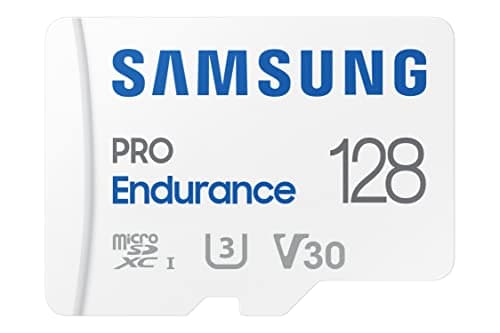
Samsung PRO Endurance microSD
At 128GB Samsung rates this card at 70,080 hours of continuous Full HD recording and 820 TBW. The comparable SanDisk High Endurance card is rated at 10,000 hours and 117 TBW at the same capacity. That is a seven-to-one difference in the only specification that matters for a device that overwrites its storage every day of its life.
- Rated endurance at 128GB
- 70,080 hours of Full HD recording
- TBW at 128GB
- 820 TB written
- Speed class
- V30
- Read speed
- Up to 100 MB/s
- Write speed
- Up to 40 MB/s
- Warranty
- 5 years
- Operating range
- Not published
- List price
- Not published
What it gets right
- 70,080 rated hours at 128GB, seven times the nearest mainstream competitor
- 820 TBW at 128GB against 117 TBW for SanDisk High Endurance
- V30 speed class, which every camera in this ledger is happy with
- Rated for the exact duty cycle a dash cam imposes: continuous write, forever
Flaws
- Costs meaningfully more than a general-purpose card of the same capacity
- 40 MB/s write is fine for one or two channels and marginal for three at high bitrate
- Endurance ratings are the maker's own figures, not an independent test
The working behind the 9.3
- Heat headroom: not scored (weight 22%)
- The maker publishes no operating-temperature ceiling, so this axis is dropped and the other weights are re-normalized.
- Install effort: 10.0 (weight 24%)
- Drops in and sits there. No fixing of any kind, and it comes out again when you sell the car.
- Price against the ceiling: not scored (weight 24%)
- No published list price we could cite on the compile date, so this axis is dropped and the other weights are re-normalized.
- Written commitment: 10.0 (weight 15%)
- 60-month warranty. This is the only promise in the entire listing that a court would read, which is why it is scored and the marketing copy is not.
- Spec transparency: 7.5 (weight 15%)
- 6 of the 8 specifications we went looking for are published by the maker (75%). A blank row is never a guess here: it prints “Not published” and it costs the product points, because a figure nobody will commit to in writing is a figure you cannot check.
Axes with no published input are dropped and the remaining weights re-normalized, so a product is not punished for a category where an axis does not apply. Specifications compiled September 4, 2026 from Samsung PRO Endurance published endurance ratings.
2A car whose windshield is already crowded
AUTO-VOX V5PRO Mirror Dash Cam
Skip this one. It is the best mirror cam here and we still would not buy one for footage alone. Card support is stated at Class 10 up to 64 GB, which across two channels is a short recording window, and putting your mirror and your camera in one device means a single failure takes both. Buy it for the backup display; buy a conventional camera for the footage.
A 9.35 inch laminated touchscreen that replaces the rear view mirror, recording front and rear while doubling as a backup camera display. It publishes the sensor — a Sony IMX307 STARVIS — which is the one specification that tells you how it behaves at night.
- Screen
- 9.35 in full-laminated touchscreen
- Front recording
- 1080p at 30 fps
- Rear recording
- 1080p at 25 fps
- Sensor
- Sony IMX307 STARVIS CMOS
- Aperture
- F/1.8
- Field of view
- 145 degrees front, 150 degrees rear
- Card support
- Class 10 microSD up to 64 GB
- Other
- GPS, G-sensor, parking mode
- Operating temperature
- Not published
- Warranty
- Not published
- List price
- Not published
What it gets right
- Publishes the actual image sensor (Sony IMX307 STARVIS) and aperture (F/1.8), which most mirror cams do not
- Full-laminated screen specifically to kill the glare that ruins cheaper mirror units in daylight
- Occupies the mirror position, so nothing new is stuck to the windshield
- The rear camera doubles as a live backup display — a real second function, unlike a normal dash cam rear channel
Flaws
- Card support is stated at Class 10 up to 64 GB, which is small for two channels and shortens your footage window considerably
- It replaces your mirror. If the screen fails you have lost a mirror as well as a camera
- No published operating-temperature ceiling, on a device that sits in the hottest part of the cabin
- Rear channel is 1080p at 25 fps rather than 30
The working behind the 8.3
- Heat headroom: not scored (weight 22%)
- The maker publishes no operating-temperature ceiling, so this axis is dropped and the other weights are re-normalized.
- Install effort: 9.0 (weight 24%)
- Clips onto a vent blade or a headrest post. Two minutes, no tools, no adhesive, no residue.
- Price against the ceiling: not scored (weight 24%)
- No published list price we could cite on the compile date, so this axis is dropped and the other weights are re-normalized.
- Written commitment: not scored (weight 15%)
- No warranty term published, so this axis is dropped and the other weights are re-normalized.
- Spec transparency: 7.3 (weight 15%)
- 8 of the 11 specifications we went looking for are published by the maker (73%). A blank row is never a guess here: it prints “Not published” and it costs the product points, because a figure nobody will commit to in writing is a figure you cannot check.
Axes with no published input are dropped and the remaining weights re-normalized, so a product is not punished for a category where an axis does not apply. Specifications compiled September 4, 2026 from AUTO-VOX V5PRO published specifications.
3Three channels, including the cabin
Vantrue N4
Skip this one. Unless you drive rideshare or carry passengers you do not know, the cabin channel is a cost with no benefit. A front camera plus a rear camera does the commuter job for less.
Front, cabin and rear on one camera with infrared night vision on the interior channel and the same 70 C published ceiling as the rest of Vantrue's supercapacitor line. It is the camera for somebody who drives for a living or carries passengers they do not know. For a plain commute it is two channels more than you need and $170 more than you need to spend.
- Channels
- Three: front, interior, rear
- Resolution
- 1440p + 1080p + 1080p at 30fps, or 4K front only
- Night vision
- Sony STARVIS with infrared on the cabin channel
- Power store
- Supercapacitor
- Operating range
- -10 C to 70 C (14 F to 158 F)
- Max microSD
- 512 GB
- Parking mode
- 24-hour, motion and collision detection
- GPS
- Supported
- Published current draw
- Not published
List price $259.99 per Vantrue's own store, captured on the compile date below. Not a live price and not what you will pay — the button is where the real number is.
What it gets right
- Three channels recording at once, with IR illumination on the cabin camera
- 70 C published ceiling and a supercapacitor
- 512GB card support, which three channels genuinely need
- 24-hour parking mode with motion and collision detection
Flaws
- $259.99 list is far outside this site's usual bracket
- Three channels fill a card fast, so the running cost is a bigger card sooner
- The interior camera is pointless for most private drivers and creates a privacy question for passengers
The working behind the 6.6
- Heat headroom: 10.0 (weight 22%)
- Published operating ceiling 70 C (158 F). A car parked in summer sun runs roughly 60-70 C inside, so 65 C and up is real headroom, 60 C is living at the limit, and anything under 55 C is a summer problem waiting to happen.
- Install effort: 6.0 (weight 24%)
- Adhesive pad onto the dashboard. Permanent in practice: repositioning means a new pad, and the pad is the part that fails first.
- Price against the ceiling: 2.5 (weight 24%)
- Listed at $259.99 on the compile date. This site's buyer has a practical ceiling around $150 for a single upgrade, so the scale rewards everything under $100 and falls away sharply past $150. The live price is very often different, and that is what the button is for.
- Written commitment: 7.0 (weight 15%)
- 18-month warranty. This is the only promise in the entire listing that a court would read, which is why it is scored and the marketing copy is not.
- Spec transparency: 8.9 (weight 15%)
- 8 of the 9 specifications we went looking for are published by the maker (89%). A blank row is never a guess here: it prints “Not published” and it costs the product points, because a figure nobody will commit to in writing is a figure you cannot check.
Axes with no published input are dropped and the remaining weights re-normalized, so a product is not punished for a category where an axis does not apply. Specifications compiled September 4, 2026 from Vantrue's N4 product page.
4A screen, voice control and room to add a rear camera
VIOFO A229 Plus 1CH
The same STARVIS 2 IMX675 sensor as the Mini 2 in a body with a screen, voice control and the option to add rear and interior channels later. You are paying roughly $40 over the Mini 2 for a display and an upgrade path, which is worth it if you expect to want a rear camera and not if you do not.
- Front resolution
- 2K HDR
- Image sensor
- Sony STARVIS 2 IMX675
- GPS
- Built in
- Voice control
- Yes
- Expandable
- Rear and interior channels available
- Operating range
- Not published
- Max microSD
- Not published
- Field of view
- Not published
List price $199.99 per VIOFO's own store, captured on the compile date below. Not a live price and not what you will pay — the button is where the real number is.
What it gets right
- Same STARVIS 2 IMX675 sensor as the Mini 2
- Screen on the body, so aiming and reviewing does not need the phone app
- Expandable to two and three channels without buying a whole new camera
- Voice control, which is the only genuinely safe way to lock a clip while moving
Flaws
- $200 list is well past this site's usual ceiling for a single upgrade
- A screen in the windshield is a screen in your eyeline; the Mini 2 hides behind the mirror
- Same hardwire requirement for parking mode as every other VIOFO
The working behind the 5.5
- Heat headroom: not scored (weight 22%)
- The maker publishes no operating-temperature ceiling, so this axis is dropped and the other weights are re-normalized.
- Install effort: 6.0 (weight 24%)
- Adhesive pad onto the dashboard. Permanent in practice: repositioning means a new pad, and the pad is the part that fails first.
- Price against the ceiling: 3.5 (weight 24%)
- Listed at $199.99 on the compile date. This site's buyer has a practical ceiling around $150 for a single upgrade, so the scale rewards everything under $100 and falls away sharply past $150. The live price is very often different, and that is what the button is for.
- Written commitment: 7.0 (weight 15%)
- 18-month warranty. This is the only promise in the entire listing that a court would read, which is why it is scored and the marketing copy is not.
- Spec transparency: 6.3 (weight 15%)
- 5 of the 8 specifications we went looking for are published by the maker (63%). A blank row is never a guess here: it prints “Not published” and it costs the product points, because a figure nobody will commit to in writing is a figure you cannot check.
Axes with no published input are dropped and the remaining weights re-normalized, so a product is not punished for a category where an axis does not apply. Specifications compiled September 4, 2026 from VIOFO's 1-channel range page.
Prices last verified October 22, 2026. They move constantly; the figure on Amazon when you click is the real one.
Questions people actually ask
Does a mirror dash cam replace a backup camera?
It provides a live rear display, which a conventional dash cam does not. Whether it is a true substitute depends on where the rear camera is mounted and its angle — a rear channel aimed for recording traffic is not necessarily aimed for judging distance while reversing.
Can I still use it as a normal mirror?
Yes. The screen displays a mirror image and most units can be switched off entirely, leaving a reflective surface. That is also your fallback if the electronics fail.
Why is the card limit only 64 GB?
It is a controller and firmware decision rather than a card limitation. It matters because two channels of continuous recording fill 64 GB quickly, which shortens how far back your footage reaches.
Will a mirror cam fit over my car's existing mirror?
Check what your mirror houses first. Auto-dimming electronics, rain sensors, toll transponders and driver-monitoring cameras all live in mirror housings on modern cars, and a large clamp-on unit does not always clear them.