The best windshield de-icers
Five bottles that all promise the same thing. Between them they publish four facts, and the one that publishes the most facts about itself is not the one with the biggest number on the label.
By Sawyer V. · Published · How we research
We have not tested any of this. Everything below is compiled from published manufacturer specifications, and the arithmetic is printed so you can check it. This page carries affiliate links: if you buy through one we earn a commission at no extra cost to you, and it does not change the order of the picks. Full disclosure.
The verdict
Buy the Zep Ice Melt at around $13 if you spray near paint, trim or wipers - it is the only one here that publishes a surface-safety list and the only one that states it contains a corrosion inhibitor. Buy the Prestone AS244 at around $18 if you want to know what is in the can, because Prestone is the only maker here that names its active ingredient. Prices as of October 17, 2026.
The better answer is the night before. Prestone's Ice and Frost Shield is a glass treatment you apply in advance so the ice never bonds. Spraying frozen glass at seven in the morning is the fix for a problem you could have prevented for about the same money.
| # | Pick | Install | Score | Price |
|---|---|---|---|---|
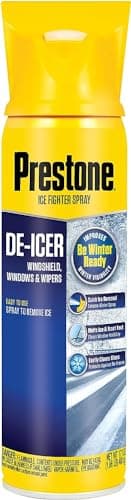
| 1 | Prestone AS244 Windshield De-Icer The only one that names its active ingredient | Drops in | 9.0/10 | $18.36 - view on Amazon |
| 2 | Zep Ice Melt Windshield De-Icer 17601 The one that says what it will not damage | Drops in | 9.0/10 | $13.49 - view on Amazon |
| 3 | Polar De-Icer Spray, 2 x 500 ml The only published temperature figure | Drops in | 9.0/10 | $18.99 - view on Amazon |
| 4 | Prestone AS246 Ice and Frost Shield Not having to de-ice at all | Drops in | 9.0/10 | $14.99 - view on Amazon |
| 5 | Visbella De-Icer Spray Showing why a number needs a source | Drops in | 9.0/10 | $16.99 - view on Amazon |
Prices last verified October 17, 2026. They move constantly; the figure on Amazon when you click is the real one.
Five products, four facts
De-icer is one of the least documented categories in car care. A can says it melts ice fast. It usually does not say what is in it, how cold it still works at, or what it will do to the rubber it lands on. Across these five products, exactly four useful facts are published, and they are published by four different companies.
| Product | Active ingredient | Rated to | Surface safety | Corrosion inhibitor | Volume | Price |
|---|---|---|---|---|---|---|
| Prestone AS244 | High methanol content | Not published | Not published | Not published | 17 oz | $18.36 |
| Zep Ice Melt 17601 | Not published | Not published | Paint, chrome, vinyl, rubber | Stated present | 19.99 fl oz | $13.49 |
| Polar De-Icer | Not published | -20 C (-4 F) | Not published | Not published | 2 x 500 ml | $18.99 |
| Prestone AS246 Frost Shield | Not published | Not published | Not published | Not published | 32 oz | $15.67 |
| Visbella | Not published | -113 F in the title, -133 F in the bullet | Not published | Not published | 16.9 fl oz | $16.99 |
That is the whole evidence base in one table. Prestone is the only company that tells you the melting is being done by methanol. Zep is the only one that tells you where you can safely point the can. Polar is the only one that gives a temperature you can test against a forecast. And Visbella gives two.
Refreeze is the failure mode, not melting
A de-icer works by lowering the freezing point of the water it lands on. The ice becomes slush and you clear it. What it leaves behind is a thin film of water mixed with alcohol, and as the alcohol evaporates - which happens fast, that is what alcohol does - the remaining water's freezing point climbs back up.
On a cold enough morning that water refreezes. Often as a thinner, smoother, harder layer than the frost you started with, and often in the exact place you need to see through. Prestone addresses this directly on the AS244, stating that it helps reduce dangerous refreeze. Visbella claims to prevent it. Nobody quantifies it.
Who each one is for
- Zep Ice Melt - if you want to spray without flinching. The only product here with a published surface list: stated harmless to paint, chrome, vinyl and rubber, and stated to leave no smeary residue on glass or wiper blades. It also states it contains a corrosion inhibitor, which is the opposite of what road salt is doing to the same metal. The biggest single can here at 19.99 fl oz, and the cheapest. Skip it if you want to know what is in it
- Prestone AS244 - if you want the chemistry named. High methanol content, stated, which is the only disclosure of its kind in this group, plus a scraper built into the cap so one hand holds one object. 17 oz. Skip it if you are spraying near trim you care about, because Prestone publishes no surface list
- Polar De-Icer - if you want a number to check against the forecast. Effective down to -20 C (-4 F), published, and the only full application method in this group. Two 500 ml trigger bottles, so one lives indoors and one in the garage. Skip it if you dislike converting metric on a cold morning, and note that a trigger bottle left in the car can freeze solid
- Prestone Ice and Frost Shield - if you park outside every night. See the next section. It is the one product here that means you do not need the others
- Visbella - no. See the skip note
The product that stops you needing a product
The Prestone AS246 is not a de-icer. It is a glass treatment applied in advance - a 32 oz bottle, the largest container in this group - that is stated to stop frost, light ice and snow sticking to the windshield and the wiper blades in the first place. Prestone states it can be used daily without altering the glass.
Applied on a Sunday afternoon, it turns a week of scraping into a week of brushing. What Prestone does not publish is how long a treatment lasts, so there is no sourced interval here - only the honest observation that this is the same approach as a rain repellent, applied for a different season, and that nothing in that category publishes a durability figure either.
The complete version of this idea is a physical cover: best windshield snow covers stops ice reaching the glass at all, which no chemistry can match.
How to actually use it
- Start the car and put the defroster on first. Everything below works faster against glass that is warming from the inside, and it costs you nothing to do it first
- Clear loose snow and slush with a scraper before you spray. Polar publishes this step. De-icer is for the bonded layer, not the pile on top of it
- Spray from about a foot away and let it work. The ice should turn to slush in under a minute. If it does not, you are either below the product's working temperature or you sprayed through snow
- Scrape with the plastic edge, not the can. The Prestone cap scraper is for finishing, not for a quarter inch of ice - a proper scraper is a different tool
- Wipe the glass dry before you drive. This is the step that stops refreeze, and it takes ten seconds with a microfiber towel
- Do the wiper blades separately. Lift them, spray the rubber, wipe them clean. A blade frozen to the glass tears when the motor pulls it, and that is a new pair of wipers
The rest of the winter glass problem
De-icer handles the outside of the windshield on one cold morning. Three other products handle the rest of it, and all three are cheap.
Washer fluid that will not freeze in the lines, because a salt-smeared windshield with nothing to clear it is more dangerous than a frosted one - best windshield washer fluid. An anti-fog treatment for the inside of the glass, which is a completely different chemistry to anything on this page - best anti-fog sprays. And a silicone seal conditioner so the doors open at all - best door seal lubricants.
The full seasonal list is in best car accessories for winter, and how to defog your windshield covers the inside-the-glass version of this morning.
Every pick, with the working
Each entry lists the specifications the maker publishes, the axis scores those specifications produce, and what you give up. Rows that read “Not published” are not omissions on our side: they are things the maker will not commit to in writing, and they cost the product points on the transparency axis. Specifications compiled September 4, 2026.
Our pickThe only one that names its active ingredient
Prestone AS244 Windshield De-Icer
Prestone is the only maker in this group that says what is actually in the can: high methanol content. That matters because methanol is the thing doing the melting, and a de-icer that will not name its chemistry is a de-icer you cannot compare. The 17-ounce can also carries a scraper built into the cap, so one hand holds one object.
- Format
- 17 oz aerosol
- Active ingredient
- Stated as high methanol content
- Applicator
- Micro-edge ice scraper built into the cap
- Refreeze
- States it helps reduce refreeze
- Rated to
- Not published
- Surface safety
- Not published
- Corrosion inhibitor
- Not published
List price $18.36 per Amazon listing, October 17, 2026, captured on the compile date below. Not a live price and not what you will pay — the button is where the real number is.
What it gets right
- States a high methanol content - the only chemistry disclosure in this group
- 17 oz, the largest single can here
- Scraper built into the cap, described as a micro-edge scraper
- States it helps reduce dangerous refreeze, which is the real failure mode of a spray de-icer
Flaws
- No temperature rating published - the can does not say how cold it still works at
- Methanol is poisonous and the listing says nothing about paint, trim or wiper rubber
- Aerosol, so it empties faster than a trigger bottle of the same volume
- No warranty or guarantee of any kind published
The working behind the 9.0
- Heat headroom: not scored (weight 22%)
- The maker publishes no operating-temperature ceiling, so this axis is dropped and the other weights are re-normalized.
- Install effort: 10.0 (weight 24%)
- Drops in and sits there. No fixing of any kind, and it comes out again when you sell the car.
- Price against the ceiling: 10.0 (weight 24%)
- Listed at $18.36 on the compile date. This site's buyer has a practical ceiling around $150 for a single upgrade, so the scale rewards everything under $100 and falls away sharply past $150. The live price is very often different, and that is what the button is for.
- Written commitment: not scored (weight 15%)
- No warranty term published, so this axis is dropped and the other weights are re-normalized.
- Spec transparency: 5.7 (weight 15%)
- 4 of the 7 specifications we went looking for are published by the maker (57%). A blank row is never a guess here: it prints “Not published” and it costs the product points, because a figure nobody will commit to in writing is a figure you cannot check.
Axes with no published input are dropped and the remaining weights re-normalized, so a product is not punished for a category where an axis does not apply. Specifications compiled September 4, 2026 from the Prestone AS244 listing.
2The one that says what it will not damage
Zep Ice Melt Windshield De-Icer 17601
The only de-icer here that publishes a surface-safety list and the only one that states it contains a corrosion inhibitor. Those two lines are the difference between a product you can spray near paint, chrome and wiper rubber on purpose and one you spray and hope. At 19.99 fluid ounces it is also the biggest can in this group.
- Format
- 19.99 fl oz aerosol
- Surface safety
- Stated harmless to paint, chrome, vinyl and rubber
- Corrosion inhibitor
- Stated present, for ferrous surfaces
- Residue
- Stated non-smearing on glass and wipers
- Active ingredient
- Not published
- Rated to
- Not published
- Applicator
- Not published
List price $13.49 per Amazon listing, October 17, 2026, captured on the compile date below. Not a live price and not what you will pay — the button is where the real number is.
What it gets right
- Published as harmless to paint, chrome, vinyl and rubber - the only surface list in this group
- States it contains a corrosion inhibitor to protect ferrous surfaces, which is the opposite of what road salt does
- States it leaves no smeary residue on glass or wiper blades
- 19.99 fl oz, the largest single container here
- Covers windshields, windows, headlights and doors
Flaws
- No active ingredient named
- No temperature rating published
- Aerosol only - there is no trigger-bottle version of this product
- Zep publishes no warranty or satisfaction term on the listing
The working behind the 9.0
- Heat headroom: not scored (weight 22%)
- The maker publishes no operating-temperature ceiling, so this axis is dropped and the other weights are re-normalized.
- Install effort: 10.0 (weight 24%)
- Drops in and sits there. No fixing of any kind, and it comes out again when you sell the car.
- Price against the ceiling: 10.0 (weight 24%)
- Listed at $13.49 on the compile date. This site's buyer has a practical ceiling around $150 for a single upgrade, so the scale rewards everything under $100 and falls away sharply past $150. The live price is very often different, and that is what the button is for.
- Written commitment: not scored (weight 15%)
- No warranty term published, so this axis is dropped and the other weights are re-normalized.
- Spec transparency: 5.7 (weight 15%)
- 4 of the 7 specifications we went looking for are published by the maker (57%). A blank row is never a guess here: it prints “Not published” and it costs the product points, because a figure nobody will commit to in writing is a figure you cannot check.
Axes with no published input are dropped and the remaining weights re-normalized, so a product is not punished for a category where an axis does not apply. Specifications compiled September 4, 2026 from the Zep 17601 listing.
3The only published temperature figure
Polar De-Icer Spray, 2 x 500 ml
Polar is the only maker in this group that publishes a temperature at which the product still works: effective down to -20 C, which is -4 F. It is also the only one that publishes an application method in enough detail to follow - scrape the loose snow first, shake, spray from about 30 cm, wipe afterwards to stop streaks.
- Format
- 2 x 500 ml trigger spray (about 17 fl oz each)
- Rated to
- -20 C (-4 F)
- Method
- Clear loose snow, shake, spray from about 30 cm, wipe
- Surfaces listed
- Glass, mirrors, headlights, locks, hinges
- Active ingredient
- Not published
- Surface safety
- Not published
- Corrosion inhibitor
- Not published
List price $18.99 per Amazon listing, October 17, 2026, captured on the compile date below. Not a live price and not what you will pay — the button is where the real number is.
What it gets right
- Published as effective down to -20 C (-4 F) - the only temperature figure in this group
- Publishes an actual method: clear loose snow first, shake, spray from about 30 cm, wipe
- Two 500 ml bottles, so one lives in the house and one lives in the trunk
- Listed for glass, mirrors, headlights and locks, plus gates and hinges
Flaws
- Volumes and temperatures are published in metric only, so you are converting on a cold morning
- Trigger bottles stored in the car can freeze solid - this is the product that wants to live indoors
- No active ingredient named and no surface-safety list
- No warranty or guarantee published
The working behind the 9.0
- Heat headroom: not scored (weight 22%)
- The maker publishes no operating-temperature ceiling, so this axis is dropped and the other weights are re-normalized.
- Install effort: 10.0 (weight 24%)
- Drops in and sits there. No fixing of any kind, and it comes out again when you sell the car.
- Price against the ceiling: 10.0 (weight 24%)
- Listed at $18.99 on the compile date. This site's buyer has a practical ceiling around $150 for a single upgrade, so the scale rewards everything under $100 and falls away sharply past $150. The live price is very often different, and that is what the button is for.
- Written commitment: not scored (weight 15%)
- No warranty term published, so this axis is dropped and the other weights are re-normalized.
- Spec transparency: 5.7 (weight 15%)
- 4 of the 7 specifications we went looking for are published by the maker (57%). A blank row is never a guess here: it prints “Not published” and it costs the product points, because a figure nobody will commit to in writing is a figure you cannot check.
Axes with no published input are dropped and the remaining weights re-normalized, so a product is not punished for a category where an axis does not apply. Specifications compiled September 4, 2026 from the Polar De-Icer listing.
4Not having to de-ice at all
Prestone AS246 Ice and Frost Shield
Not a de-icer. This is a glass treatment you apply the night before so frost and light ice do not bond to the windshield in the first place, which is a different and better job. It is the only preventive product in this group and the only 32-ounce container, and Prestone states it can be used daily without altering the glass.
- Format
- 32 oz glass treatment
- Function
- Preventive - stops frost and light ice bonding
- Covers
- Windshield glass and wiper blades
- Use frequency
- Stated safe for daily use
- Durability
- Not published
- Rated to
- Not published
- Active ingredient
- Not published
List price $15.67 per Amazon listing, October 17, 2026, captured on the compile date below. Not a live price and not what you will pay — the button is where the real number is.
What it gets right
- Prevents rather than melts - frost, light ice and snow are stated not to stick to treated glass or wipers
- 32 oz, the largest container in this group by a distance
- Stated safe for daily use without altering the windshield
- Treats wiper blades as well as glass, which is where ice does the hidden damage
Flaws
- Has to be applied in advance. It does nothing for a windshield that is already frozen this morning
- No durability figure published - nothing says how many days or washes a treatment lasts
- No temperature rating published
- Describes itself as a balance of hydrophobic and hydrophilic characteristics, which is a claim with no number attached
The working behind the 9.0
- Heat headroom: not scored (weight 22%)
- The maker publishes no operating-temperature ceiling, so this axis is dropped and the other weights are re-normalized.
- Install effort: 10.0 (weight 24%)
- Drops in and sits there. No fixing of any kind, and it comes out again when you sell the car.
- Price against the ceiling: 10.0 (weight 24%)
- Listed at $15.67 on the compile date. This site's buyer has a practical ceiling around $150 for a single upgrade, so the scale rewards everything under $100 and falls away sharply past $150. The live price is very often different, and that is what the button is for.
- Written commitment: not scored (weight 15%)
- No warranty term published, so this axis is dropped and the other weights are re-normalized.
- Spec transparency: 5.7 (weight 15%)
- 4 of the 7 specifications we went looking for are published by the maker (57%). A blank row is never a guess here: it prints “Not published” and it costs the product points, because a figure nobody will commit to in writing is a figure you cannot check.
Axes with no published input are dropped and the remaining weights re-normalized, so a product is not punished for a category where an axis does not apply. Specifications compiled September 4, 2026 from the Prestone AS246 listing.
5Showing why a number needs a source
Visbella De-Icer Spray
Skip this one. Its one headline number appears twice on its own listing with two different values: -113 F in the title and -133 F in the first bullet directly beneath it. Twenty degrees apart, about the single specification the product is sold on. A figure that disagrees with itself is not a figure, and the makers here that publish nothing are being more honest than the one that publishes two answers.
The only product in this group that publishes a cold rating twice, and the two figures do not match: the title says -113 F and the first bullet directly below it says -133 F. Twenty degrees Fahrenheit apart, on the same listing, about the single specification the product is sold on. Everything else here publishes less and contradicts itself less.
- Format
- 16.9 fl oz trigger spray
- Rated to
- Listing states -113 F in the title and -133 F in the first bullet
- Refreeze
- States it prevents refreeze
- Covers
- Glass and wiper blades
- Active ingredient
- Not published
- Surface safety
- Not published
- Corrosion inhibitor
- Not published
List price $16.99 per Amazon listing, October 17, 2026, captured on the compile date below. Not a live price and not what you will pay — the button is where the real number is.
What it gets right
- 16.9 fl oz trigger bottle, a useful size
- States it removes ice from wiper blades as well as glass
- States it prevents refreeze
Flaws
- The listing publishes two different deep-freeze ratings - -113 F in the title and -133 F in the bullet beneath it
- The listing's own warranty field reads no
- No active ingredient named, no surface-safety list, no corrosion inhibitor claim
- A figure that disagrees with itself on the same page is not a specification
The working behind the 9.0
- Heat headroom: not scored (weight 22%)
- The maker publishes no operating-temperature ceiling, so this axis is dropped and the other weights are re-normalized.
- Install effort: 10.0 (weight 24%)
- Drops in and sits there. No fixing of any kind, and it comes out again when you sell the car.
- Price against the ceiling: 10.0 (weight 24%)
- Listed at $16.99 on the compile date. This site's buyer has a practical ceiling around $150 for a single upgrade, so the scale rewards everything under $100 and falls away sharply past $150. The live price is very often different, and that is what the button is for.
- Written commitment: not scored (weight 15%)
- No warranty term published, so this axis is dropped and the other weights are re-normalized.
- Spec transparency: 5.7 (weight 15%)
- 4 of the 7 specifications we went looking for are published by the maker (57%). A blank row is never a guess here: it prints “Not published” and it costs the product points, because a figure nobody will commit to in writing is a figure you cannot check.
Axes with no published input are dropped and the remaining weights re-normalized, so a product is not punished for a category where an axis does not apply. Specifications compiled September 4, 2026 from the Visbella de-icer listing.
Prices last verified October 17, 2026. They move constantly; the figure on Amazon when you click is the real one.
Questions people actually ask
What is the best windshield de-icer?
On published information, Zep Ice Melt at about $13.49. It is the only de-icer in this group that publishes a surface-safety list - stated harmless to paint, chrome, vinyl and rubber - and the only one that states it contains a corrosion inhibitor. Prestone AS244 is the alternative if you want the active ingredient named, because Prestone is the only maker here that states one: high methanol content.
Does de-icer damage car paint?
Only one product in this group makes a claim either way. Zep states its formula is harmless to paint, chrome, vinyl and rubber. The others publish no surface-safety information at all, which is not the same as saying they are unsafe - it means nobody has committed to anything in writing. Spray onto glass, wipe what overspray lands on trim, and prefer the product that publishes a list.
Why does my windshield refreeze after using de-icer?
Because the de-icer leaves water behind. The product lowers the freezing point of the ice it melts, but the alcohol evaporates quickly and the remaining water's freezing point climbs back toward normal. On a cold morning it refreezes, often as a thinner and harder layer. The fix is to wipe the glass dry with a cloth before you drive off rather than letting cold airflow do it for you.
Can I make my own windshield de-icer?
This site does not publish home recipes, because the thing that makes a commercial de-icer safe to use is the part nobody at home can verify: what it does to paint, trim, rubber and wiper rubber over a season. Zep is the only product here that publishes that information, and a bottle costs about thirteen dollars.
How cold does de-icer still work?
Only one product in this group publishes a figure you can use: Polar states it is effective down to -20 C, which is -4 F. Prestone and Zep publish no temperature rating at all. Visbella publishes two that contradict each other on the same listing, -113 F in the title and -133 F in the first bullet, which is why it is this page's skip.
Sources
- Published methanol content, refreeze claim and cap scraper for the Prestone AS244
- Published surface-safety list and corrosion inhibitor statement for the Zep Ice Melt 17601
- Published -20 C effectiveness figure and application method for the Polar De-Icer spray
- Published preventive function and daily-use statement for the Prestone AS246 Ice and Frost Shield
- The two conflicting temperature figures published on the Visbella de-icer listing