The best tire tread depth gauges
Winter is the season a few thirty-seconds of an inch decide what the car does. It is also the season to notice that the color bands on these gauges are not a standard.
By Sawyer V. · Published · How we research
We have not tested any of this. Everything below is compiled from published manufacturer specifications, and the arithmetic is printed so you can check it. This page carries affiliate links: if you buy through one we earn a commission at no extra cost to you, and it does not change the order of the picks. Full disclosure.
The verdict
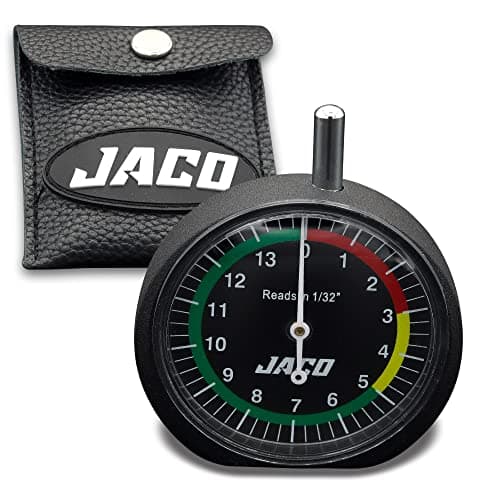
Buy the JACO TreadPro at around $16 if you want a number you can defend: it is the only gauge here that publishes an accuracy tolerance (plus or minus 0.25 percent) rather than a resolution, and it holds the reading on the dial so you are not squinting at it under a wheel arch. It carries a lifetime warranty. Buy the GODESON 88702 at around $4 if you just want the answer - it publishes exactly where its color bands start and stop, which most gauges do not. Prices as of October 17, 2026.
The number that matters. The US Tire Manufacturers Association publishes one figure: tire treads should be at least 2/32 of an inch, or the height of a penny. It publishes no separate figure for rain or snow. The color bands on these gauges go further than that - and they do not agree with each other.
| # | Pick | Install | Score | Price |
|---|---|---|---|---|
| 1 | JACO TreadPro Dial Tread Depth Gauge The only published accuracy figure | Drops in | 9.5/10 | $15.90 - view on Amazon |
| 2 | GODESON 88702 Color Coded Tread Gauge Four dollars, and it publishes its bands | Drops in | 8.9/10 | $4.25 - view on Amazon |
| 3 | CZC AUTO 2-in-1 Pressure and Tread Gauge One tool for both tire checks | Drops in | 8.9/10 | $18.99 - view on Amazon |
| 4 | GODESON DTG02 Digital Tread Gauge Reading a number instead of a scale | Drops in | 8.9/10 | $13.48 - view on Amazon |
| 5 | GODESON 88703 Dial Tread Gauge A metal body for ten dollars | Drops in | 8.3/10 | $9.99 - view on Amazon |
Prices last verified October 17, 2026. They move constantly; the figure on Amazon when you click is the real one.
Two gauges, one brand, two different red zones
Every color-coded tread gauge works the same way: push the plunger into the groove, read where the colored bar stops. Red means replace, yellow means watch it, green means fine. Simple, and that is the appeal.
Here is what this page found. The GODESON 88702, a four-dollar mechanical gauge, publishes its bands as red 0 to 3/32, yellow 3/32 to 6/32, green 6/32 and up. The GODESON DTG02, a digital gauge from the same brand, publishes red 0 to 2/32, yellow 2 to 5/32, green 5/32 and up.
The useful consequence: read the number, not the color. Every gauge here gives you a figure in thirty-seconds of an inch. The figure is comparable between products. The color is not.
What the tire industry actually publishes
The US Tire Manufacturers Association, the trade body for tire makers in the United States, publishes this on its Tire Care Essentials page: Tire treads should be at least 2/32 of an inch, or the height of a penny. And: Once your tread wears down to 2/32nds of an inch, it is time to visit your local tire shop.
It also describes the penny test exactly: Place a penny upside down into a tread groove. If part of Lincoln's head is covered by the tread, you're good to go. If you can see all of his head, it's new tire time.
Two things are worth noticing about that. First, USTMA does not call 2/32 a legal minimum - the word legal does not appear on the page; it is stated as a should-be-at-least figure. Second, and more surprisingly for a page published in October, USTMA publishes no separate tread figure for rain or snow. What it says is that tread equals traction, especially in bad weather, and that losing too much tread means losing control. No second number.
So when a gauge's yellow band starts at 5/32 or 6/32, that threshold is the gauge maker's own judgment rather than an industry figure, and this site is not going to present it as more than that. USTMA also points at the tire's own built-in wear bars: when the tops of these bars are flush with the tire's tread, the tire needs to be replaced. Those are molded into every tire sold in the US and they cost nothing to look at.
The five, on what they publish
| Gauge | Type | Accuracy published | Red band starts | Warranty | Price |
|---|---|---|---|---|---|
| JACO TreadPro | Dial | Plus or minus 0.25 percent | Not published | Lifetime | $15.90 |
| GODESON 88702 | Plunger | Not published | Under 3/32 | 12 months | $4.25 |
| CZC AUTO 2-in-1 | Digital, plus pressure | Plus or minus 0.3 mm tread, 1 psi pressure | Not published | 12 months | $18.99 |
| GODESON DTG02 | Digital | Resolution only, published as accuracy | Under 2/32 | 12 months | $13.48 |
| GODESON 88703 | Dial, zinc body | Not published | Not published | 12 months | $9.99 |
One column deserves a note. The GODESON DTG02 publishes 0.01 mm and calls it accuracy. It is a display resolution - the smallest increment the screen can show - and the two are not the same thing. A gauge can display to a hundredth of a millimeter while being wrong by half of one.
This site has had to make the same distinction before, in the AstroAI tire gauge review, where resolution and accuracy were being conflated on a pressure gauge. It is the single most common specification error in the whole tire-tool category, and the JACO is the only product on this page that gets it right.
Who each one is for
- JACO TreadPro - if you want a defensible number. A published tolerance of plus or minus 0.25 percent, 1/128 inch resolution, a 14/32 inch maximum, a lifetime warranty, and it holds the reading on the dial after you pull it out of the groove. It also publishes its own limits: not for ATV, UTV or aggressive mud tires. Skip it if fifteen dollars for a single-purpose tool feels absurd, which is reasonable
- GODESON 88702 - four dollars, and it shows its working. The only gauge here that publishes where its color bands begin and end. Calibrated 0 to 1 inch in thirty-seconds, with a pocket clip and no battery. Skip it if you want an accuracy figure, and read the number rather than the color
- CZC AUTO 2-in-1 - if you would rather carry one tool. It measures both of the things that decide how a tire behaves in snow, and publishes a tolerance for each: plus or minus 1 psi and plus or minus 0.3 mm. Backlit, which matters because this is a job done in the dark half the year. Skip it if precision is the point - plus or minus 0.3 mm is roughly 0.4/32 inch, which is coarse
- GODESON DTG02 - if you want a number on a screen. Reads in inches and millimeters, zeroes at any position, auto-off after five minutes. Skip it knowing its published 0.01 mm is a resolution and not a tolerance, and that its red band starts one thirty-second away from its own stablemate's
- GODESON 88703 - no, at this price. See the skip note
How to measure it properly
- Measure cold, on level ground. Same conditions as a pressure check, and for the same reason: consistency between readings is what tells you the wear rate
- Take three readings across each tire. Outer shoulder, center, inner shoulder. One reading tells you a depth; three tell you whether something is wrong
- Measure in the main grooves, not the sipes. The small slits in the tread blocks are shallower by design, and a gauge in one reads low
- Avoid the wear bars. The raised bridges at the bottom of the grooves are the reference, not the floor. Measuring on one gives you a reading several thirty-seconds shallow
- Write it down, with the date. The reading is almost useless alone and very useful against the same measurement three months ago - that is what tells you whether the tires will survive the winter
- Note any difference between inner and outer. Outer shoulders worn and the center fine usually means underinflation; the center worn and the shoulders fine usually means over. Both are free to fix - best tire pressure gauges
What to do with the number in winter
Tread is how water and slush get out from under the tire. Less tread means less space for either, which is why the same tire that felt fine in July feels vague in a December downpour. USTMA's own wording is that tread equals traction, giving your tires a grip on the road, especially in bad weather.
If your measurement is near the 2/32 figure, that is a tire shop conversation, not a gauge conversation. If it is comfortably above it and you still want more grip on snow, the options this site covers are snow socks and tire chains and the choice between them in snow socks vs tire chains.
And the cheapest thing you can do for traction on any tread depth is keep the pressure right, because cold air alone drops it. A continuous monitor does this without you remembering - best TPMS sensors - and what to carry for the morning it has gone badly wrong is in best tire repair kits and what to keep in your car in winter.
Every pick, with the working
Each entry lists the specifications the maker publishes, the axis scores those specifications produce, and what you give up. Rows that read “Not published” are not omissions on our side: they are things the maker will not commit to in writing, and they cost the product points on the transparency axis. Specifications compiled September 4, 2026.
Our pickThe only published accuracy figure
JACO TreadPro Dial Tread Depth Gauge
The only tread gauge in this group that publishes an accuracy tolerance rather than a resolution: plus or minus 0.25 percent, calibrated to meet or exceed industry standards, with a 1/128-inch resolution and a 14/32-inch maximum. It also carries a lifetime warranty on a fifteen-dollar tool, and it holds the reading on the dial after you pull it out of the groove.
- Type
- Dial
- Accuracy
- Plus or minus 0.25 percent
- Resolution
- 1/128 in
- Range
- Up to 14/32 in
- Reading hold
- Yes, retained on the dial
- Warranty
- Lifetime
- Color band thresholds
- Not published
- Named standard
- Not published
List price $15.90 per Amazon listing, October 17, 2026, captured on the compile date below. Not a live price and not what you will pay — the button is where the real number is.
What it gets right
- Publishes an accuracy tolerance of plus or minus 0.25 percent - not a resolution figure dressed up as one
- 1/128 in resolution with a 14/32 in maximum depth, both published
- Retains the reading on the dial after measuring, so you are not reading it upside down under a wheel arch
- 100 percent lifetime warranty published
- States its own limits: not for ATV, UTV or aggressive mud tires
Flaws
- Fifteen dollars for a tool that does one thing a four-dollar one also does
- Dial type, so it is the bulkiest gauge here and the one most likely to be damaged in a glovebox
- Color bands are described but the thresholds behind them are not published
- Calibrated to meet or exceed industry standards does not name the standard
The working behind the 9.5
- Heat headroom: not scored (weight 22%)
- The maker publishes no operating-temperature ceiling, so this axis is dropped and the other weights are re-normalized.
- Install effort: 10.0 (weight 24%)
- Drops in and sits there. No fixing of any kind, and it comes out again when you sell the car.
- Price against the ceiling: 10.0 (weight 24%)
- Listed at $15.9 on the compile date. This site's buyer has a practical ceiling around $150 for a single upgrade, so the scale rewards everything under $100 and falls away sharply past $150. The live price is very often different, and that is what the button is for.
- Written commitment: 10.0 (weight 15%)
- 1200-month warranty. This is the only promise in the entire listing that a court would read, which is why it is scored and the marketing copy is not.
- Spec transparency: 7.5 (weight 15%)
- 6 of the 8 specifications we went looking for are published by the maker (75%). A blank row is never a guess here: it prints “Not published” and it costs the product points, because a figure nobody will commit to in writing is a figure you cannot check.
Axes with no published input are dropped and the remaining weights re-normalized, so a product is not punished for a category where an axis does not apply. Specifications compiled September 4, 2026 from the JACO TreadPro listing.
2Four dollars, and it publishes its bands
GODESON 88702 Color Coded Tread Gauge
A four-dollar plunger gauge calibrated 0 to 1 inch in 32nds, and the only gauge here that publishes exactly where its color bands start and stop: red 0-3/32, yellow 3/32-6/32, green 6/32 and up. Those published thresholds are the most useful thing on this page and they are also the reason to read the next entry carefully.
- Type
- Plunger with color-coded bar
- Range
- 0 to 1 in, in 1/32 in
- Red band
- 0 to 3/32 in
- Yellow band
- 3/32 to 6/32 in
- Green band
- 6/32 to 32/32 in
- Warranty
- 12 months
- Accuracy
- Not published
List price $4.25 per Amazon listing, October 17, 2026, captured on the compile date below. Not a live price and not what you will pay — the button is where the real number is.
What it gets right
- Publishes its color thresholds in full: red 0-3/32, yellow 3/32-6/32, green 6/32 to 32/32
- Calibrated 0 to 1 inch in 1/32 inch increments
- Four dollars, with a pocket clip, and nothing in it to run out of battery
- 1-year warranty published on a four-dollar tool
Flaws
- No accuracy tolerance published - a plunger gauge read by eye against a printed scale
- Its red band starts at 3/32, where GODESON's own digital gauge puts red at 2/32 - the same brand, two different answers
- The color bands are the maker's opinion, not a published standard
- Small enough to vanish in a door pocket
The working behind the 8.9
- Heat headroom: not scored (weight 22%)
- The maker publishes no operating-temperature ceiling, so this axis is dropped and the other weights are re-normalized.
- Install effort: 10.0 (weight 24%)
- Drops in and sits there. No fixing of any kind, and it comes out again when you sell the car.
- Price against the ceiling: 10.0 (weight 24%)
- Listed at $4.25 on the compile date. This site's buyer has a practical ceiling around $150 for a single upgrade, so the scale rewards everything under $100 and falls away sharply past $150. The live price is very often different, and that is what the button is for.
- Written commitment: 5.5 (weight 15%)
- 12-month warranty. This is the only promise in the entire listing that a court would read, which is why it is scored and the marketing copy is not.
- Spec transparency: 8.6 (weight 15%)
- 6 of the 7 specifications we went looking for are published by the maker (86%). A blank row is never a guess here: it prints “Not published” and it costs the product points, because a figure nobody will commit to in writing is a figure you cannot check.
Axes with no published input are dropped and the remaining weights re-normalized, so a product is not punished for a category where an axis does not apply. Specifications compiled September 4, 2026 from the GODESON 88702 listing.
3One tool for both tire checks
CZC AUTO 2-in-1 Pressure and Tread Gauge
The only tool here that measures both of the things that decide how a tire behaves in snow, and the only one that publishes a tolerance for each: plus or minus 1 psi on pressure and plus or minus 0.3 mm on tread. Two published tolerances on a nineteen-dollar tool is more than most single-purpose gauges in this ledger manage.
- Type
- Digital, pressure plus tread depth
- Pressure accuracy
- Plus or minus 1 psi
- Tread accuracy
- Plus or minus 0.3 mm
- Pressure range
- 0-100 PSI / 0-7 Bar / 0-700 kPa
- Tread range
- 0-15.1 mm (0-19/32 in)
- Display
- Backlit LCD, 30-second auto-off
- Battery
- 2 x CR2032, pre-installed
- Warranty
- 12 months, plus 30-day money back
- Color band thresholds
- Not published
List price $18.99 per Amazon listing, October 17, 2026, captured on the compile date below. Not a live price and not what you will pay — the button is where the real number is.
What it gets right
- Publishes both tolerances: plus or minus 1 psi and plus or minus 0.3 mm
- Pressure range 0-100 PSI with Bar, kgf/cm2 and kPa, tread range 0-15.1 mm (0-19/32 in)
- Backlit LCD, which matters because this is a job done in the dark half the year
- Two CR2032 cells pre-installed, 30-second auto shut-off
- 12-month warranty and a 30-day money-back term published
Flaws
- Plus or minus 0.3 mm is roughly plus or minus 0.4/32 in, which is coarse next to the JACO's percentage tolerance
- Two batteries to go flat instead of none
- Doing two jobs means it is bulkier than either single-purpose tool
- The listing spells tread as thread throughout, which does not inspire confidence in the proofreading of the rest
The working behind the 8.9
- Heat headroom: not scored (weight 22%)
- The maker publishes no operating-temperature ceiling, so this axis is dropped and the other weights are re-normalized.
- Install effort: 10.0 (weight 24%)
- Drops in and sits there. No fixing of any kind, and it comes out again when you sell the car.
- Price against the ceiling: 10.0 (weight 24%)
- Listed at $18.99 on the compile date. This site's buyer has a practical ceiling around $150 for a single upgrade, so the scale rewards everything under $100 and falls away sharply past $150. The live price is very often different, and that is what the button is for.
- Written commitment: 5.5 (weight 15%)
- 12-month warranty. This is the only promise in the entire listing that a court would read, which is why it is scored and the marketing copy is not.
- Spec transparency: 8.9 (weight 15%)
- 8 of the 9 specifications we went looking for are published by the maker (89%). A blank row is never a guess here: it prints “Not published” and it costs the product points, because a figure nobody will commit to in writing is a figure you cannot check.
Axes with no published input are dropped and the remaining weights re-normalized, so a product is not punished for a category where an axis does not apply. Specifications compiled September 4, 2026 from the CZC AUTO 2-in-1 listing.
4Reading a number instead of a scale
GODESON DTG02 Digital Tread Gauge
A digital gauge with a 0-25.4 mm range, zeroable at any position, reading in both inches and millimeters. Its published figure of 0.01 mm is a resolution, not an accuracy - the listing calls it accuracy, and the difference is the same one this site has already had to spell out for pressure gauges. Its color bands also disagree with GODESON's own mechanical gauge.
- Type
- Digital LCD
- Range
- 0-25.4 mm / 0-1 in
- Resolution
- 0.01 mm / 0.0005 in, published as accuracy
- Units
- Inches and millimeters
- Red band
- 0 to 2/32 in
- Yellow band
- 2/32 to 5/32 in
- Green band
- 5/32 to 32/32 in
- Battery
- 1.5 V SR44/LR, auto-off after 5 minutes
- Accuracy tolerance
- Not published
List price $13.48 per Amazon listing, October 17, 2026, captured on the compile date below. Not a live price and not what you will pay — the button is where the real number is.
What it gets right
- Reads in both inches and millimeters, on a large LCD, with the number stated rather than estimated against a scale
- Zeroable at any position, which is what lets you measure from the top of a wear bar rather than the groove floor
- Auto shut-off after 5 minutes on a standard SR44/LR battery
- Publishes its color bands: red 0-2/32, yellow 2-5/32, green 5/32 and up
Flaws
- The listing calls 0.01 mm an accuracy. It is a display resolution - the two are not the same thing and no tolerance is published
- Its red band starts at 2/32, where GODESON's own 88702 starts red at 3/32
- A battery is one more thing to be dead in February
- Three times the price of the same brand's mechanical gauge
The working behind the 8.9
- Heat headroom: not scored (weight 22%)
- The maker publishes no operating-temperature ceiling, so this axis is dropped and the other weights are re-normalized.
- Install effort: 10.0 (weight 24%)
- Drops in and sits there. No fixing of any kind, and it comes out again when you sell the car.
- Price against the ceiling: 10.0 (weight 24%)
- Listed at $13.48 on the compile date. This site's buyer has a practical ceiling around $150 for a single upgrade, so the scale rewards everything under $100 and falls away sharply past $150. The live price is very often different, and that is what the button is for.
- Written commitment: 5.5 (weight 15%)
- 12-month warranty. This is the only promise in the entire listing that a court would read, which is why it is scored and the marketing copy is not.
- Spec transparency: 8.9 (weight 15%)
- 8 of the 9 specifications we went looking for are published by the maker (89%). A blank row is never a guess here: it prints “Not published” and it costs the product points, because a figure nobody will commit to in writing is a figure you cannot check.
Axes with no published input are dropped and the remaining weights re-normalized, so a product is not punished for a category where an axis does not apply. Specifications compiled September 4, 2026 from the GODESON DTG02 listing.
5A metal body for ten dollars
GODESON 88703 Dial Tread Gauge
Skip this one. A solid zinc dial gauge for ten dollars is a good object, and it is the skip because of what it does not say. No accuracy tolerance, and its color zones are explained only as clearly indicates the tire different conditions during different weather. Five dollars more buys the JACO, which publishes a tolerance, a resolution, a maximum depth and a lifetime warranty.
A solid zinc-cast dial gauge with a 2-inch face, reading in 32nds, for ten dollars - the cheapest way to get a metal gauge with a dial big enough to read at arm's length. It publishes no accuracy tolerance and no band thresholds, which puts it a step behind both the JACO and its own cheaper stablemate.
- Type
- Dial, 2 in face
- Body
- Solid zinc casting
- Increments
- 1/32 in
- Warranty
- 12 months satisfaction guarantee
- Accuracy
- Not published
- Color band thresholds
- Not published
- Reading hold
- Not published
List price $9.99 per Amazon listing, October 17, 2026, captured on the compile date below. Not a live price and not what you will pay — the button is where the real number is.
What it gets right
- Solid zinc casting rather than plastic - it will survive a toolbox
- 2-inch dial, the easiest face here to read crouched beside a wheel
- Reads in 1/32 inch increments
- 1-year satisfaction guarantee published
Flaws
- No accuracy tolerance published, unlike the JACO dial gauge for five dollars more
- Colourful zones are described but their thresholds are never stated
- No reading-hold feature, so you read it in position
- Clearly indicates the tire different conditions during different weather is the entire explanation of its color bands
The working behind the 8.3
- Heat headroom: not scored (weight 22%)
- The maker publishes no operating-temperature ceiling, so this axis is dropped and the other weights are re-normalized.
- Install effort: 10.0 (weight 24%)
- Drops in and sits there. No fixing of any kind, and it comes out again when you sell the car.
- Price against the ceiling: 10.0 (weight 24%)
- Listed at $9.99 on the compile date. This site's buyer has a practical ceiling around $150 for a single upgrade, so the scale rewards everything under $100 and falls away sharply past $150. The live price is very often different, and that is what the button is for.
- Written commitment: 5.5 (weight 15%)
- 12-month warranty. This is the only promise in the entire listing that a court would read, which is why it is scored and the marketing copy is not.
- Spec transparency: 5.7 (weight 15%)
- 4 of the 7 specifications we went looking for are published by the maker (57%). A blank row is never a guess here: it prints “Not published” and it costs the product points, because a figure nobody will commit to in writing is a figure you cannot check.
Axes with no published input are dropped and the remaining weights re-normalized, so a product is not punished for a category where an axis does not apply. Specifications compiled September 4, 2026 from the GODESON 88703 listing.
Prices last verified October 17, 2026. They move constantly; the figure on Amazon when you click is the real one.
Questions people actually ask
What is the minimum tire tread depth?
The US Tire Manufacturers Association publishes one figure: tire treads should be at least 2/32 of an inch, or the height of a penny, and once tread wears down to 2/32nds it is time to visit a tire shop. USTMA does not describe that as a legal minimum, and it publishes no separate figure for rain or snow. Your tire's own molded wear bars are the same reference: when their tops are flush with the tread, the tire needs replacing.
How do I use a tire tread depth gauge?
Push the plunger into a main groove until the gauge body sits flat on the tread blocks, then read the figure in thirty-seconds of an inch. Take three readings per tire - outer shoulder, center, inner shoulder - stay out of the small sipes and off the raised wear bars, and write the numbers down with the date so the next measurement means something.
Is the penny test accurate?
It is the method the US Tire Manufacturers Association publishes, and it answers one question: are you at 2/32 or not. Place a penny upside down in a tread groove; if part of Lincoln's head is covered you are above the figure, and if you can see all of his head you are at or below it. What it cannot do is track wear over time, which is what a gauge and a written record give you.
Do the color bands on tread gauges mean anything?
They are the manufacturer's own judgment, not a standard, and they disagree with each other. GODESON's mechanical 88702 publishes its red band as 0 to 3/32; GODESON's own digital gauge publishes red as 0 to 2/32. A tire at 2.5/32 is red on one and yellow on the other. Read the number, which is comparable, rather than the color, which is not.
Is a digital tread depth gauge better than a dial one?
Not automatically. Digital gauges display more decimal places, but a displayed decimal is a resolution, not an accuracy - GODESON's digital gauge publishes 0.01 mm and calls it accuracy, which is the resolution of its screen. The only gauge on this page publishing a real tolerance is the JACO dial gauge, at plus or minus 0.25 percent.
Sources
- Published minimum tread figure, penny test wording and wear bar guidance, US Tire Manufacturers Association
- Published accuracy tolerance, resolution, maximum depth and lifetime warranty for the JACO TreadPro
- Published color band thresholds for the GODESON 88702 mechanical gauge
- Published color band thresholds and resolution figure for the GODESON DTG02 digital gauge
- Published pressure and tread accuracy tolerances for the CZC AUTO 2-in-1 gauge
- Published body material and dial size for the GODESON 88703 dial gauge