The best car accessories for Uber and Lyft drivers
Driving for money changes the arithmetic. Something you use for eight hours a day justifies a price a commuter's accessory never could.
By Sawyer V. · Published · How we research
We have not tested any of this. Everything below is compiled from published manufacturer specifications, and the arithmetic is printed so you can check it. This page carries affiliate links: if you buy through one we earn a commission at no extra cost to you, and it does not change the order of the picks. Full disclosure.
The short answer
Buy for hours, not for novelty. A three-channel dash cam, a good phone mount and a high-wattage charger are the three that earn their place immediately, because you use all three every hour of every shift. Then a bin and a vacuum, because a rideshare car gets dirty at a rate a private car never does. Audio recording of passengers is regulated and varies by state — check your own rules before enabling the interior microphone.
| # | Pick | Install | Score | Price |
|---|---|---|---|---|
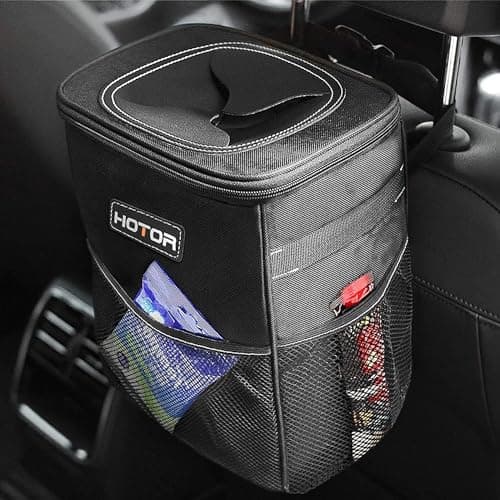
| 1 | HOTOR Car Trash Can (2 gallon) The cheapest fix for a permanently messy car | Drops in | 9.7/10 | $9.98 - view on Amazon |
| 2 | UGREEN 130W 3-Port Car Charger A laptop and two phones at once | Plugs in | 9.5/10 | $21.99 - view on Amazon |
| 3 | ThisWorx Car Vacuum Reaching the trunk without an extension lead | Plugs in | 9.2/10 | $20.99 - view on Amazon |
| 4 | iOttie Easy One Touch 5 Air Vent The default vent mount | Clips on | 8.3/10 | Check price on Amazon |
| 5 | FH Group Universal Cloth Seat Covers Covering a seat you have already ruined | Drops in | 8.1/10 | $44.97 - view on Amazon |
| 6 | Vantrue N4 Three channels, including the cabin | Adhesive | 6.6/10 | Check price on Amazon |
Prices last verified October 22, 2026. They move constantly; the figure on Amazon when you click is the real one.
Why the arithmetic changes
A commuter uses their car for an hour a day. A full-time rideshare driver uses it for eight or more, with strangers in it, doing continuous short trips in traffic. If the passengers are parcels rather than people, the wear pattern is different again — that is the delivery driver list.
Three consequences follow, and they reorder the entire priority list:
- Things that save seconds compound. A mount that takes two seconds instead of eight, several hundred times a week, is a real difference
- Wear happens at several times the rate. Seats, carpets and door cards age on a working car's schedule, not a private one's
- A price you would not pay for a hobby is easy to justify. Anything that keeps you working rather than cleaning or fixing pays for itself quickly
The three-channel dash cam, which is the one genuine specialist
Almost everything else on this site is the same product a private owner would buy. The interior-facing camera is the exception, and it is the one item where rideshare is the actual use case.
The Vantrue N4 records front, rear and cabin. For a private owner that third channel is storage spent on footage of an empty passenger seat. For someone carrying strangers for money, it is the channel that documents what happened inside the car.
| Channel | Private owner | Rideshare driver |
|---|---|---|
| Front | Essential | Essential |
| Rear | Useful — rear-end collisions | Useful |
| Cabin | Pointless | The reason to buy this camera |
Three channels roughly triple the write rate of one, which shortens how far back your footage reaches on a given card. Buy the largest high-endurance card the camera supports — Samsung publishes 70,080 hours and 820 TBW at 128 GB against SanDisk High Endurance at 10,000 hours and 117 TBW, and on an eight-hour-a-day duty cycle that gap matters more than it does for anyone else. See best microSD cards for a dash cam and best dash cams for rideshare.
The recording question, stated properly
Two practical points that follow. A visible notice informing passengers that the vehicle is recorded is common practice and is a reasonable step regardless of what your state requires. And most cameras allow audio to be disabled while keeping video, which is worth knowing if your jurisdiction makes audio awkward.
The wider legal picture, including windshield obstruction rules that also govern where the camera can go, is in are dash cams legal.
The two you touch every hour
The phone mount is doing more work here than in any other application. The phone is your dispatch, navigation and payment terminal, and you interact with it constantly — so the seconds a good mount saves compound across hundreds of pickups.
Position matters more than product: as close to your natural forward view as possible without being in it. Vent mounts score well on eyeline, obstruction and heat simultaneously — vent vs dashboard vs windshield and where to mount your phone in a car.
The charger needs headroom, because a phone running navigation and a driver app at full brightness for eight hours can discharge faster than a weak supply charges. A high-wattage USB-C charger with a spare port for passengers is the sensible specification.
Read the per-port figure rather than the headline — a “67W” charger may cap every port at 35W, and the total is shared the moment a passenger plugs in. And use an E-marked cable: without the chip a USB-C cable is capped at 3 A regardless of the charger. Best multi-port car chargers and best USB-C cables for a car.
Managing wear at three times the rate
A rideshare car accumulates in a month what a private car accumulates in a quarter. The equipment that matters is unglamorous.
- A bin, emptied every shift. Passengers leave cups, wrappers and receipts, and nothing degrades a rating faster than a visibly dirty car — best car trash cans
- A vacuum you own. Not a better one, a nearer one. The barrier to cleaning is going somewhere to do it — best car vacuums
- All-weather floor mats. Rear footwells take everything passengers bring in — best all-weather floor mats
- An enzyme cleaner in the trunk. For the spill you cannot end the shift over. Enzymes break protein down rather than diluting it, which is what removes the smell as well as the mark — how to remove stains from car seats
The part about you
Eight hours in a seat is a different proposition from a commute, and the seat is the piece of equipment you spend the most time in contact with.
Start with the free thing: the seat's own adjustments. Height and cushion tilt are the two least-used controls and they do what a wedge cushion does, built in — how to set up your driving position. Only then consider a cushion or a lumbar support, and the two solve different problems — seat cushion vs lumbar support.
Fatigue on long shifts is a scheduling problem more than an equipment one, and how to reduce driver fatigue covers what actually works.
Small things passengers notice
A charging cable in the back, a bottle of water, a phone mount that is not blocking their view forward. These cost very little and they are disproportionately visible.
Two cautions. Anything hard mounted at head height in the back is an unrestrained object in a collision — seat-back tablet holders are on our list of things not to buy for exactly this reason, in car accessories that are not worth buying. And air fresheners are a gamble: a strong scent is as likely to bother a passenger as please them, and it never fixes a smell that has a source — how to get smells out of your car.
Every pick, with the working
Each entry lists the specifications the maker publishes, the axis scores those specifications produce, and what you give up. Rows that read “Not published” are not omissions on our side: they are things the maker will not commit to in writing, and they cost the product points on the transparency axis. Specifications compiled September 4, 2026.
Our pickThe cheapest fix for a permanently messy car
HOTOR Car Trash Can (2 gallon)
Two gallons, 7.9 by 5.5 by 10.2 inches, Oxford cloth over a waterproof PEVA lining, with four magnetic snaps holding the bag open and a strap that fastens it to a headrest or the console. A car gets cluttered because there is nowhere to put rubbish, and this is thirteen dollars of nowhere-to-put-rubbish solved.
- Capacity
- 2 gallons (3-gallon version also sold)
- Dimensions
- 7.9 x 5.5 x 10.2 in
- Weight
- 1.0 lb
- Outer material
- Oxford cloth
- Lining
- Waterproof PEVA
- Bag retention
- 4 magnetic snaps, 2 spare bags included
- Pockets
- 3 mesh
- Mounting
- Adjustable strap with quick-release buckle
- Warranty
- Not published
List price $12.99 per Walmart listing, 2-gallon, captured on the compile date below. Not a live price and not what you will pay — the button is where the real number is.
What it gets right
- Published dimensions and capacity, so you can check it against the space beside your seat
- PEVA waterproof lining — the difference between a bin and a stain when someone puts a coffee cup in it
- Four magnetic snaps hold a liner bag open, which is the detail that makes it usable one-handed while driving
- Strap and quick-release buckle, so it attaches to something rather than sliding around the footwell
Flaws
- Two gallons is small if you carry passengers who eat in the car; the 3-gallon version exists for that
- Soft-sided, so it needs to be strapped to something or it tips
- It only works if you empty it, which is the same problem as every bin ever made
The working behind the 9.7
- Heat headroom: not scored (weight 22%)
- The maker publishes no operating-temperature ceiling, so this axis is dropped and the other weights are re-normalized.
- Install effort: 10.0 (weight 24%)
- Drops in and sits there. No fixing of any kind, and it comes out again when you sell the car.
- Price against the ceiling: 10.0 (weight 24%)
- Listed at $12.99 on the compile date. This site's buyer has a practical ceiling around $150 for a single upgrade, so the scale rewards everything under $100 and falls away sharply past $150. The live price is very often different, and that is what the button is for.
- Written commitment: not scored (weight 15%)
- No warranty term published, so this axis is dropped and the other weights are re-normalized.
- Spec transparency: 8.9 (weight 15%)
- 8 of the 9 specifications we went looking for are published by the maker (89%). A blank row is never a guess here: it prints “Not published” and it costs the product points, because a figure nobody will commit to in writing is a figure you cannot check.
Axes with no published input are dropped and the remaining weights re-normalized, so a product is not punished for a category where an axis does not apply. Specifications compiled September 4, 2026 from the HOTOR 2-gallon listing — HOTOR's own product page publishes none of these figures.
2A laptop and two phones at once
UGREEN 130W 3-Port Car Charger
Three ports totaling 130W with one USB-C rated at 100W on its own, a 100W E-marked cable in the box, and a published 45-gram weight. It is the only charger here that will genuinely run a laptop at full speed, and it costs less than the 67W chargers do because UGREEN prices aggressively.
- Ports
- 2 x USB-C, 1 x USB-A
- Total output
- 130 W
- USB-C 1 maximum
- 30 W
- USB-C 2 maximum
- 100 W
- USB-A maximum
- 22.5 W (SCP) / 18 W (QC 3.0)
- Protocols
- PD 3.0, QC 4.0, QC 3.0, SCP, AFC, PPS
- In the box
- 100 W E-marked USB-C to USB-C cable
- Weight
- 45 g
- Warranty
- Not published
- Operating range
- Not published
List price $22.49 per UGREEN's own store, sale price (regular $39.99), captured on the compile date below. Not a live price and not what you will pay — the button is where the real number is.
What it gets right
- 100 W on a single USB-C port, which is a real laptop charge rather than a trickle
- A 100 W E-marked USB-C cable is included, and that cable alone is often $15
- Publishes both per-port ceilings separately (30 W and 100 W) instead of one combined figure
- Broad protocol support: PD 3.0, QC 4.0, QC 3.0, SCP, AFC and PPS
Flaws
- 130 W in a 12V socket is close to what many car circuits are fused for; check your fuse rating
- The second USB-C port is only 30 W, so it is not two laptop ports
- UGREEN publishes no warranty term and no operating-temperature range
The working behind the 9.5
- Heat headroom: not scored (weight 22%)
- The maker publishes no operating-temperature ceiling, so this axis is dropped and the other weights are re-normalized.
- Install effort: 10.0 (weight 24%)
- Plugs into a 12V socket or a USB port. Nothing to mount, nothing to route, reversible in a second.
- Price against the ceiling: 10.0 (weight 24%)
- Listed at $22.49 on the compile date. This site's buyer has a practical ceiling around $150 for a single upgrade, so the scale rewards everything under $100 and falls away sharply past $150. The live price is very often different, and that is what the button is for.
- Written commitment: not scored (weight 15%)
- No warranty term published, so this axis is dropped and the other weights are re-normalized.
- Spec transparency: 8.0 (weight 15%)
- 8 of the 10 specifications we went looking for are published by the maker (80%). A blank row is never a guess here: it prints “Not published” and it costs the product points, because a figure nobody will commit to in writing is a figure you cannot check.
Axes with no published input are dropped and the remaining weights re-normalized, so a product is not punished for a category where an axis does not apply. Specifications compiled September 4, 2026 from UGREEN's 130W car charger product page.
3Reaching the trunk without an extension lead
ThisWorx Car Vacuum
A 106 W corded vacuum drawing 8.8 amps from the 12V socket, with a 16-foot cord and a metal turbine. The cord is the reason to buy the corded one: sixteen feet reaches the trunk of most cars from the front socket, and a cordless handheld runs out of battery halfway through the back seat.
- Power
- 106 W
- Current draw
- 8.8 A
- Cord length
- 16 ft
- Weight
- 2.4 lb
- Power source
- 12 V socket
- Filter
- HEPA, spare included
- Attachments
- Flathead, extendable, brush nozzle
- Suction (kPa or air watts)
- Not published
- Warranty
- Not published
What it gets right
- 16 ft cord, published — genuinely reaches every corner of a normal car from one socket
- 106 W and 8.8 A published, which is more useful than the 'high power' every listing in this category claims
- 2.4 lb, so it is easy to hold at an angle under a seat for five minutes
- Ships with three attachments, a spare HEPA filter and a bag, so it is complete out of the box
Flaws
- ThisWorx publishes no suction figure in kPa or air watts, which is the number that would let you compare it to anything
- 8.8 A is a real load on the 12V socket; run the engine
- Corded means the cord is always in the way of what you are vacuuming
The working behind the 9.2
- Heat headroom: not scored (weight 22%)
- The maker publishes no operating-temperature ceiling, so this axis is dropped and the other weights are re-normalized.
- Install effort: 10.0 (weight 24%)
- Plugs into a 12V socket or a USB port. Nothing to mount, nothing to route, reversible in a second.
- Price against the ceiling: not scored (weight 24%)
- No published list price we could cite on the compile date, so this axis is dropped and the other weights are re-normalized.
- Written commitment: not scored (weight 15%)
- No warranty term published, so this axis is dropped and the other weights are re-normalized.
- Spec transparency: 7.8 (weight 15%)
- 7 of the 9 specifications we went looking for are published by the maker (78%). A blank row is never a guess here: it prints “Not published” and it costs the product points, because a figure nobody will commit to in writing is a figure you cannot check.
Axes with no published input are dropped and the remaining weights re-normalized, so a product is not punished for a category where an axis does not apply. Specifications compiled September 4, 2026 from ThisWorx car vacuum published specifications.
4The default vent mount
iOttie Easy One Touch 5 Air Vent
A twist-lock vent clamp and the one-handed cradle iOttie has been refining for a decade, at $24.95. It grips the phone mechanically rather than magnetically, which means it does not care what case you have, and it costs a quarter of what the Qi2 chargers cost because it does not charge anything.
- Attachment
- Twist-lock air vent
- Hold
- Mechanical cradle, one-touch lock and release
- Orientation
- Portrait or landscape
- Cable management
- Magnetic cord organizer
- SKU
- HLCRIO172
- Weight capacity
- Not published
- Operating range
- Not published
List price $24.95 per iOttie's own store, captured on the compile date below. Not a live price and not what you will pay — the button is where the real number is.
What it gets right
- Twist-lock vent attachment rather than a spring clip, which is the difference between staying put and rattling loose
- Mechanical cradle works with any case, any thickness, and any phone that fits
- One-handed lock and release, which is the entire point of the product line
- $24.95 list, the cheapest way to solve the problem properly
Flaws
- Blocks a vent, and in summer that vent is the one you wanted
- No charging, so the cable still has to come from somewhere
- A heavy phone on a thin vent blade will still droop over time on some cars
The working behind the 8.3
- Heat headroom: not scored (weight 22%)
- The maker publishes no operating-temperature ceiling, so this axis is dropped and the other weights are re-normalized.
- Install effort: 9.0 (weight 24%)
- Clips onto a vent blade or a headrest post. Two minutes, no tools, no adhesive, no residue.
- Price against the ceiling: 10.0 (weight 24%)
- Listed at $24.95 on the compile date. This site's buyer has a practical ceiling around $150 for a single upgrade, so the scale rewards everything under $100 and falls away sharply past $150. The live price is very often different, and that is what the button is for.
- Written commitment: 5.5 (weight 15%)
- 12-month warranty. This is the only promise in the entire listing that a court would read, which is why it is scored and the marketing copy is not.
- Spec transparency: 7.1 (weight 15%)
- 5 of the 7 specifications we went looking for are published by the maker (71%). A blank row is never a guess here: it prints “Not published” and it costs the product points, because a figure nobody will commit to in writing is a figure you cannot check.
Axes with no published input are dropped and the remaining weights re-normalized, so a product is not punished for a category where an axis does not apply. Specifications compiled September 4, 2026 from iOttie's Easy One Touch 5 Air Vent page.
5Covering a seat you have already ruined
FH Group Universal Cloth Seat Covers
Skip this one. Good covers with airbag-compatible stitching, and on a rideshare car they are a harder call than they look. Passengers judge a car that looks covered up, and a cover that shifts under people getting in and out looks worse than clean upholstery. Buy them if your seats are already marked; hold off if they are not.
Semi-universal cloth covers with 3 mm of breathable foam backing and — this is the specification that matters — stitching designed to let a side airbag deploy through the seam, which FH Group states is tested. A seat cover without that is a genuine safety problem, and plenty of cheap ones do not mention it at all.
- Airbag compatibility
- Stitched for side-airbag deployment, stated as tested
- Padding
- 3 mm breathable foam backing
- Care
- Machine washable, air dry
- Fit
- Semi-universal; full set or front set
- Material weight
- Not published
- Durability rating
- Not published
- List price
- Not published
- Warranty
- Not published
What it gets right
- Airbag-compatible stitching, stated as officially tested. This is the one specification to insist on
- 3 mm breathable foam backing, published, which is what stops them feeling like a bin bag
- Machine washable, which is the entire point for anyone with children or a dog
- Semi-universal fit covering most sedans, SUVs and trucks, with full-set and front-only options
Flaws
- Semi-universal means it will never look like upholstery. It looks like a cover, because it is one
- Getting them taut takes far longer than the listing suggests, and a loose cover slides
- FH Group publishes no material weight or durability figure, only the foam thickness
The working behind the 8.1
- Heat headroom: not scored (weight 22%)
- The maker publishes no operating-temperature ceiling, so this axis is dropped and the other weights are re-normalized.
- Install effort: 10.0 (weight 24%)
- Drops in and sits there. No fixing of any kind, and it comes out again when you sell the car.
- Price against the ceiling: not scored (weight 24%)
- No published list price we could cite on the compile date, so this axis is dropped and the other weights are re-normalized.
- Written commitment: not scored (weight 15%)
- No warranty term published, so this axis is dropped and the other weights are re-normalized.
- Spec transparency: 5.0 (weight 15%)
- 4 of the 8 specifications we went looking for are published by the maker (50%). A blank row is never a guess here: it prints “Not published” and it costs the product points, because a figure nobody will commit to in writing is a figure you cannot check.
Axes with no published input are dropped and the remaining weights re-normalized, so a product is not punished for a category where an axis does not apply. Specifications compiled September 4, 2026 from FH Group seat cover published specifications.
6Three channels, including the cabin
Vantrue N4
Skip this one. Unless you drive rideshare or carry passengers you do not know, the cabin channel is a cost with no benefit. A front camera plus a rear camera does the commuter job for less.
Front, cabin and rear on one camera with infrared night vision on the interior channel and the same 70 C published ceiling as the rest of Vantrue's supercapacitor line. It is the camera for somebody who drives for a living or carries passengers they do not know. For a plain commute it is two channels more than you need and $170 more than you need to spend.
- Channels
- Three: front, interior, rear
- Resolution
- 1440p + 1080p + 1080p at 30fps, or 4K front only
- Night vision
- Sony STARVIS with infrared on the cabin channel
- Power store
- Supercapacitor
- Operating range
- -10 C to 70 C (14 F to 158 F)
- Max microSD
- 512 GB
- Parking mode
- 24-hour, motion and collision detection
- GPS
- Supported
- Published current draw
- Not published
List price $259.99 per Vantrue's own store, captured on the compile date below. Not a live price and not what you will pay — the button is where the real number is.
What it gets right
- Three channels recording at once, with IR illumination on the cabin camera
- 70 C published ceiling and a supercapacitor
- 512GB card support, which three channels genuinely need
- 24-hour parking mode with motion and collision detection
Flaws
- $259.99 list is far outside this site's usual bracket
- Three channels fill a card fast, so the running cost is a bigger card sooner
- The interior camera is pointless for most private drivers and creates a privacy question for passengers
The working behind the 6.6
- Heat headroom: 10.0 (weight 22%)
- Published operating ceiling 70 C (158 F). A car parked in summer sun runs roughly 60-70 C inside, so 65 C and up is real headroom, 60 C is living at the limit, and anything under 55 C is a summer problem waiting to happen.
- Install effort: 6.0 (weight 24%)
- Adhesive pad onto the dashboard. Permanent in practice: repositioning means a new pad, and the pad is the part that fails first.
- Price against the ceiling: 2.5 (weight 24%)
- Listed at $259.99 on the compile date. This site's buyer has a practical ceiling around $150 for a single upgrade, so the scale rewards everything under $100 and falls away sharply past $150. The live price is very often different, and that is what the button is for.
- Written commitment: 7.0 (weight 15%)
- 18-month warranty. This is the only promise in the entire listing that a court would read, which is why it is scored and the marketing copy is not.
- Spec transparency: 8.9 (weight 15%)
- 8 of the 9 specifications we went looking for are published by the maker (89%). A blank row is never a guess here: it prints “Not published” and it costs the product points, because a figure nobody will commit to in writing is a figure you cannot check.
Axes with no published input are dropped and the remaining weights re-normalized, so a product is not punished for a category where an axis does not apply. Specifications compiled September 4, 2026 from Vantrue's N4 product page.
Prices last verified October 22, 2026. They move constantly; the figure on Amazon when you click is the real one.
Questions people actually ask
Do I need a three-channel dash cam for rideshare?
The interior channel is the one genuinely rideshare-specific item, and it is why cameras like the Vantrue N4 exist. It costs you card capacity, since three channels write roughly three times as fast as one.
Can I record passengers in my car?
Video is treated far more permissively than audio. Several states require all-party consent for recording conversations. Check your state and your platform's policy, and consider a visible notice regardless — this is general information, not legal advice.
Are seat covers worth it for rideshare?
It cuts both ways. They protect upholstery that is aging fast, and a cover that shifts under passengers looks worse than clean seats. If yours are already marked, cover them. If not, hold off and clean often.
What is the single best purchase for a rideshare driver?
A good phone mount, because you interact with the phone hundreds of times per shift and the seconds compound. After that, a charger with genuine headroom, since a phone running navigation all day can discharge faster than a weak supply charges.