The best car upgrades under $50
At this price the question is not which product is best but which category is worth spending in at all. Some things are fine cheap. Some are not.
By Sawyer V. · Published · How we research
We have not tested any of this. Everything below is compiled from published manufacturer specifications, and the arithmetic is printed so you can check it. This page carries affiliate links: if you buy through one we earn a commission at no extra cost to you, and it does not change the order of the picks. Full disclosure.
The short answer
Buy a phone mount, a tire gauge and a bin first. Between them they cost very little and they address something you encounter every single journey: where the phone goes, whether the tires are right, and where the rubbish goes. Then a charger, a keyring escape tool and a seat gap filler. Do not buy a dash cam, a jump starter or a tire inflator at this price — those are the three categories where the cheap version fails at the moment you need it.
| # | Pick | Install | Score | Price |
|---|---|---|---|---|
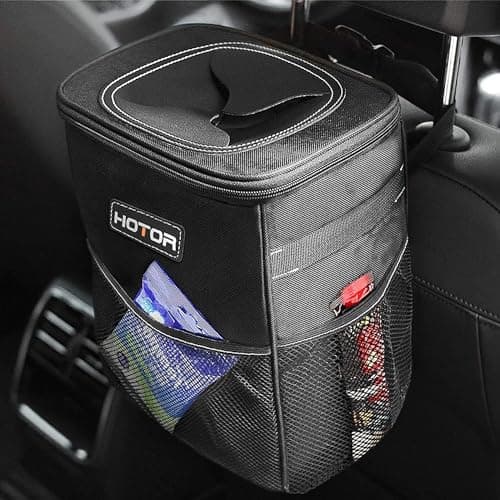
| 1 | HOTOR Car Trash Can (2 gallon) The cheapest fix for a permanently messy car | Drops in | 9.7/10 | $9.98 - view on Amazon |
| 2 | Anker 323 Car Charger (52.5W) The one most people should actually buy | Plugs in | 9.2/10 | $14.99 - view on Amazon |
| 3 | Drop Stop Seat Gap Filler Never fishing a phone out of the seat rail again | Drops in | 9.2/10 | $24.99 - view on Amazon |
| 4 | resqme Car Escape Tool Keeping an escape tool actually within reach | Drops in | 9.2/10 | $17.15 - view on Amazon |
| 5 | EcoNour Car Side Window Sun Shade (2 pack) A rear passenger in afternoon sun | Drops in | 8.6/10 | $17.99 - view on Amazon |
| 6 | AstroAI Digital Tire Gauge (150 PSI) Knowing what your tires are actually at | Drops in | 8.4/10 | $6.99 - view on Amazon |
| 7 | iOttie Easy One Touch 5 Air Vent The default vent mount | Clips on | 8.3/10 | Check price on Amazon |
Prices last verified October 20, 2026. They move constantly; the figure on Amazon when you click is the real one.
The organizing principle
Under fifty dollars, the interesting question stops being which brand and becomes which category. Some products are essentially solved at this price — a bin is a bin, a gap filler is a piece of shaped foam — and paying more buys you very little.
Others are only good at this price if you are lucky, because what makes them work is a component or a specification that costs money: a supercapacitor instead of a battery, a published accuracy figure, a real duty cycle.
What is genuinely worth buying at this price
| Upgrade | Problem it solves | How often you notice |
|---|---|---|
| Phone mount | Where the phone goes | Every journey |
| Tire gauge | Pressures nobody checks | Monthly, but affects every journey |
| Bin | Rubbish accumulating | Every journey |
| 12V charger | Arriving with a flat phone | Every journey |
| Seat gap filler | Things falling beside the seat | Weekly |
| Escape tool | Jammed belt or window | Once, possibly never |
| Side window shade | Sun on a rear passenger | Only with passengers |
The phone mount, which is the obvious one
A phone loose on a passenger seat or in a cup holder is a phone you look down for, and a phone in the seat gap is a phone you reach into a footwell for at speed. A mount is the cheapest attention upgrade available.
At this price you are buying a clamp mount rather than a charging one, which is fine — a cable charges faster and cooler than any wireless mount anyway. The position decision matters more than the product: vent vs dashboard vs windshield, and if it will not stay put, why your phone mount keeps falling.
The tire gauge, which is the one nobody buys
It is the cheapest instrument you can put in a car and the only one whose entire job is accuracy. AstroAI publishes plus or minus 1 PSI and a resolution of 0.1 PSI — a published accuracy figure, which almost nothing in the category states at all.
The reason it matters: TPMS typically only warns at around 25% below the recommended pressure — roughly 26 PSI on a 35 PSI target — by which point you have been driving underinflated for a long time. TPMS catches punctures; a gauge catches slow loss. See best tire pressure gauges.
The small ones that punch above their price
- A bin. Most of what makes a car unpleasant is rubbish, and rubbish accumulates because there is nowhere to put it — best car trash cans
- A seat gap filler. Solves a specific, recurring irritation for almost nothing, and removes the impulse to reach into a footwell while driving — best car seat gap fillers
- A keyring escape tool. resqme is TUV certified, 2.93 inches, and on your keys rather than in a glovebox you may not be able to reach — best car escape tools. Check whether your side glass is laminated first, because these only work on tempered
- A 12V charger. A modest single or dual-port unit beats your car's built-in USB-A port comfortably — best 12V cigarette lighter chargers
- A good USB-C cable. Genuinely a performance part: a cable without an E-marker is capped at 3 A regardless of the charger — best USB-C cables for a car
Three things not to buy at this price
A dash cam. The specification that decides whether footage exists is the published operating-temperature ceiling, and cheap cameras publish nothing. A camera that fails in August is a camera that was never doing its job. The realistic entry point is under $100, not under fifty.
A jump starter. This is a product whose entire value is working once, in cold weather, after sitting unused for months. Cell quality and the protection circuitry are exactly what gets cut to hit a price — best portable jump starters.
A tire inflator. The specification that matters is duty cycle — how long it can run before it has to stop and cool. Cheap units overheat partway through inflating one tire, which is where you find out — best tire inflators.
The upgrades that cost nothing
Worth saying on a budget page: the two highest-value changes available to most cars are free.
Setting your seat, wheel and mirrors up properly changes every drive you take, costs nothing, and takes ten minutes — how to set up your driving position. And clearing the car out and cleaning it properly makes it feel like a different vehicle — how to clean your car interior and small fixes that declutter a car.
If your budget stretches further, the next tier up is best car upgrades under $100.
Every pick, with the working
Each entry lists the specifications the maker publishes, the axis scores those specifications produce, and what you give up. Rows that read “Not published” are not omissions on our side: they are things the maker will not commit to in writing, and they cost the product points on the transparency axis. Specifications compiled September 4, 2026.
Our pickThe cheapest fix for a permanently messy car
HOTOR Car Trash Can (2 gallon)
Two gallons, 7.9 by 5.5 by 10.2 inches, Oxford cloth over a waterproof PEVA lining, with four magnetic snaps holding the bag open and a strap that fastens it to a headrest or the console. A car gets cluttered because there is nowhere to put rubbish, and this is thirteen dollars of nowhere-to-put-rubbish solved.
- Capacity
- 2 gallons (3-gallon version also sold)
- Dimensions
- 7.9 x 5.5 x 10.2 in
- Weight
- 1.0 lb
- Outer material
- Oxford cloth
- Lining
- Waterproof PEVA
- Bag retention
- 4 magnetic snaps, 2 spare bags included
- Pockets
- 3 mesh
- Mounting
- Adjustable strap with quick-release buckle
- Warranty
- Not published
List price $12.99 per Walmart listing, 2-gallon, captured on the compile date below. Not a live price and not what you will pay — the button is where the real number is.
What it gets right
- Published dimensions and capacity, so you can check it against the space beside your seat
- PEVA waterproof lining — the difference between a bin and a stain when someone puts a coffee cup in it
- Four magnetic snaps hold a liner bag open, which is the detail that makes it usable one-handed while driving
- Strap and quick-release buckle, so it attaches to something rather than sliding around the footwell
Flaws
- Two gallons is small if you carry passengers who eat in the car; the 3-gallon version exists for that
- Soft-sided, so it needs to be strapped to something or it tips
- It only works if you empty it, which is the same problem as every bin ever made
The working behind the 9.7
- Heat headroom: not scored (weight 22%)
- The maker publishes no operating-temperature ceiling, so this axis is dropped and the other weights are re-normalized.
- Install effort: 10.0 (weight 24%)
- Drops in and sits there. No fixing of any kind, and it comes out again when you sell the car.
- Price against the ceiling: 10.0 (weight 24%)
- Listed at $12.99 on the compile date. This site's buyer has a practical ceiling around $150 for a single upgrade, so the scale rewards everything under $100 and falls away sharply past $150. The live price is very often different, and that is what the button is for.
- Written commitment: not scored (weight 15%)
- No warranty term published, so this axis is dropped and the other weights are re-normalized.
- Spec transparency: 8.9 (weight 15%)
- 8 of the 9 specifications we went looking for are published by the maker (89%). A blank row is never a guess here: it prints “Not published” and it costs the product points, because a figure nobody will commit to in writing is a figure you cannot check.
Axes with no published input are dropped and the remaining weights re-normalized, so a product is not punished for a category where an axis does not apply. Specifications compiled September 4, 2026 from the HOTOR 2-gallon listing — HOTOR's own product page publishes none of these figures.
2The one most people should actually buy
Anker 323 Car Charger (52.5W)
Two ports, 52.5W total, and a published voltage table showing 30W maximum on the USB-C port. Thirty watts charges any phone at or near its own ceiling, which means the 67W chargers above it are selling you headroom nothing in your pocket can use. At $19.99 this is the honest default.
- Ports
- 1 x USB-C, 1 x USB-A
- Total output
- 52.5 W
- USB-C output
- 5V/3A, 9V/3A, 12V/2.5A, 15V/2A, 20V/1.5A (30 W max)
- USB-A output
- 5V/3A, 9V/2A, 10V/2.25A (22.5 W max)
- Input
- 12V at 5.6 A, 24V at 3.6 A
- Safety
- ActiveShield 2.0
- Model
- A2735
- Warranty
- 18 months
- Operating range
- Not published
List price $19.99 per Anker's own store, captured on the compile date below. Not a live price and not what you will pay — the button is where the real number is.
What it gets right
- Anker publishes the full PDO table — 5V/3A, 9V/3A, 12V/2.5A, 15V/2A, 20V/1.5A — rather than a headline number
- 30 W on USB-C is at or above what almost every phone will accept
- Input rated 12V and 24V, so it works in a truck as well as a car
- $19.99 list and physically small, which matters in a tight console
Flaws
- Two ports, not three. A second passenger and a tablet is one device too many
- 30 W will not charge a laptop at any useful speed
- The USB-A port tops out at 22.5 W, so it is the slow one
The working behind the 9.2
- Heat headroom: not scored (weight 22%)
- The maker publishes no operating-temperature ceiling, so this axis is dropped and the other weights are re-normalized.
- Install effort: 10.0 (weight 24%)
- Plugs into a 12V socket or a USB port. Nothing to mount, nothing to route, reversible in a second.
- Price against the ceiling: 10.0 (weight 24%)
- Listed at $19.99 on the compile date. This site's buyer has a practical ceiling around $150 for a single upgrade, so the scale rewards everything under $100 and falls away sharply past $150. The live price is very often different, and that is what the button is for.
- Written commitment: 7.0 (weight 15%)
- 18-month warranty. This is the only promise in the entire listing that a court would read, which is why it is scored and the marketing copy is not.
- Spec transparency: 8.9 (weight 15%)
- 8 of the 9 specifications we went looking for are published by the maker (89%). A blank row is never a guess here: it prints “Not published” and it costs the product points, because a figure nobody will commit to in writing is a figure you cannot check.
Axes with no published input are dropped and the remaining weights re-normalized, so a product is not punished for a category where an axis does not apply. Specifications compiled September 4, 2026 from Anker's 323 Car Charger product page.
3Never fishing a phone out of the seat rail again
Drop Stop Seat Gap Filler
A neoprene wedge that fills the gap between the seat and the center console, with a slot the seatbelt catch passes through. That slot is the patent and it is the reason this one stays put where generic wedges migrate. It is more expensive than it has any right to be, and it solves a problem that genuinely happens while you are driving.
- Material
- Neoprene
- Quantity
- 2 per pack, driver and passenger
- Fit method
- Expands and contracts to the gap; seatbelt slot anchors it
- Cleaning
- Liquid and stain resistant, wipe clean
- Dimensions
- Not published
- Warranty
- Not published
List price $24.99 per Walmart listing, two-pack, captured on the compile date below. Not a live price and not what you will pay — the button is where the real number is.
What it gets right
- The seatbelt slot means it is anchored rather than wedged, which is the difference from every generic copy
- Neoprene expands and contracts to fit whatever gap your car has, so 'universal' is closer to true than usual
- Liquid and stain resistant, and it wipes clean
- Sold as a pair, so both front seats are covered
Flaws
- $25 to $40 for two pieces of shaped neoprene, depending entirely on where you buy
- It fills the gap, which also means the gap is no longer available for anything you wanted to put there
- Cars with an unusually wide gap or a console that flares will still see items get past the ends
The working behind the 9.2
- Heat headroom: not scored (weight 22%)
- The maker publishes no operating-temperature ceiling, so this axis is dropped and the other weights are re-normalized.
- Install effort: 10.0 (weight 24%)
- Drops in and sits there. No fixing of any kind, and it comes out again when you sell the car.
- Price against the ceiling: 10.0 (weight 24%)
- Listed at $24.99 on the compile date. This site's buyer has a practical ceiling around $150 for a single upgrade, so the scale rewards everything under $100 and falls away sharply past $150. The live price is very often different, and that is what the button is for.
- Written commitment: not scored (weight 15%)
- No warranty term published, so this axis is dropped and the other weights are re-normalized.
- Spec transparency: 6.7 (weight 15%)
- 4 of the 6 specifications we went looking for are published by the maker (67%). A blank row is never a guess here: it prints “Not published” and it costs the product points, because a figure nobody will commit to in writing is a figure you cannot check.
Axes with no published input are dropped and the remaining weights re-normalized, so a product is not punished for a category where an axis does not apply. Specifications compiled September 4, 2026 from Drop Stop published product description and materials.
4Keeping an escape tool actually within reach
resqme Car Escape Tool
The one escape tool small enough to live on your keyring, which is the only place an escape tool is any use — a hammer in the glovebox is a hammer you cannot reach with a jammed belt across your chest. Spring-loaded, so it needs no swing.
- Height
- 2.93 in
- Materials
- ABS plastic and stainless steel
- Window breaker
- Spring-loaded stainless spike, resets after each use
- Belt cutter
- Stainless blade, rated for up to 100 seat belts
- Cut time
- Under 2 seconds (manufacturer figure)
- Certification
- TUV tested and certified
- Origin
- Made in USA
- Works on laminated glass
- No — tempered side glass only
- List price
- Not published
- Warranty
- Not published
What it gets right
- 2.93 inches tall and keyring-mounted, so it is on you rather than in a compartment you cannot reach
- Spring-loaded spike needs no room to swing, which matters when you are belted in
- Publishes a service life: one unit cuts up to 100 seat belts, and the spike resets after each use
- TUV tested and certified, and made in the USA
Flaws
- Breaks tempered side glass only. It will not touch a laminated side window, which is increasingly common on newer cars
- Small enough to lose, and a lost escape tool is no escape tool
- No published warranty term
The working behind the 9.2
- Heat headroom: not scored (weight 22%)
- The maker publishes no operating-temperature ceiling, so this axis is dropped and the other weights are re-normalized.
- Install effort: 10.0 (weight 24%)
- Drops in and sits there. No fixing of any kind, and it comes out again when you sell the car.
- Price against the ceiling: not scored (weight 24%)
- No published list price we could cite on the compile date, so this axis is dropped and the other weights are re-normalized.
- Written commitment: not scored (weight 15%)
- No warranty term published, so this axis is dropped and the other weights are re-normalized.
- Spec transparency: 8.0 (weight 15%)
- 8 of the 10 specifications we went looking for are published by the maker (80%). A blank row is never a guess here: it prints “Not published” and it costs the product points, because a figure nobody will commit to in writing is a figure you cannot check.
Axes with no published input are dropped and the remaining weights re-normalized, so a product is not punished for a category where an axis does not apply. Specifications compiled September 4, 2026 from resqme published specifications and certification.
5A rear passenger in afternoon sun
EcoNour Car Side Window Sun Shade (2 pack)
Skip this one. It is a good product and it is the one on this list most people will not use. Side shades matter enormously if you regularly carry a passenger in the back and barely at all if you do not. Every other item here earns its place in any car; this one earns it in some cars.
A stretch mesh sock that goes over the whole door frame rather than a suction-cup square that covers a third of the glass. The trade is that it is a screen, not a blackout: it cuts glare and direct sun while you can still see out and still lower the window.
- Sizes offered
- 18 x 20 in, 36 x 17 in, XL 24 x 38 in
- Material
- Nylon, spandex and rubber stretch mesh
- Fitment
- Over the door frame, not on the glass
- Window still opens
- Yes
- Pack size
- 2
- UV blocking percentage
- Not published
- List price
- Not published
- Warranty
- Not published
What it gets right
- Covers the full window aperture instead of a suction-cupped rectangle in the middle of it
- Breathable stretch fabric means the window still opens with the shade fitted
- No suction cups, so nothing falls off the glass on a hot day
- Sold in pairs, which is what a car with two rear windows actually needs
Flaws
- It is a mesh screen. It reduces glare and direct sun; it is not a blackout and does not make the back seat dark
- Sizing is by window aperture, and a shade sized for a sedan will not stretch over a minivan frame
- No published UV-blocking percentage or UPF rating for the mesh
The working behind the 8.6
- Heat headroom: not scored (weight 22%)
- The maker publishes no operating-temperature ceiling, so this axis is dropped and the other weights are re-normalized.
- Install effort: 10.0 (weight 24%)
- Drops in and sits there. No fixing of any kind, and it comes out again when you sell the car.
- Price against the ceiling: not scored (weight 24%)
- No published list price we could cite on the compile date, so this axis is dropped and the other weights are re-normalized.
- Written commitment: not scored (weight 15%)
- No warranty term published, so this axis is dropped and the other weights are re-normalized.
- Spec transparency: 6.3 (weight 15%)
- 5 of the 8 specifications we went looking for are published by the maker (63%). A blank row is never a guess here: it prints “Not published” and it costs the product points, because a figure nobody will commit to in writing is a figure you cannot check.
Axes with no published input are dropped and the remaining weights re-normalized, so a product is not punished for a category where an axis does not apply. Specifications compiled September 4, 2026 from EcoNour side window shade published specifications.
6Knowing what your tires are actually at
AstroAI Digital Tire Gauge (150 PSI)
0 to 150 PSI, factory calibrated to plus or minus 1 PSI, reading in 0.1 increments across four units with a backlit screen. The gas-station gauge you have been trusting is almost certainly worse than this, and this costs about the same as one tank of fuel.
- Range
- 0-150 PSI / 0-10 Bar / 0-10 Kgf/cm2 / 0-1000 kPa
- Accuracy
- Plus or minus 1 PSI
- Calibration standard
- ANSI B40.7, AstroAI UK listing only
- Resolution
- 0.1 PSI
- Display
- Backlit LCD, 4 selectable units
- Auto shut-off
- 30 seconds
- List price
- Not published
- Warranty
- 1 year, stated
What it gets right
- Published accuracy of plus or minus 1 PSI, stated in the listing title — almost nothing else in this category states an accuracy figure at all
- Reads to 0.1 PSI, which matters because a 3 PSI error is the difference between correct and noticeably underinflated
- Backlit screen, because tire pressures get checked in the dark more often than not
- Auto shut-off after 30 seconds, so the battery lasts
Flaws
- 150 PSI range is far beyond a passenger car, so the useful part of the scale is the bottom fifth
- A digital gauge has a battery, and a battery in a glovebox is a battery you will find dead
- It measures. It does not inflate — that is a separate tool
The working behind the 8.4
- Heat headroom: not scored (weight 22%)
- The maker publishes no operating-temperature ceiling, so this axis is dropped and the other weights are re-normalized.
- Install effort: 10.0 (weight 24%)
- Drops in and sits there. No fixing of any kind, and it comes out again when you sell the car.
- Price against the ceiling: not scored (weight 24%)
- No published list price we could cite on the compile date, so this axis is dropped and the other weights are re-normalized.
- Written commitment: 5.5 (weight 15%)
- 12-month warranty. This is the only promise in the entire listing that a court would read, which is why it is scored and the marketing copy is not.
- Spec transparency: 8.8 (weight 15%)
- 7 of the 8 specifications we went looking for are published by the maker (88%). A blank row is never a guess here: it prints “Not published” and it costs the product points, because a figure nobody will commit to in writing is a figure you cannot check.
Axes with no published input are dropped and the remaining weights re-normalized, so a product is not punished for a category where an axis does not apply. Specifications compiled September 4, 2026 from AstroAI 150 PSI gauge published specifications.
7The default vent mount
iOttie Easy One Touch 5 Air Vent
A twist-lock vent clamp and the one-handed cradle iOttie has been refining for a decade, at $24.95. It grips the phone mechanically rather than magnetically, which means it does not care what case you have, and it costs a quarter of what the Qi2 chargers cost because it does not charge anything.
- Attachment
- Twist-lock air vent
- Hold
- Mechanical cradle, one-touch lock and release
- Orientation
- Portrait or landscape
- Cable management
- Magnetic cord organizer
- SKU
- HLCRIO172
- Weight capacity
- Not published
- Operating range
- Not published
List price $24.95 per iOttie's own store, captured on the compile date below. Not a live price and not what you will pay — the button is where the real number is.
What it gets right
- Twist-lock vent attachment rather than a spring clip, which is the difference between staying put and rattling loose
- Mechanical cradle works with any case, any thickness, and any phone that fits
- One-handed lock and release, which is the entire point of the product line
- $24.95 list, the cheapest way to solve the problem properly
Flaws
- Blocks a vent, and in summer that vent is the one you wanted
- No charging, so the cable still has to come from somewhere
- A heavy phone on a thin vent blade will still droop over time on some cars
The working behind the 8.3
- Heat headroom: not scored (weight 22%)
- The maker publishes no operating-temperature ceiling, so this axis is dropped and the other weights are re-normalized.
- Install effort: 9.0 (weight 24%)
- Clips onto a vent blade or a headrest post. Two minutes, no tools, no adhesive, no residue.
- Price against the ceiling: 10.0 (weight 24%)
- Listed at $24.95 on the compile date. This site's buyer has a practical ceiling around $150 for a single upgrade, so the scale rewards everything under $100 and falls away sharply past $150. The live price is very often different, and that is what the button is for.
- Written commitment: 5.5 (weight 15%)
- 12-month warranty. This is the only promise in the entire listing that a court would read, which is why it is scored and the marketing copy is not.
- Spec transparency: 7.1 (weight 15%)
- 5 of the 7 specifications we went looking for are published by the maker (71%). A blank row is never a guess here: it prints “Not published” and it costs the product points, because a figure nobody will commit to in writing is a figure you cannot check.
Axes with no published input are dropped and the remaining weights re-normalized, so a product is not punished for a category where an axis does not apply. Specifications compiled September 4, 2026 from iOttie's Easy One Touch 5 Air Vent page.
Prices last verified October 20, 2026. They move constantly; the figure on Amazon when you click is the real one.
Questions people actually ask
Is a cheap dash cam better than no dash cam?
Only if it is actually recording, which is the problem. A camera with no published heat ceiling in a car that reaches 60-70 C may have stopped working months before you need it, and it looks identical either way. We would save up rather than buy at this price.
What is the single best thing to buy under $50?
A phone mount, because it addresses something in every journey. A tire gauge is the best value if you already have a mount — it is the cheapest instrument in the car and the one with the clearest published accuracy.
Are cheap phone mounts any good?
Broadly yes, at this price the category is solved. What varies is whether the attachment method suits your car and your phone's weight — a vent mount on a thin louvre with a heavy phone is the usual failure, and that is a fitment issue rather than a price one.
Should I buy a cheap tire inflator for emergencies?
We would not. Duty cycle is the specification that matters and it is the first thing cut to hit a low price. An inflator that overheats partway through one tire has failed at the only job it had.